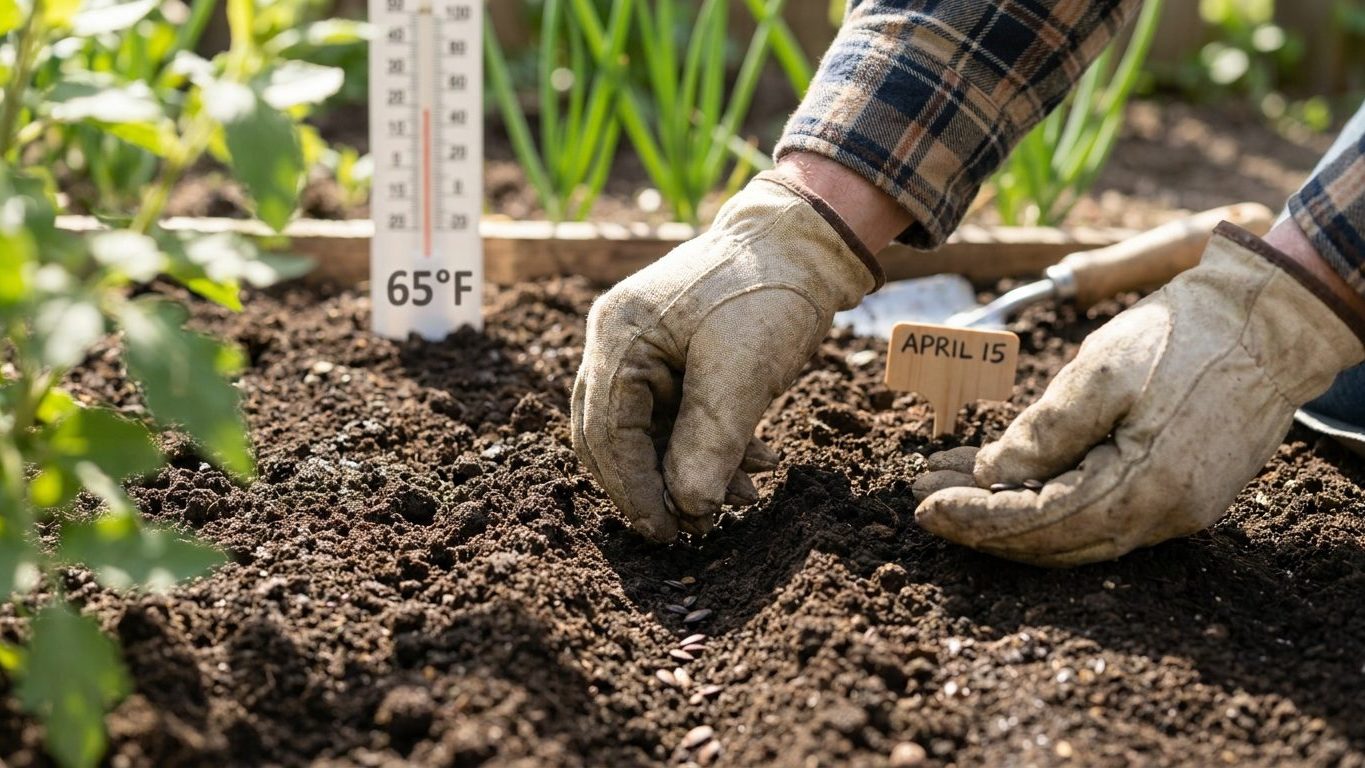

Melons go in the ground in Kentucky once the soil has warmed past the last frost risk, which for the state’s reference station falls between March 24 and April 4. That date range only marks when frost becomes unlikely, not when melon roots can actually grow, so most gardeners are still transplanting in mid-May and counting on frost-free growing until early November.
The short answer for Kentucky
The window that matters for melons in Kentucky runs from the last spring frost, dated March 24 to April 4 at the state’s reference climate station, to the first fall frost, dated November 2 to November 12. Those aren’t fixed calendar days. They’re a 30 to 70 percent probability band for a 32-degree freeze, built from NOAA’s 1991-2020 Climate Normals. Read March 24 as the point where the odds of another freeze have dropped to about 70 percent, and April 4 as the point where they’ve fallen to roughly 30 percent. Melons don’t tolerate that remaining 30 percent well, so most growers treat the later end of the window, or a few days past it, as the real starting line.
That’s also where soil temperature takes over from frost dates as the deciding factor. Melon seed barely germinates below 65 degrees Fahrenheit at the soil line, and transplants set into cold ground simply sit and sulk rather than grow. In practice, that pushes direct-seeding into early-to-mid May across most of the state, with transplants (started indoors three to four weeks earlier) going out around the same time once nighttime lows are reliably holding above 55.
There’s a wrinkle worth knowing before you circle a date. The National Weather Service office in Louisville has flagged that its own reference station runs later in spring and earlier in fall than the rural county surrounding it. That means the frost dates above, drawn from that same station, should be treated as bookends rather than loose guidelines if you’re gardening outside the city itself. A rural Kentucky garden should expect a tighter frost-free stretch than the raw dates suggest, which argues for leaning toward April 4 rather than March 24 when deciding it’s finally safe, and not assuming the season stretches all the way to November 12 on the back end.
Counting backward from a mid-May transplant date, indoor seed-starting for melons typically lands in mid-to-late April. Counting forward to harvest, a melon that needs 80 days from transplant to fruit, which covers most cantaloupe and many smaller watermelon varieties, comfortably beats even a conservative fall frost date. That’s the arithmetic that makes melons workable here at all.
What will not work here
Kentucky’s frost-free stretch is generous on paper, roughly 210 to 220 days between the two dated windows. But that number is deceptive, because the two ends of it aren’t equally forgiving. A melon planted too early into cold soil won’t just be delayed, it will often fail outright from seed rot or root damage before it ever shows a true leaf. That rules out the very slow-maturing melon types, the 100-plus-day heirloom watermelons and some of the larger muskmelon varieties, unless a grower is willing to start them indoors well ahead of the safe transplant date and babysit them under cover.
Summer heat is the other trap, and it’s a different failure than most gardeners expect. The reference station averages 37.2 days a year at or above 90 degrees. That’s not a temperature average, it’s a count of how many days the garden is under real heat load, and it’s the number that drives water demand and heat stress on flowering plants. Melon blossoms can abort in extended 90-plus stretches even when the plant itself looks healthy, so a run of hot days right at fruit set is a common, invisible cause of a vine that flowers heavily but sets little fruit.
Rainfall doesn’t bail anyone out of that heat load automatically. Summer rainfall averages about 12 inches across June, July and August, but August, the month melons are often filling out fruit, is also the driest of the three at 3.71 inches. A weekly watering habit built for a wetter month can quietly starve a melon patch in August, especially on sandy soil that drains within a day of a storm. Clay soil holds that same rain for closer to a week, which is exactly why the same rainfall total behaves so differently from one Kentucky garden to the next; a rain gauge on the actual plot settles the question a regional average can’t.
Humidity compounds the water problem into a disease problem. Close spacing that might get away with it in a drier climate invites powdery and downy mildew here once August humidity sets in, especially on vines already stressed by heat. Wide spacing and airflow aren’t cosmetic choices in Kentucky, they’re what keeps a heat-stressed vine from also becoming a mildew-stressed one.
What changes across Kentucky
Kentucky spans USDA Hardiness Zones 6a to 7a, a range built entirely on one measurement: the average annual extreme minimum temperature, not spring warm-up speed or frost timing directly. The frost dates cited above come from a single reference station, and the state’s own zone spread is a reminder that no single date range describes the whole commonwealth.
| General zone position | What it typically means for melon timing |
|---|---|
| Cooler end (6a), often higher elevation or northern counties | Colder winter extremes suggest a later safe transplant date and a shorter practical window for slow-maturing varieties |
| Warmer end (7a), often western and central lowland counties | Milder winter extremes are consistent with an earlier safe transplant date and more slack for longer-season melons |
That’s a general pattern tied to how the zone system works, not a set of dates for any specific county. A garden at higher elevation in eastern Kentucky is working with a different frost rhythm than one in the western Pennyroyal region, even though both fall inside the state’s overall 6a-7a range. The right move isn’t to guess which end applies to a given yard; it’s to check the USDA Plant Hardiness Zone Map directly for that address and treat the state range here as context, not a personal answer.
The practical shift for a reader on the cooler end is to push transplant dates later and lean toward shorter-season melon varieties, since the frost-free stretch is tighter than the state average suggests. On the warmer end, there’s more room to start earlier and to grow the slower varieties this article otherwise flags as risky. Either way, the state-level frost dates are a starting frame, not a final schedule.
Where to check this for your own county
University of Kentucky Cooperative Extension runs the state’s land-grant extension service, reachable at extension.ca.uky.edu. That’s the correct next stop for anyone who wants a date range narrower than a statewide climate normal.
Two things are worth looking for once there. First, a county-level planting calendar, since county offices often publish guidance tuned to local frost records rather than a single reference station. Second, a list of melon varieties actually trialled in that county or region, which matters more than any date. A variety that performs well in a UK Extension trial nearby has already been tested against the same heat load and humidity a reader’s own garden will face, which a generic seed catalog description can’t promise.
It’s worth being direct about the hierarchy here. A county extension recommendation, built from local records and local variety trials, outranks it every time there’s a conflict.
Some gardeners also time melons by the Moon: when to plant watermelon and cantaloupe by the moon, as almanac tradition rather than fact.
Checking this against your own garden
No date beats what the actual garden is doing, and three signs are worth tracking through spring without any special equipment.
- Soil warmth by feel: press a hand into the planting bed a few inches down in the morning. If it still feels cold rather than cool, the soil hasn’t caught up to the calendar yet, regardless of what the frost date says.
- The first flush of male flowers: melons typically produce male blossoms before the fruit-bearing female flowers show up. An early, strong flush signals the plant has settled into real growth, not just survival.
- The first true leaves: the rounder seed leaves that emerge first don’t mean much on their own. The jagged true leaves that follow are the sign the plant has moved past germination stress and started building the growth it needs before flowering.
Each of these tells a slightly different story about a specific yard’s microclimate, a slope, a windbreak, a patch of sandy fill soil, that no station-wide average can capture. A garden that’s consistently a week or two ahead of or behind these signs compared to a neighbor’s plot isn’t wrong; it’s just running its own local season, and that’s the one worth trusting once the plants are actually in the ground.