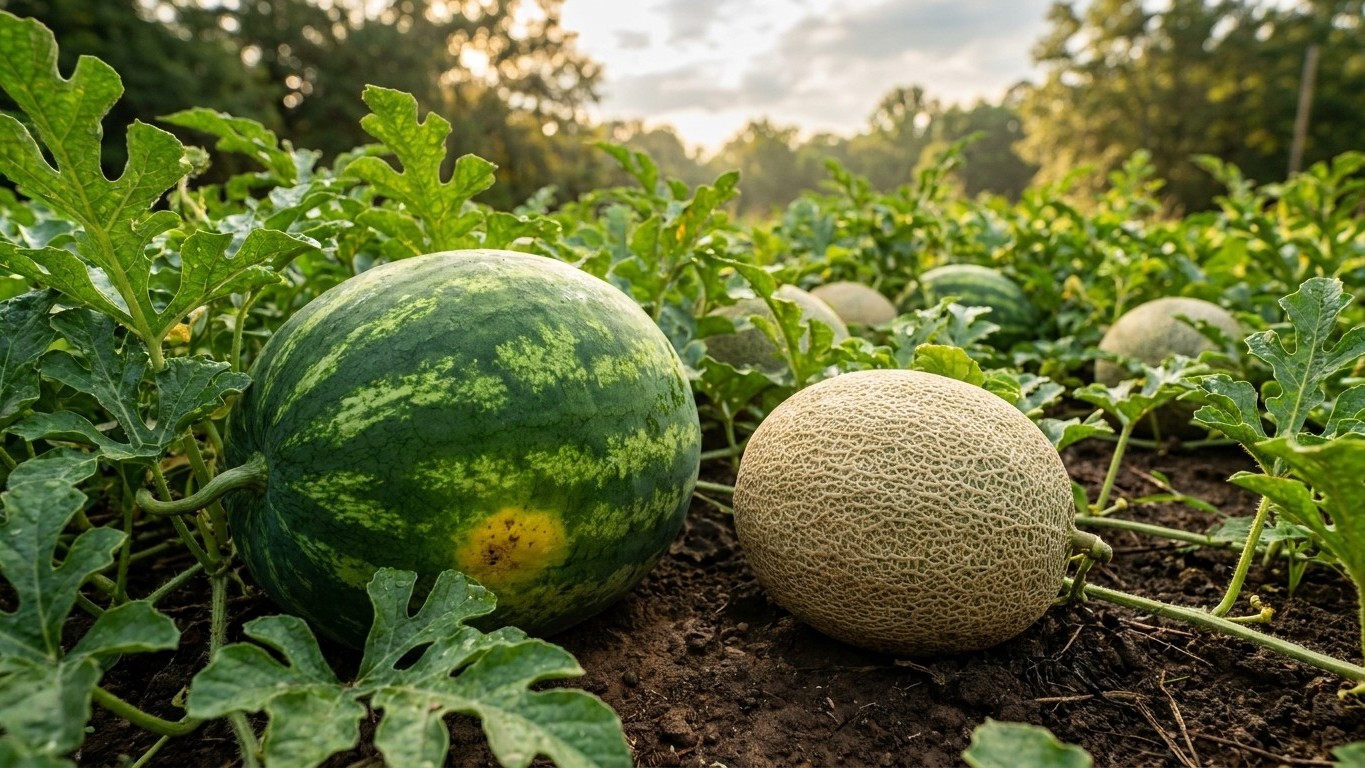

For Massachusetts gardens, the smart bet is short-season muskmelons (cantaloupes) bred for northern climates, paired with compact icebox watermelons. Both mature fast enough to beat the frost window and don’t demand the heavy heat load the state simply doesn’t deliver. Big Crenshaw, casaba, and full-size watermelon varieties are a harder sell here without extra help.
The short answer for Massachusetts
Start with the two numbers that actually decide this: the frost dates and the heat. At the reference station (Boston/Logan), the last spring frost falls between April 1 and April 8, and the first fall frost arrives between November 3 and November 14. That’s a wide frost-free window on paper, roughly seven months at the coast. But melons don’t care about frost-free days alone, they care about warm soil and warm nights, and Massachusetts only averages 10.2 days a year at or above 90°F. That’s a modest heat budget for a fruit that evolved in places where 90°F is a Tuesday in June.
That single fact, 10.2 days of real heat, is what should drive variety selection more than the frost calendar does. Melons that need sustained high heat to sweeten (long-season honeydews, casabas, most Crenshaws) rarely get enough hot days here to finish properly, even when the calendar gives them enough time. The plants can survive the season; they just don’t ripen well by the end of it.
What actually fits the numbers
Short-season muskmelons, the 75-to-85-day types bred specifically for northern gardens, are the closest match to what this climate offers. Icebox watermelons in the same maturity range are the second-best fit, since their smaller fruit size needs fewer cumulative heat units than a 20-pound classic watermelon. Here’s how the main categories line up against the state’s numbers:
| Melon type | Typical days to maturity | Fit for Massachusetts |
|---|---|---|
| Short-season muskmelon/cantaloupe | 75-85 days | Good, matches frost window and low heat load |
| Icebox watermelon | 75-80 days | Good, smaller fruit needs fewer heat units |
| Standard full-size watermelon | 85-100 days | Marginal, needs plastic mulch or row cover to finish |
| Honeydew, long-season type | 90-100+ days | Poor without season-extension help |
| Crenshaw, casaba | 100-110 days | Poor, rarely ripens fully outdoors |
None of this is a ban on the slower melons. It’s a statement about what happens without help: black plastic mulch to warm the root zone, row cover to trap heat early in the season, and transplants started indoors rather than direct-seeded. Those three tricks can push a marginal variety into the workable column. Without them, stick to the top two rows of that table.
What will not work here
The clearest failure mode in Massachusetts melon patches isn’t drought, it’s the opposite. Summer rainfall here runs about 10.4 inches across June, July, and August, with even the driest month, August, still delivering 3.23 inches. That’s enough moisture, combined with the humidity that comes with it, to make fungal disease the real threat rather than thirst. Powdery mildew and downy mildew both thrive in the sticky stretches between rain events, and a melon patch planted the way a Southwestern gardening guide recommends, vines packed tight for maximum yield per square foot, turns into a mildew farm by mid-July.
Spacing is the fix that matters most, and it’s the one most often skipped. Vines need real airflow between them, more than the tag on a seed packet grown for a drier region would suggest. Trellising vertically, where the variety allows it, helps more here than in a dry climate, because it lifts foliage out of the damp air pooling near the ground. Watering practices matter too: overhead watering in the evening leaves leaves wet overnight, which is exactly the setup mildew needs. Morning watering, or better, drip irrigation at the soil line, avoids feeding the problem.
The other trap: chasing heat the state doesn’t have
The second failure is simpler to describe. Varieties selected for their sugar content in hot desert or Mediterranean climates lean on sustained 90-plus-degree stretches to convert starches to sugar late in the ripening process. Massachusetts offers 10.2 such days a year, on average, and they don’t arrive in a tidy block. A gardener who plants a melon bred for the Central Valley of California and expects Central Valley sweetness is going to be disappointed, not because the plant died, but because it never got the heat units to finish the job. This isn’t a soil problem or a watering problem; it’s a climate mismatch that no amount of fertilizer fixes.
Direct-seeding anything in the slower half of that maturity table is its own separate mistake. Massachusetts soil in early April, right around the last frost date, is still cold. A melon seed dropped straight into that ground sits and rots more often than it germinates. Starting seed indoors three to four weeks before the last frost, then transplanting once soil has warmed, buys back the days that direct-seeding would waste.
What changes across Massachusetts
Massachusetts is not one climate, and the USDA Plant Hardiness Zone Map makes that plain: the state spans zones 5a through 7b. That’s a real spread, built on the coldest annual extreme temperature a location typically sees, and it means a recommendation calibrated to Boston (on the milder end of that range) can miss badly for a garden in the Berkshires or a cold inland valley.
The frost dates cited earlier come from the Logan reference station, a waterfront site in Boston Harbor, which NOAA itself flags as the mildest spot in the state. Inland and higher-elevation gardens frost measurably earlier in fall and later in spring than that station shows. A gardener working land in the Berkshires, at the colder end of the state’s zone range, should treat the April 1-8 and November 3-14 window as optimistic and shift toward the shorter-season end of the variety table rather than the middle. That means leaning harder on the 75-day muskmelons and icebox watermelons, and being more willing to use black plastic and row cover even for those.
Coastal and Cape Cod gardens sit closer to the milder end of the zone range and typically see later fall frosts than the state average, which stretches the usable window. But coastal soil is often sandy, and sandy soil drains the same summer rain faster than the clay-heavier soils found further inland, which can mean more frequent watering there even though the regional rainfall total is identical. Elevation matters too: gardens sitting in low frost pockets, the bottom of a slope where cold air collects, will run colder than their county average regardless of what zone the map assigns them.
None of this adds up to a single answer for “Massachusetts.” It adds up to a spread from 5a to 7b, and the practical move is to find where a specific garden sits inside that spread before locking in a variety list, using the USDA hardiness zone map itself rather than a statewide average.
Where to check this for your own county
This page gives the state-level picture: frost dates from one reference station, a heat-load figure for the whole region, and a hardiness zone range spanning most of the map. A county-level recommendation from the University of Massachusetts Amherst Extension service beats every one of those numbers, because it accounts for local frost pockets, local soil, and varieties that have actually been trialled in that county’s conditions rather than modeled from statewide normals.
The extension service is reachable at ag.umass.edu. Two things are worth looking for specifically once there. First, a local or regional planting calendar that translates the statewide frost window into a date range for a specific county or growing region within Massachusetts, since the difference between coastal and inland can run to two or three weeks in either direction. Second, any vegetable variety trial results or recommended-cultivar lists covering melons, cantaloupes, or watermelons, since those reflect what has actually produced a ripe crop in Massachusetts test plots rather than what a national seed catalog claims for a generic “short season.”
State-level information like the numbers on this page is useful for a first pass, ruling out the long-season melons and pointing toward the muskmelon and icebox watermelon categories. But it can’t replace a source that knows whether a particular county tends to run two weeks behind or ahead of the Boston reference station, or which specific cultivar has actually performed well in university trial beds a few towns over. That’s the gap a county-level extension answer closes and a state-level page like this one can’t.
Checking this against your own garden
Every date on this page describes an average, and a garden rarely sits exactly on the average. The most reliable signals come from the plant and the soil themselves, and none of them require anything more than a hand and a pair of eyes.
Soil warmth by feel is the first check. Cold, damp soil that still feels chilly to the touch in late April, even after the calendar’s last-frost date has passed, is a sign that a particular spot runs colder than the regional average, maybe from shade, poor drainage, or low ground that collects cold air overnight. That’s a cue to hold transplants a week or two longer rather than trust the date alone.
The first flush of male flowers is the second signal, and it’s often misread. Melon vines produce male flowers before female ones, sometimes by a week or two, and a gardener who panics at a vine full of blossoms with no fruit set is usually just seeing that normal sequence play out. What matters is watching for female flowers, the ones with a tiny swollen bulge behind the petals, since their arrival marks the real start of fruit production and tells a gardener how far behind or ahead of a typical season their patch is running.
The appearance of the first true leaves, the second set that emerges after the initial rounded seed leaves, is the third marker. Slow, stunted true-leaf growth after transplant usually points to soil that’s still too cold or nights that are still dipping lower than the plant wants, a more honest read of local conditions than any frost-date table, because it’s coming directly from the plant growing in that exact spot.