
Melons need three things Massachusetts can supply on its own timeline: warm soil, roughly seven months of frost-free growing window, and a plan for the state’s modest heat load. The short answer is yes, with attention to timing and variety type rather than a fixed calendar date.
When the soil is warm enough in Massachusetts
The last spring frost across the state’s reference station falls between April 1 and April 8, according to NOAA’s 1991-2020 Climate Normals for the 32°F freeze probability band at Boston Logan. That’s the date range gardeners lean on, but it answers the wrong question for melons. Frost tells you when the air stops threatening to kill a plant outright. Melons care about something slower: soil temperature. Cold, wet soil rots seed and stunts transplants even when the air feels mild, and soil in a New England spring typically lags behind air temperature by two to three weeks.
That frost window itself is a probability, not a guarantee, and it’s worth saying only once: some years bring a freeze after April 8, some years the ground never freezes past March. The bigger caution is geographic. Logan sits on the waterfront in the mildest corner of the state. Inland suburbs, the Connecticut River Valley, and especially the Berkshires run frost risk noticeably later in spring and earlier in fall, so a gardener in Pittsfield should treat the Logan date as a floor, not a forecast for their own yard.
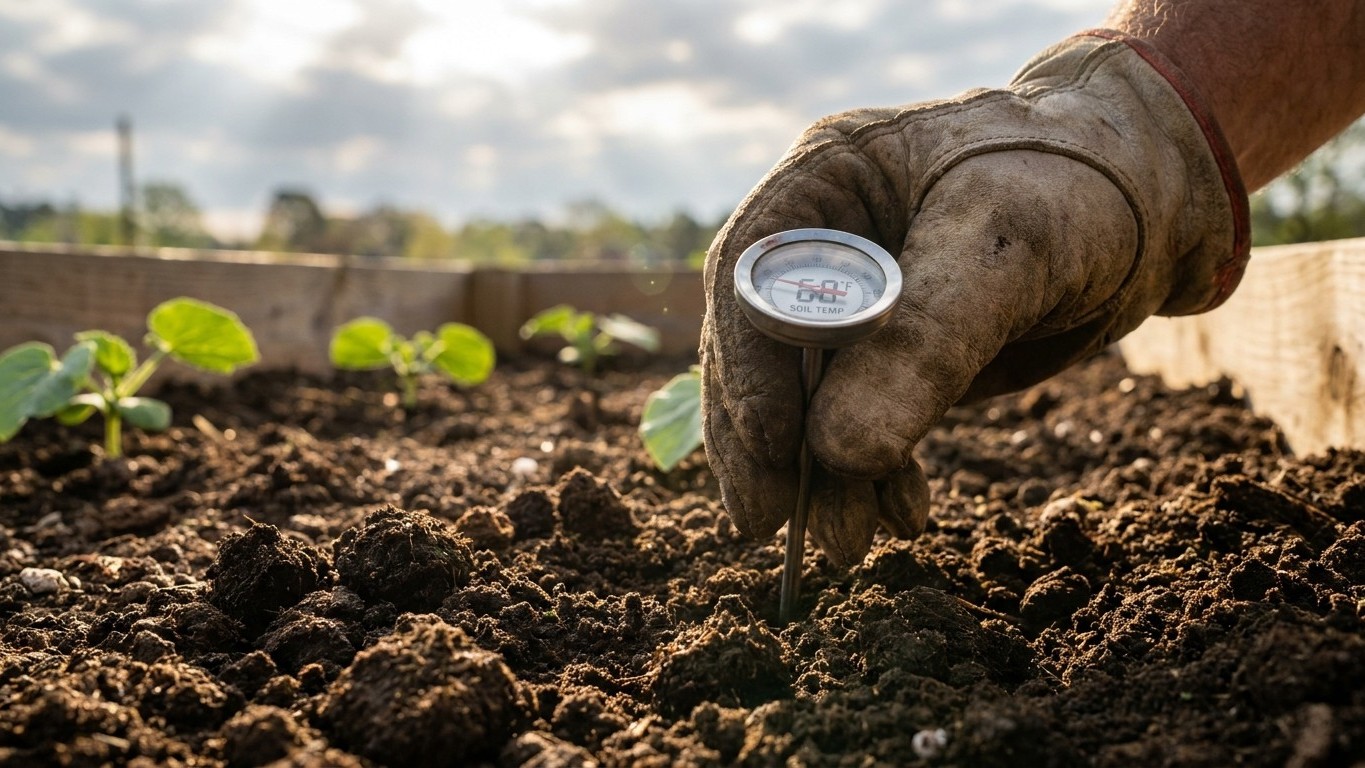
Because melons are one of the most cold-sensitive crops a home gardener grows, most Massachusetts growers don’t plant to the frost date at all. They plant to soil temperature, checked with a simple soil thermometer a few inches down, and they use techniques to push that number up faster than the calendar would on its own:
- Black plastic mulch laid over the bed for a week or two before planting, to trap solar heat in the soil
- Raised beds or mounded rows, which drain faster and warm quicker than flat, saturated ground
- Floating row cover over young plants, to hold heat at night without blocking the sun by day
None of these tricks make frost irrelevant. They shrink the gap between the date the sky stops threatening and the date the soil actually welcomes a melon seedling. For the varieties best suited to that compressed window, the UMass Extension service maintains current trial results for what performs in Massachusetts conditions specifically, which matters more here than anywhere warmer.
How long the season lasts here
Pair the spring frost window (April 1 to April 8) with the first fall frost window, which NOAA’s same Logan-based normals put at November 3 to November 14. Subtracting the two gives a frost-free season running somewhere between roughly 209 days, in the tightest case, and 227 days, in the most generous. Both numbers come straight from the same NOAA dataset, so the range is real rather than estimated, and it lands Massachusetts in a surprisingly comfortable spot: seven months, give or take, is a longer window than a lot of gardeners assume for a New England state.
What that length actually allows is the more useful question. A window creeping toward 227 days gives a melon crop room to finish even if the first sowing gets delayed by a cold, wet spring, and it leaves enough calendar left over that a second, staggered sowing of a fast type is worth trying rather than wasted effort. A window sitting closer to 209 days is a tighter fit. It doesn’t rule out melons, but it makes the first sowing the one that has to work, and it shifts the calculation toward starting plants indoors and transplanting rather than direct-seeding in the garden.
Transplanting comes with its own tax, though. Melons resent root disturbance more than most garden vegetables, so a gardener working the shorter end of that range needs to start seedlings in individual, deep containers that let the whole root ball slide out intact, rather than cell packs that force roots to tangle. Get that step wrong and the week or two “saved” by transplanting gets lost to transplant shock anyway.
Either way, the frost-free length here supports thinking beyond a single planting date. The site’s succession sowing guide walks through how to stagger sowings to spread harvest and hedge against a bad early frost, which is worth reading before committing an entire bed to one sowing date.
Heat and water in Massachusetts
Boston’s reference station averages just 10.2 days a year at or above 90°F, per NOAA’s 1991-2020 Climate Normals. That’s a modest heat load. Melons don’t actually care about hitting 90°F on the thermometer, they respond to accumulated warmth over the whole season, but a low count of hot days is still a signal: this isn’t a territory where the sun does most of the work for you. In a state with few days that hot, the sowing date matters less than the type of melon chosen and the soil-warming groundwork covered above. A short, cooler summer punishes a melon that needs a long stretch of genuine heat far more than it punishes one bred to set and ripen fruit on a shorter, milder run.
Rainfall tells a related but separate story. Summer rain across June, July and August averages about 10.4 inches at the same reference station, broken down as 3.89 inches in June, 3.27 in July, and 3.23 in August, the driest of the three. That’s a moderate, fairly steady supply rather than a drought pattern, which is good news for fruit sizing but not a reason to skip irrigation planning altogether.
| Month | Average rainfall |
|---|---|
| June | 3.89 in. |
| July | 3.27 in. |
| August | 3.23 in. |
The figure never reads alone, though. That inch of rain behaves completely differently depending on what it lands on: sandy soil drains it within a day, clay holds it for a week, so a Massachusetts garden on sandy loam near the coast can still need watering every second day despite a summer total that sounds generous on paper. And because rain this time of year often arrives as a single thunderstorm rather than a gentle soak, much of it runs off instead of reaching the root zone. With a heat load this modest, the bigger risk in a cool, damp stretch isn’t scorched fruit, it’s slow ripening and fungal disease, powdery and downy mildew especially, favoring leaves that stay wet overnight. Watering at the soil line rather than overhead, and giving vines room for airflow, does more for a Massachusetts melon patch than chasing extra heat ever could.
Which melons suit Massachusetts
Given a heat load this side of hot and a season that runs long but not scorching, the type that makes sense here is the earliest-maturing muskmelon category, sometimes sold as cantaloupe types, bred to set and ripen fruit without a long run of 90-degree days. These types are built for exactly the gap Massachusetts sits in: enough season length to finish, not quite enough heat to rush.
Disease resistance deserves equal weight, given the summer rainfall pattern and the mildew risk that comes with humid, dew-heavy nights. Types bred or selected for resistance to powdery and downy mildew hold their leaves later into the season, and healthy leaves are what actually finish the fruit’s sugar in that final stretch, not extra heat the region doesn’t reliably provide.
What this page won’t do is hand over a specific variety name. That’s not a hedge, it’s the honest answer: cultivar performance shifts from year to year and even from one part of the state to another, and a name picked without a current trial behind it is a guess dressed up as advice. The UMass Extension service runs and publishes exactly those trials for Massachusetts growing conditions, and its recommendations reflect what actually fruited in local soil the previous season rather than a general description of a “type.” For a gardener working within the state’s roughly seven-month window and its ten-day-a-year heat count, that local trial data is worth more than any single name repeated across a hundred garden websites.