
Massachusetts melon growers work within a last-spring-frost band of April 1 to April 8 and a first-fall-frost band of November 3 to November 14 at the state’s reference station. But frost dates only tell half the story here. The real constraint on melon success in this state is heat, not cold, and that changes when you should actually plant.
The short answer for Massachusetts
Start melon seeds indoors 3 to 4 weeks before your target transplant date, then move seedlings outside only after the calendar clears the April 1 to April 8 last-frost band, and after soil has had real time to warm. In practice, that means most Massachusetts gardens are not ready for melon transplants until mid-May at the earliest, with early June being the safer call for anyone at higher elevation or away from the coast.
That April 1-8 window is a probability band, not a guarantee. NOAA’s 1991-2020 climate normals define it as the range where a 32°F freeze has a 30 to 70 percent chance of occurring on any given date. A date falling inside that band still carries meaningful frost risk on the early end. Waiting until you’re clearly past the band, not just technically past the midpoint, is the more reliable practice for a plant as cold-sensitive as melon.
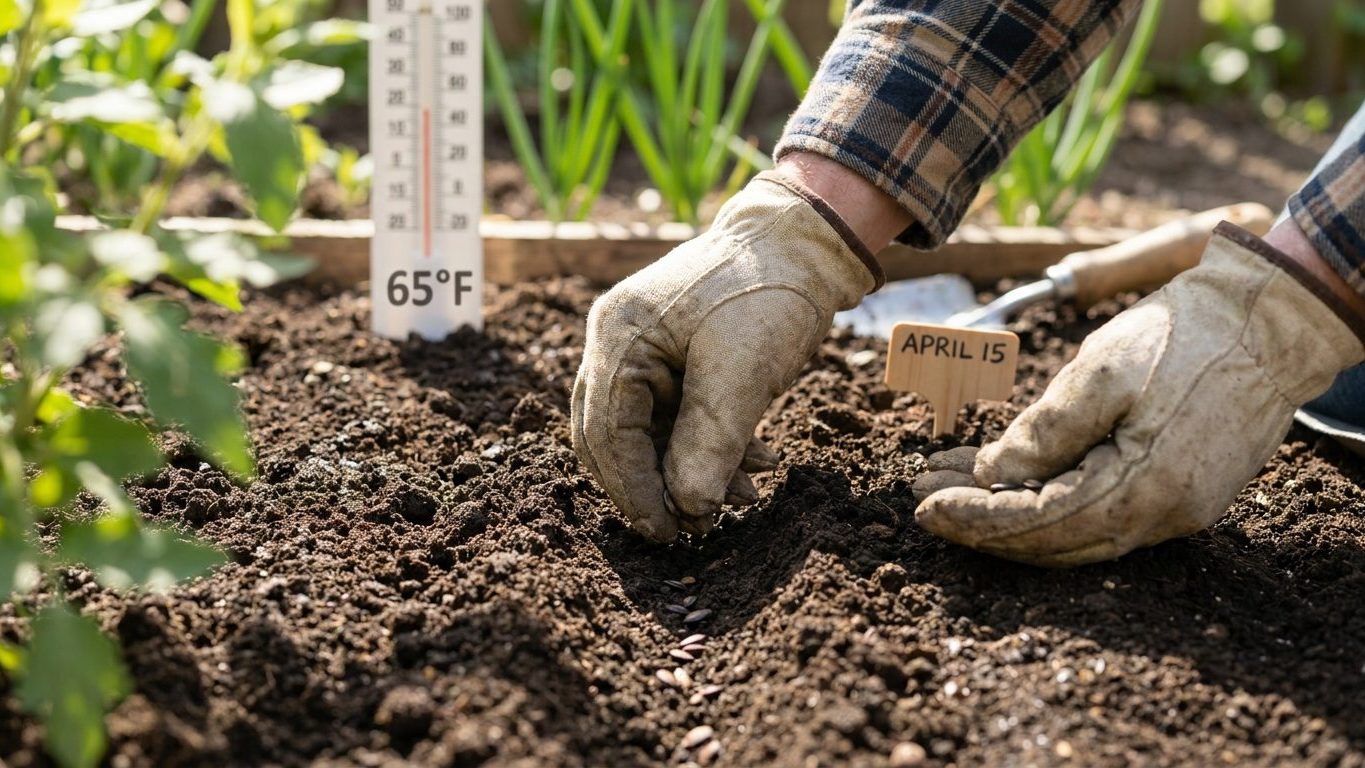
There’s a second reason to wait beyond the frost date alone: melon seed germinates poorly, and transplants sulk, in cold soil. Soil temperature lags air temperature by weeks in spring, so even once frost risk has passed, ground that’s still in the 50s won’t support a melon plant that wants soil in the mid-60s or warmer to really get going. This is why the recommended approach is indoor starting followed by a later transplant, rather than direct seeding right after the frost-free date arrives.
On the back end, the first-fall-frost band of November 3 to November 14 gives Massachusetts a long nominal frost-free season, on paper stretching past 200 days depending on which edge of each band you use. That sounds generous for melons. It is not the whole picture, and the next section explains why that long window doesn’t translate into an easy melon season for every variety.
One more note on the frost dates themselves: they come from a waterfront, urban reference station, which NOAA’s own documentation flags as the mildest spot in the state. Inland suburbs and the Berkshires will see frost arrive earlier in fall and linger later in spring than these dates suggest. Anyone gardening away from the immediate coast should treat both bands as optimistic and build in extra buffer on both ends of the season.
What will not work here
The number that undercuts an otherwise long Massachusetts growing season is 10.2. That’s the average number of days per year the reference station reaches 90°F or higher. Melons are a crop that converts heat directly into sugar and ripening speed, and a state averaging barely over a week and a half of genuinely hot days per year is not a heat-rich environment by the standards melons prefer. Large, long-season watermelon varieties bred for regions with weeks of sustained 90-plus-degree heat are the poorest fit here. They may vine vigorously through a cool Massachusetts summer and never accumulate enough heat units to finish sweetening before fall frost arrives.
This isn’t an argument against melons in Massachusetts. It’s an argument against choosing the same varieties a grower in a hotter climate would choose. A long days-to-maturity number on a seed packet means more than a countdown from planting date. It means that variety needs a specific accumulated heat load, and Massachusetts hands out that heat load slowly, in a state averaging just over 10 days a year above 90°F.
Rain, humidity, and spacing
Summer rainfall compounds the heat problem rather than solving it. The reference station averages about 10.4 inches across June, July, and August, front-loaded in June at 3.89 inches and tapering to the driest month, August, at 3.23 inches. That’s not a drought-prone summer, but it isn’t a light one either, and it arrives as a mix of steady rain and occasional thunderstorms rather than a dry heat pattern. Combined with cooler night temperatures, that moisture load favors fungal disease on melon foliage, especially in vines planted at tight spacing where air can’t move between leaves. A planting layout copied from a hot, dry-summer state will trap humidity here in a way it wouldn’t there.
Watering on a fixed weekly schedule is another mismatch. On sandy soil, June and July rain totals in the 3-to-4-inch range per month can vanish within a day or two of falling, leaving a melon patch dry well before the next scheduled watering. On clay, that same rain sits for a week, and adding irrigation on top of it risks root rot rather than drought stress. The 10.4-inch summer figure is a regional average, not a guarantee for any particular yard, and it never tells you enough on its own to set a watering schedule. A rain gauge on the actual plot, checked against the soil underneath it, is what actually answers that question.
What changes across Massachusetts
Massachusetts spans USDA Hardiness Zone 5a through 7b, according to the USDA Plant Hardiness Zone Map’s 2023 update, built on 1991-2020 normals. That’s a wide spread for a state its size, and it’s built on a single variable: the average annual extreme minimum winter temperature. It says nothing directly about summer heat or frost timing, but it’s a reliable proxy for how much colder and shorter a season runs in one part of the state versus another.
A gap that wide means there is no single melon calendar that fits the whole state equally well. A zone 7b garden, likely near the coast or the Islands, can expect an effectively longer, milder season around the edges of both frost bands. A zone 5a garden, more typical of the Berkshires and higher inland elevations, should expect frost lingering later into spring and returning earlier in fall than the state-level bands describe, along with a shorter run of warm nights for melon ripening.
The practical shift for a reader gardening at higher elevation or further from the coast isn’t a different set of varieties so much as a different set of dates: push the indoor seed-starting date later, push the transplant date later, and treat the fall harvest deadline as arriving sooner than the state’s November 3-14 fall-frost band implies. Someone gardening in a milder coastal pocket can lean toward the early side of every date in this article; someone inland or at altitude should lean toward the late side, and pad it further.
This page can describe the range. It can’t tell an individual reader which end of that 5a-7b spread their own yard falls into. That requires checking the actual map rather than guessing from a town name, since local terrain, elevation, and distance from water all shift a property’s effective zone within the state’s broader range.
Where to check this for your own county
The state-level dates in this article come from one reference station, and Massachusetts is too varied, zone 5a to 7b, coastal to inland, to treat that single station as a stand-in for every county. The University of Massachusetts Amherst runs the state’s land-grant extension service, and its site at ag.umass.edu is the source built for exactly this gap.
Two things are worth looking for there specifically. First, a local or regional planting calendar that reflects frost timing closer to your actual county rather than the mild coastal station cited in national climate normals. Second, variety trial results or recommendations for melons that have actually been grown and evaluated under Massachusetts conditions, rather than seed-catalog descriptions written for the country as a whole. Extension trial data reflects what performed in real soil, real summers, and real disease pressure in this state, which is a different kind of evidence than a maturity date printed on a seed packet.
A county-level recommendation from extension staff working with your local Soil and Water Conservation District or county office will consistently beat a state-wide article like this one, because it accounts for local frost patterns, local soil types, and local disease history that a single reference station cannot capture. This page is deliberately the broad, state-level version of that information. Treat it as the starting framework, and treat your county extension office as the source that adjusts it to your actual ground.
Checking this against your own garden
Every date in this article is a regional average built from one weather station and one hardiness map. Your own garden will confirm or contradict those averages faster than any calendar can, and three simple observations outrank all of them.
Soil warmth by feel is the first and most direct check. Press a hand into the planting bed in mid-morning, a few inches down. If it still feels distinctly cool or damp-cold rather than mild, the soil isn’t ready to support melon roots regardless of what the frost-date calendar says. This single check catches the exact gap this article flagged earlier: air temperature clearing the frost band doesn’t mean soil temperature has caught up.
The first flush of male flowers is the second signal. Melon vines typically produce a wave of male blossoms before the female flowers, the ones with the small swelling behind the petals that will become fruit, appear. Seeing plenty of male flowers but no females yet is normal and not a sign of trouble; it’s simply the plant sequencing its bloom.
The appearance of the first true leaves, the serrated, melon-shaped leaves that follow the rounded seed leaves, tells you the plant has moved past its most fragile transplant stage and is establishing real root growth in your specific soil and microclimate. A slow arrival of true leaves after transplant, compared to what a neighbor’s plants are doing a few miles away, is often the clearest sign that a particular yard runs cooler or wetter than the county average, and that every date discussed above should be nudged later on that plot specifically.