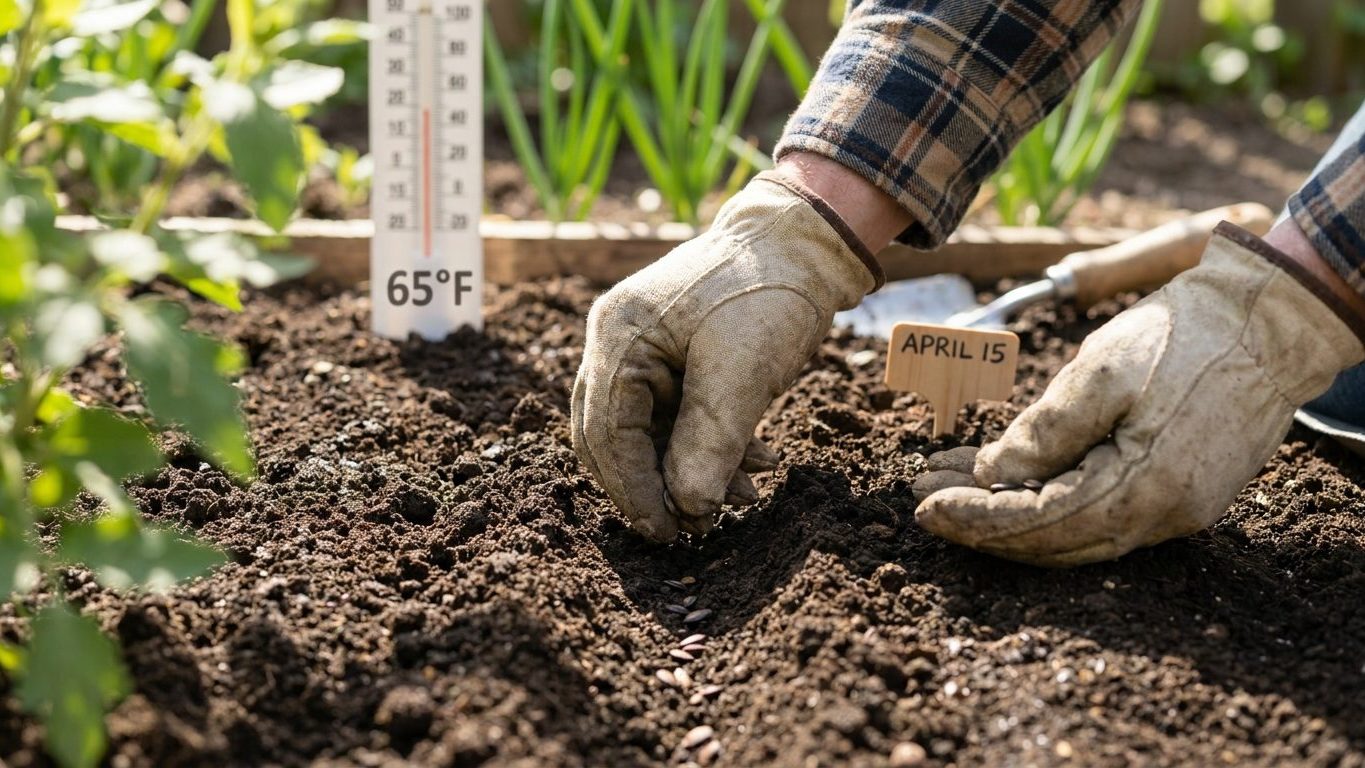

Melons go into Michigan ground after the soil has warmed past 65°F, which usually lands in late May to early June across the Lower Peninsula. That’s roughly three to four weeks after the last spring frost, not the day after it. Waiting for warm soil, not just frost-free air, is what separates a melon patch that sets fruit from one that sits and sulks all June.
The short answer for Michigan
MSU Extension puts the last spring frost around April 30 in the Detroit area, with early to mid May typical across most of the Lower Peninsula. Those are frost-free dates, meaning the probability of frost drops sharply after that point, not that frost becomes impossible. A cold night in the second week of May is still well within the normal range for much of the state.
Melon seed barely germinates in soil below 65°F, and it sulks even in soil in the high 50s. Air temperature can clear the frost threshold weeks before the ground catches up, especially after a wet, cloudy spring. That gap is why the practical planting window for melons sits later than the frost date alone would suggest: figure on the last week of May through the first week or two of June for direct seeding or setting out transplants in most of the Lower Peninsula, with the Detroit area able to push a little earlier some years given its slightly earlier frost-free date.
On the back end, MSU’s Michigan Garden Calendar puts the first fall frost between October 6 and October 21 for zone 6a. Counting from a late-May planting to an early-October frost gives a growing season in the neighborhood of 130 to 145 days, and counting from the earliest possible mid-May planting to the latest fall frost date stretches that closer to 155 days. Most melon varieties bred for northern gardens finish in 65 to 90 days, which fits inside that window with margin to spare, provided the planting date itself isn’t pushed too late by a slow, cold spring.
That margin matters because Michigan’s spring is rarely tidy. A grower who plants the moment the calendar says frost has passed, without checking the ground itself, is the one who loses the head start the season length otherwise provides.
What will not work here

Seeding directly into cold soil the week after the frost date is the most common failure. Melon seed sitting in soil in the high 50s or low 60s doesn’t just grow slowly, it often rots before it germinates, especially after a spring rain. Michigan’s spring soil warms unevenly, and a garden with heavier clay holds that cold moisture for days longer than a sandy one does. Rushing the calendar here costs a replant, not just a delay.
Long-season melon varieties, the kind bred for a 100-day-plus growing window, are a poor match for a state where the workable window runs closer to 130 to 145 days once cold-soil delays are factored in. A variety that needs 100 days from a June 1 planting is due in early September, which sounds safe against an October frost, but any stretch of cool, cloudy weather in July or August (not unusual here) pushes that maturity date right up against the fall frost line with no room left to recover.
Watering on a fixed weekly schedule also fails more often than gardeners expect. Michigan’s reference station averages about 10 inches of rain across June, July and August, split fairly evenly between the three months (3.26, 3.51 and 3.26 inches respectively). That sounds like enough, but the same station logs 10.3 days a year at or above 90°F, and that heat load drives evaporation fast, especially when the rain arrives as one heavy thunderstorm that runs off rather than soaks in. A melon vine setting fruit during a 90°F stretch with no rain in the forecast needs a look at the soil, not a glance at the calendar, before the next scheduled watering.
Tight spacing is the other quiet failure. Summer humidity following that same rainfall pattern is enough to encourage powdery mildew and other fungal trouble on vines that don’t get airflow. Crowding melon hills to save space in a small yard tends to show up as blighted leaves by mid-August, right when the fruit needs healthy foliage the most.
What changes across Michigan
Michigan spans USDA hardiness zones 4a to 6b, and that’s a wide enough range that there is no single melon calendar for the whole state. Zone 6b, closer to the Detroit reference station and the warmer parts of the southern Lower Peninsula, gets the earlier frost-free date and the longer season on the back end. Zone 4a, found in the colder pockets of the Upper Peninsula and higher, more exposed inland sites, runs both frost dates in the opposite direction: a later last spring frost and an earlier first fall frost, which shrinks the workable window from both ends at once.
| Situation | General pattern | Practical shift |
|---|---|---|
| Warmer zone (closer to 6b) | Earlier soil warm-up, later fall frost | Can plant nearer the early end of the window; longer-season varieties have more room |
| Colder zone (closer to 4a) | Slower soil warm-up, earlier fall frost | Push planting later, lean on short-season (65-75 day) varieties, consider black plastic mulch or row cover to add heat |
A garden on a north-facing slope or in a low frost pocket behaves colder than its zone number suggests, and a south-facing spot against a wall or foundation can run noticeably warmer than the open field next to it. The state’s spread says nothing about any one yard’s exact position inside it. The USDA Plant Hardiness Zone Map is built on average annual extreme minimum winter temperature, one variable, which makes it useful for guessing zone but not a substitute for watching your own soil and your own frost pattern.
Anyone trying to pin down which end of that 4a-6b range their own property falls into should check the USDA map directly rather than guess from a regional description. A calendar built for the Detroit area and one built for a cold northern county are not the same calendar, and treating them as interchangeable is where a lot of disappointing melon seasons start.
Where to check this for your own county
Michigan State University Extension is the state’s land-grant extension service, and its outreach directory at canr.msu.edu/outreach/ is the starting point for finding the office covering a specific county. That local office is where the state-level numbers in this article get replaced with something sharper.
Two things are worth asking for specifically. First, the county’s own planting calendar, which accounts for local frost records rather than the regional averages cited here, and can differ by a week or more from the Detroit-area dates even within the same general zone. Second, any variety trial results the county or a nearby MSU research station has run on melons, since those trials show which varieties actually reached full ripeness locally in real growing seasons, not just on paper based on days-to-maturity listed on a seed packet.
A county recommendation beats a state one every time, because it’s built from data closer to the actual soil and microclimate a reader is planting into. Statewide frost dates, a single reference station’s rainfall and heat data, and a broad hardiness zone range cover the entire state. That’s useful for understanding the general shape of a Michigan melon season, but it isn’t a substitute for the county-specific numbers an extension office can provide, and it isn’t meant to be. Treat this article as the wide-angle view and the county office as the answer for the specific plot of ground being planted.
Checking this against your own garden
A reader’s own garden will confirm or override those numbers faster than any calendar can, and three simple observations do most of that work.
Soil warmth by feel is the first and most direct check. Pushing a bare hand two or three inches into the planting bed on a sunny afternoon gives a rough read: soil that still feels cool and damp like early spring isn’t ready for melon seed regardless of what the calendar says, while soil that feels warm through and dry on the surface a day after rain is a better sign the ground has caught up to the air temperature.
The first flush of male flowers on an already-growing vine is the second signal. Melons produce male flowers before female ones, often by a week or two, and that first bloom is a sign the plant has settled in and started its reproductive clock, which is a more reliable marker of local conditions than a planting date on a bag.
The appearance of true leaves, the second set that emerges after the rounder seed leaves, marks the point where a young melon plant is actually functioning on its own rather than living off stored seed energy. A slow gap between seed leaves and true leaves, longer than what the seed packet describes, usually points to soil that’s still a bit cooler than ideal for that particular spot, which is exactly the kind of microclimate detail no regional calendar can capture in advance.
Some gardeners also time melons by the Moon: when to plant watermelon and cantaloupe by the moon, as almanac tradition rather than fact.