
In most of Minnesota, melon transplants go into the ground roughly two to three weeks after the last spring frost, once soil has actually warmed, not the moment frost risk fades. That means late May into early June for the Twin Cities area, with harvest needing to wrap up well before the first fall frost between October 11 and October 23.
The short answer for Minnesota
The last spring frost date for the Twin Cities reference station runs April 17 to April 30, and the first fall frost falls October 11 to October 23. Those dates come from NOAA’s 1991-2020 climate normals and represent a 30 to 70 percent probability band for a 32F freeze, not a hard line. In practice that means there’s still a real chance of frost even after April 30, and a real chance the season ends before October 11. Neither date tells a melon grower when to plant, only when frost becomes unlikely.
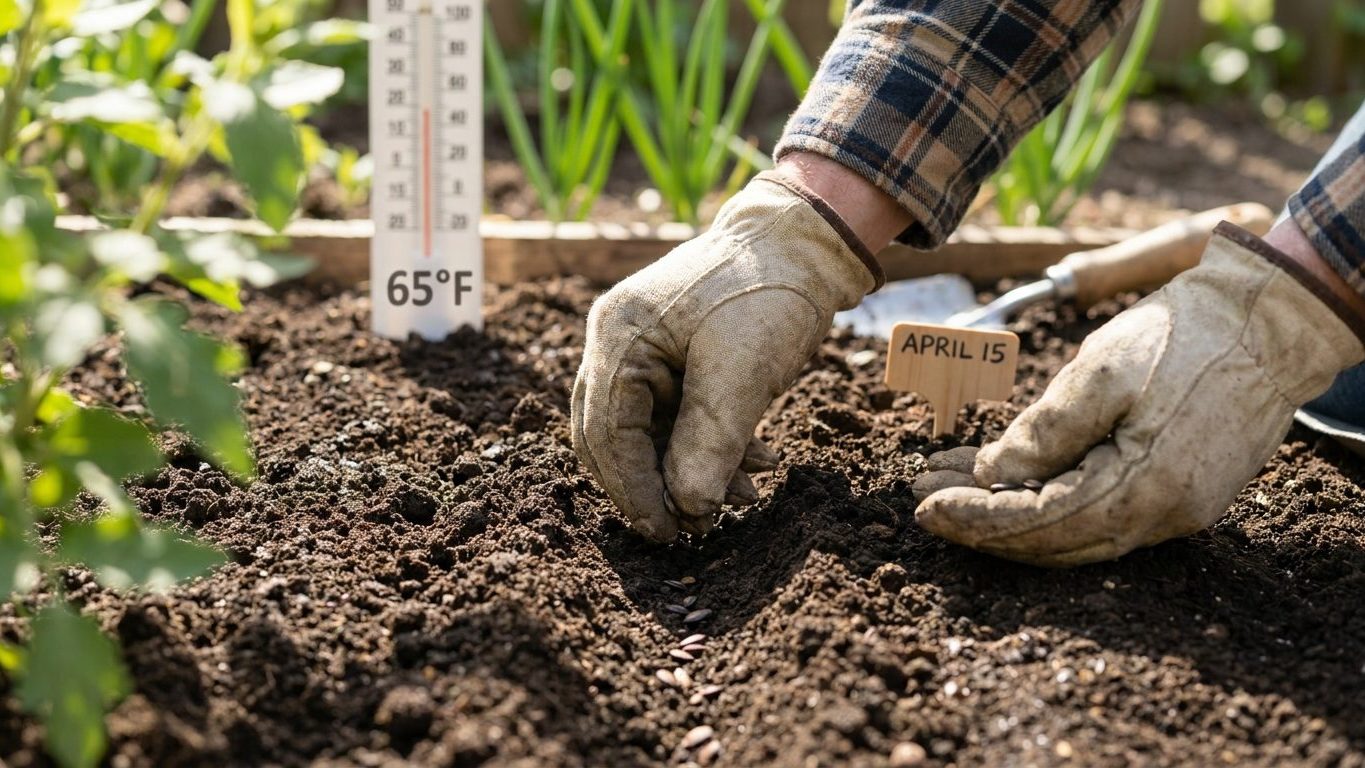
Melon seeds germinate poorly below 65F soil temperature, and transplants set out into cold ground simply sit and sulk rather than grow. Minnesota soil rarely holds steady at that mark until well after the frost-probability window closes, usually mid to late May in the southern part of the state. That’s why most Minnesota gardeners start melon seed indoors three to four weeks before their intended transplant date, then move seedlings outside once both frost risk and cold soil are behind them, typically the last week of May through the first week of June.
Counting backward from fall frost
Work the calendar from the other end too. If the first fall frost lands anywhere in the October 11 to October 23 range, and a melon variety needs 70 to 95 days from transplant to ripe fruit (a typical range across melon types), a transplant date in late May to early June leaves a workable but not generous cushion. The Twin Cities reference station also averages just 10.6 days a year at or above 90F, the heat load that pushes melon vines to size fruit and build sugar quickly. Fewer hot days means slower ripening, so that cushion matters more here than it would in a hotter climate.
What will not work here
Direct-seeding melons outdoors on the last frost date itself is one of the more common failures. April 17 to April 30 soil in Minnesota is still cold from winter, and melon seed dropped into it either rots before germinating or germinates weeks late, losing the head start a short growing season can’t spare. The fix isn’t a different frost date, it’s skipping direct seeding altogether in favor of indoor starts or purchased transplants.
Long-season melon types, the ones bred for 90 to 100+ days to maturity, run into the same wall from the other direction. With only 10.6 days a year above 90F to drive ripening, and a fall frost that can arrive as early as October 11, a late-maturing variety transplanted in early June is racing a clock it’s likely to lose. Shorter-season types matched to the available window perform far more reliably here.
Watering and disease pressure
Minnesota summers aren’t dry in the way a desert climate is dry. The Twin Cities area averages about 13.0 inches of rain across June, July and August, with July the driest month at 4.06 inches. That sounds like plenty, but it arrives unevenly, often as single thunderstorms that run off rather than soak in, especially on sandy soil. A grower watering on a fixed weekly schedule regardless of that rainfall pattern risks both underwatering between storms and overwatering right after one.
- Cold-soil seeding: fails because germination needs 65F+ soil, not just frost-free air.
- Long-season varieties: fail because they outrun the 10.6-day heat allowance and the October frost.
- Tight plant spacing: fails because roughly 13 inches of summer rain keeps foliage damp enough for fungal disease to spread fast in a crowded planting.
That last point matters more than gardeners expect. Close spacing traps humidity around the leaves after every rain event, and Minnesota’s summer rainfall, while moderate, is enough to feed powdery mildew and other fungal issues if air can’t move through the planting.
What changes across Minnesota
Minnesota isn’t one climate, it’s several stacked north to south. The USDA Plant Hardiness Zone Map, built from average annual extreme minimum temperatures, places the state anywhere from zone 3a to zone 5a. That’s a wide spread for a single state, and it means there’s no single planting date that works from the Iowa border to the Canadian one.
The frost dates cited above come from the Twin Cities reference station, which sits in the milder southern part of that range. Northern Minnesota, closer to zone 3a, runs two to three weeks tighter at both ends: a later last spring frost and an earlier first fall frost, which shrinks the whole growing window. A grower in International Falls is working with a meaningfully shorter season than one in the Twin Cities metro, even though both are technically “Minnesota.”
Rather than guess which zone applies to a given yard, check the USDA Plant Hardiness Zone Map directly. It’s built from measured temperature data down to a fine grid, and it will show a specific zone for a specific address, something no statewide range can do. Readers in the northern third of the state should treat every date as a starting point to shift later in spring and earlier in fall, not as a fixed target.
Where to check this for your own county
The University of Minnesota Extension service, at extension.umn.edu, publishes recommendations built around specific counties rather than a single statewide reference station. That distinction matters more in a state that spans three hardiness zones than it would almost anywhere else.
Two things are worth looking for once there. First, a county or regional planting calendar, which will reflect the tighter frost windows found in northern counties rather than the milder Twin Cities dates. Second, a list of melon varieties actually trialled in Minnesota conditions, since a variety that performs well in a longer, hotter growing season elsewhere in the country may not size up or ripen reliably here, given the state’s modest count of 10.6 days above 90F each year.
A county-level recommendation from Extension will always beat a state-level one. A single reference station’s climate normals give a workable statewide starting point, but they can’t account for a specific county’s soil, elevation, or local frost pocket the way a county Extension office can. Treat the dates and reasoning here as the baseline, and let the local office narrow it down.
Some gardeners also time melons by the Moon: when to plant watermelon and cantaloupe by the moon, as almanac tradition rather than fact.
Checking this against your own garden
Every date is built from long-term averages, not a forecast for any single spring. The most reliable check is still a gardener’s own observation, made right on the plot where the melons will grow.
Soil warmth by feel is the first and simplest test. Push a bare hand two or three inches into the bed in mid to late spring; soil that still feels cold and damp, closer to refrigerator temperature than room temperature, isn’t ready for melon roots yet, regardless of what the calendar says. Warm, slightly dry-to-the-touch soil is the better signal.
The first flush of male flowers on an established melon vine tells a different story: the plant has moved past establishment and into reproductive growth, meaning it found conditions it liked well enough to commit energy to flowering. Male flowers typically appear before female ones, so their arrival is an early read on how the season is progressing for that particular plant, not yet a sign fruit is coming.
The appearance of the first true leaves, the ones that look like scaled-down adult melon foliage rather than the rounded seed leaves, marks the point a seedling has switched from living off stored seed energy to actually photosynthesizing on its own. A slow arrival of true leaves after transplant, well beyond the usual timeline, is often the clearest on-the-ground sign that a particular yard runs cooler or slower than the regional average.