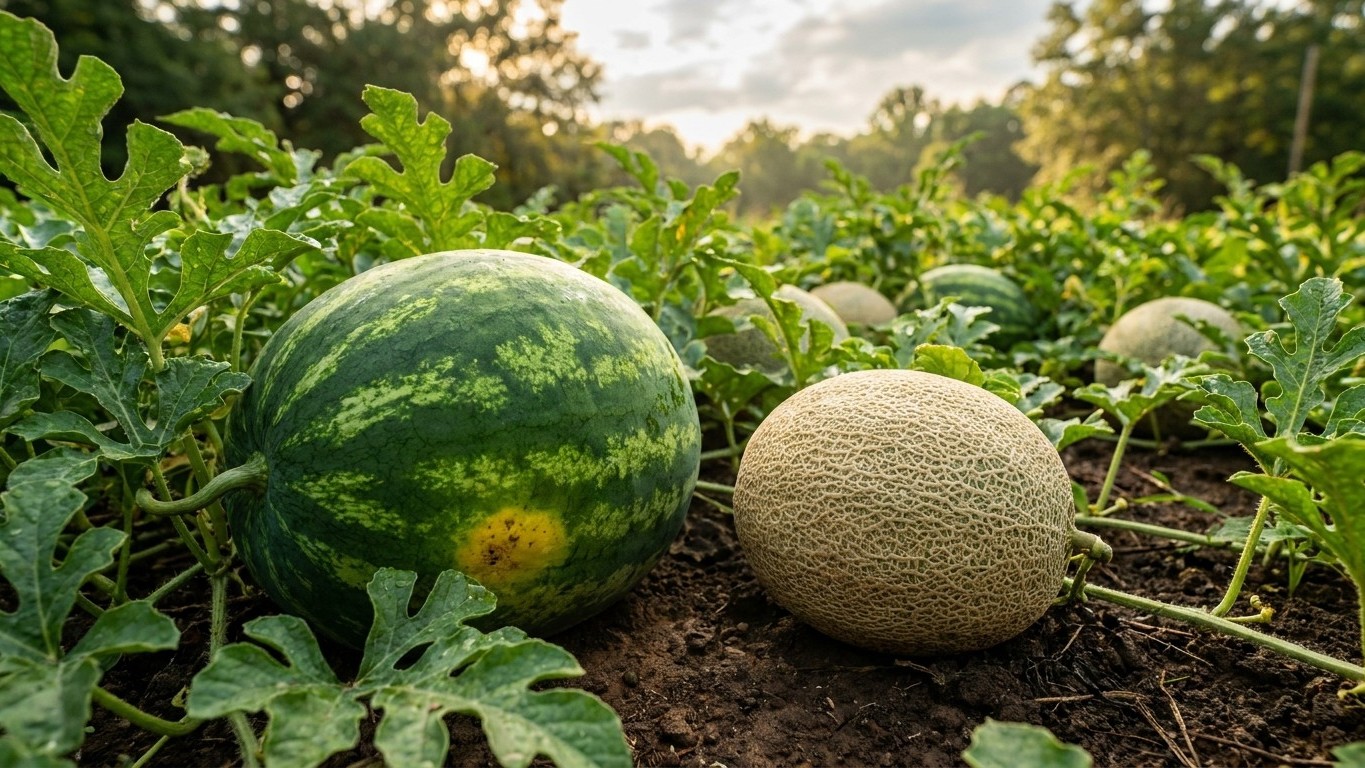

Minnesota gardeners get the best results with short-season muskmelon and cantaloupe types bred to ripen fast in cool-summer climates. Compact, quick-maturing watermelon varieties can work too, but honeydew is a tough bet almost anywhere in the state. The reasoning comes down to two numbers: how long the frost-free window runs, and how much real heat the state gets during it.
The short answer for Minnesota
Minnesota’s frost-free window runs from a last spring frost of April 17 to April 30, to a first fall frost of October 11 to October 23. Depending on where you land in that range, that’s somewhere between 164 and 189 days without a killing freeze. On paper, that sounds like plenty of runway for a melon crop. But melons don’t just need a frost-free calendar. They need heat, and that’s where Minnesota gets stingy.
The reference station near Minneapolis, which sits at the milder, southern edge of the state, averages only 10.6 days a year at 90F or hotter. That’s the number that actually governs melon success, because melons build sugar and finish ripening on accumulated warmth, not just on the absence of frost. A long frost-free season with low heat load still produces slow, underwhelming fruit if you plant the wrong type.
That’s why the decision in Minnesota is really a decision by category, not by brand or catalog page. Muskmelon and cantaloupe types bred for short, cool seasons are the strongest fit: many mature in the 70-to-85-day range, which comfortably fits inside even the tighter end of the frost-free window and doesn’t demand weeks of 90-degree days to sweeten up. The University of Minnesota’s own agricultural breeding program produced a small, fast cantaloupe specifically for northern gardens decades ago, and that lineage still points to the right strategy today: small fruit, fast maturity, bred for marginal heat.
Watermelon is the second-tier option. Skip the large classic types that expect a long hot summer, and look instead at the icebox and personal-size category, which typically matures faster and needs less cumulative heat to reach a good sugar level. These still carry more risk than a good short-season muskmelon, but they’re workable in most Minnesota summers.
Honeydew is the category to approach with real caution. It generally wants more sustained heat than muskmelon, and it doesn’t signal ripeness as clearly, since the skin color shift is subtler. Combined with only 10.6 days a year above 90F, honeydew is asking Minnesota’s climate for something it rarely delivers.
What will not work here
Full-size, long-season watermelon varieties are the clearest mismatch. These are bred for regions where 90-degree days stack up for weeks at a stretch. Minnesota averages barely more than ten such days across an entire year at the reference station, so the heat units needed to convert a large watermelon from green and bland to fully sweet simply aren’t there most seasons. Even if the vine survives to frost, the fruit inside is often pale and underripe.
Honeydew runs into the same wall, and a worse one, since it needs a longer stretch of warm nights on top of the heat. In a state where the frost-free window can be as tight as 164 days on the early-frost, late-spring-frost end of the range, there just isn’t margin for a long, heat-hungry maturation curve.
There’s also a timing trap hiding inside that 164-to-189-day figure. Melon seed doesn’t germinate well in cold soil, so the practical growing season starts later than the calendar frost-free date suggests. Direct-seeding right at the last frost date often means the plant sits and sulks for a week or two before real growth begins, which quietly eats into whatever margin a slower variety was counting on.
Watering habits built around a “once a week” routine are the second failure point, and it’s a rainfall math problem more than a soil problem. Summer rainfall across June, July and August averages about 13.0 inches, with July, the driest month, at 4.06 inches. That sounds adequate spread evenly across a month. It rarely arrives that way. A good chunk of that rain lands as a single thunderstorm that runs off rather than soaking in, especially once those 90-degree days above show up and pull moisture out of the topsoil fast. A gardener watering on a strict weekly schedule can still hit a stretch of stressed, cracking fruit during a dry pocket in July.
Finally, tight vine spacing is a risk multiplier in a state with this rainfall pattern. Wet foliage that doesn’t dry quickly between storms is exactly what powdery and downy mildew look for, and both diseases spread faster through vines planted close enough that air can’t move between them.
What changes across Minnesota
Minnesota is not one climate wearing a single label. The USDA Plant Hardiness Zone Map, built on the average annual extreme minimum temperature, places the state anywhere from zone 3a to zone 5a. That’s a wide spread for one state, and it means there’s no single melon answer that applies from the Iowa border to the Canadian one.
The frost dates cited above come from a reference station near Minneapolis, which sits at the mild, southern end of that range. The stated caution on those dates is worth repeating plainly: northern Minnesota runs two to three weeks tighter at both ends of the season. That’s not a rounding error. Two to three weeks off a frost-free window that might already be as short as 164 days is a meaningful chunk of the growing season, and it pushes northern gardeners even harder toward the fastest-maturing muskmelon types and away from watermelon and honeydew altogether.
The hardiness zone number itself, based only on extreme winter cold, doesn’t directly predict melon success since melons are annuals and don’t overwinter. But it’s a useful proxy for how different the state’s regions are, and a zone 3a garden in the north is operating under a materially shorter, cooler season than a zone 5a garden near the Twin Cities, even though both are technically “Minnesota.”
None of this means a reader should guess which zone applies to their yard from a description. The right move is checking the USDA Plant Hardiness Zone Map directly for a specific address, since zone boundaries can shift within fairly short distances, especially near larger bodies of water or in valley terrain.
Where to check this for your own county
Everything above is a state-level answer, built from a single reference station and a state-wide hardiness zone range. That’s useful for deciding which category of melon to plant, but it’s not a substitute for what your county extension office already knows about your specific ground.
The University of Minnesota Extension, at extension.umn.edu, is the place to go next. Two things are worth looking for specifically once there. First, a local planting calendar tied to your county or region, which will reflect the tighter frost dates typical of northern counties rather than the milder Twin Cities numbers used in this article. Second, any variety trial results or recommendations specific to Minnesota growing conditions, since county-level extension offices and university trial gardens often test how particular muskmelon, watermelon and honeydew varieties actually perform under real Minnesota summers, not just their seed-packet maturity dates.
A county-level recommendation will always beat a state-level one, for a simple reason: a county extension calendar is built from data closer to your actual soil, elevation and microclimate. Think of this article as the map, and the extension office as the terrain report for your specific parcel of it.
Checking this against your own garden
Every date and average describes a normal, not a promise. Your own garden will tell you more than any calendar once the season actually starts, and three simple observations outrank all of it.
Soil warmth by feel comes first. Melon seed wants soil that feels warm to the touch, not just frost-free air. If you push your hand a couple inches into the planting bed in spring and it still feels cool and damp rather than warm and dry-ish, the soil hasn’t caught up to the calendar yet, whatever the frost date says. That’s your cue to hold off another few days rather than seeding on schedule.
The first flush of male flowers is the next signal. Melon vines typically produce a wave of male flowers before the female flowers, which have the tiny swelling behind the bloom that will become fruit, appear in any number. A strong, early flush of male flowers is a decent sign the plant is growing under conditions it likes; a sparse, delayed flush suggests the vine is stressed, often by cooler nights than the plant wants.
Third, watch how fast true leaves develop after the first seed leaves. Quick, vigorous true-leaf growth points to a warm, well-suited microclimate in that particular bed. Slow, stalled growth at the true-leaf stage, even when neighboring beds look fine, often points to a cooler pocket, perhaps low ground, shade from a fence, or heavier clay holding more moisture and staying cooler longer, and that’s worth factoring into where you plant melons next season.