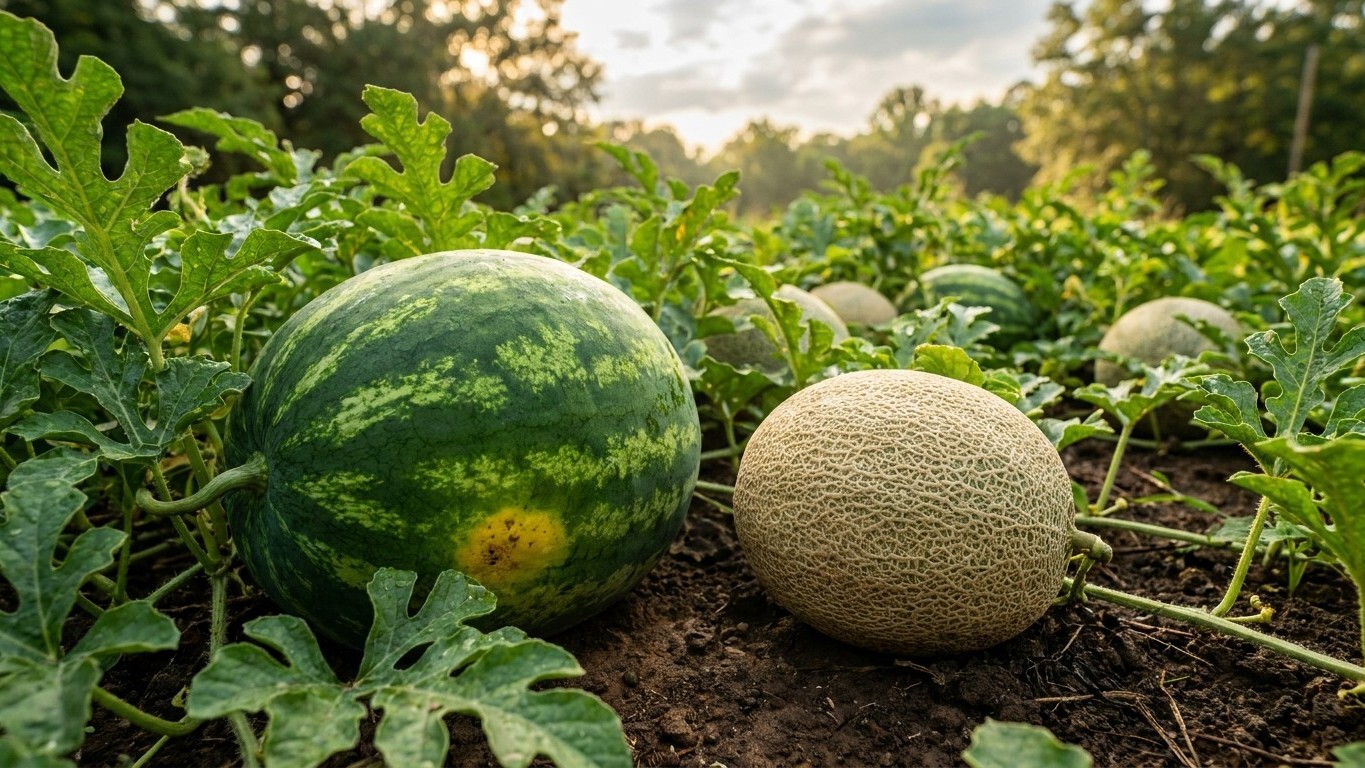

Watermelon types, especially icebox and standard slicing varieties, are the safest bet for Missouri gardens, given a long frost-free window and heavy summer heat. Cantaloupe does well too, if you pick disease-resistant varieties. Honeydew and other long-season, dry-climate melons are the riskiest choice here, because Missouri’s thunderstorm-driven rain and thick summer humidity favor fungal disease over the steady, dry heat those melons actually want.
The short answer for Missouri
Start with the calendar. NOAA’s 1991-2020 normals put the last spring frost at the Kansas City reference station between April 6 and April 20, and the first fall frost between October 18 and October 29. Run the math on the worst-case combination (latest spring frost, earliest fall frost) and you still get 181 frost-free days. The best-case combination stretches to 206 days. Even the shortest version of that window covers the days-to-maturity of every melon type sold in a Missouri garden center, so season length is not what separates a good choice from a bad one here.
Heat is what separates them. The same reference station averages 32.7 days a year at or above 90F. That is a heavy heat load, and it rewards melon types bred to keep setting fruit through stretches of high temperature rather than stalling out. Watermelon, especially icebox varieties maturing in 70 to 75 days and standard slicing types in the 80 to 90 day range, handles that load well. Cantaloupe and other muskmelons, typically 75 to 90 days, do fine on heat tolerance but need help on the disease side, which the next section covers. Honeydew, often listed at 80 to 110 days and bred for drier growing regions, is the type most likely to disappoint in a Missouri backyard, not because the season runs out on it, but because the climate it wants (steady heat, low humidity) is not the climate Missouri summers deliver.
| Melon type | Typical days to maturity | Fits Missouri’s frost window | Fits Missouri’s heat load |
|---|---|---|---|
| Icebox watermelon | 70-75 | Yes, with margin | Strong |
| Standard watermelon | 80-90 | Yes | Strong |
| Cantaloupe/muskmelon | 75-90 | Yes | Good, disease pressure is the limit |
| Honeydew | 80-110 | Tight in cooler pockets | Weak, prefers drier heat |
What will not work here
Long-season honeydew and other 100-plus day melons are the first thing to cross off the list, and not for the reason people assume. The raw frost-free window is long enough on paper. The problem is that the usable part of that window, after soil has actually warmed enough to plant and before disease pressure builds through the humid part of summer, is narrower than the calendar suggests. Push a 100-day honeydew into a cool spring or a shaded bed and it can still be closing in on the October frost dates when it should be drying down for harvest.
A weekly watering schedule is the second failure point, and it is a common one. With 32.7 days a year hitting 90F or higher, evaporation demand spikes hard during exactly the stretch when melon vines are setting and sizing fruit. A once-a-week soak might have carried a garden through a mild June, but it will not carry fruit set through a run of 90-degree days in July. Blossom drop and bitter, watery fruit are the usual result.
Tight spacing is the third one, and it interacts directly with Missouri’s rainfall pattern. Summer rain here totals about 14.1 inches across June, July and August, with June the wettest month at 5.25 inches and August the driest at 4.24 inches. That rain rarely arrives as a gentle soak. It comes in thunderstorm bursts, which means a lot of it runs off a clay surface rather than soaking in, while the humid air that follows a storm lingers over the garden for days. Melon vines planted close together, with poor airflow between them, turn that humidity into a breeding ground for powdery mildew, downy mildew and anthracnose. Wide spacing and morning watering (so leaves dry before evening) do more to prevent disease here than any fungicide schedule.
Finally, treating that 14.1-inch summer total as a reason to skip a rain gauge is a mistake. The same rain behaves differently on sand than on clay, and a single storm that dumps an inch in twenty minutes leaves a very different soil-moisture picture than an inch spread gently over three days. The regional average tells you what to expect. It does not tell you what your own bed received last week.
What changes across Missouri
Missouri is not one garden, and the USDA Plant Hardiness Zone Map (2023 edition, built on the 1991-2020 average annual extreme minimum temperature) puts the state across a wide 5b-7b range. That is a two-full-zone spread inside one state’s borders, which means there is no single frost-free window or heat-load number that fits every county. The frost dates cited above come from the Kansas City reference station, and even there the CAUTION on the underlying data matters: the airport station sits north of downtown Kansas City, downtown itself typically runs about five days earlier in spring, and southern Missouri is milder again on top of that.
Practically, that spread means a gardener in the far north of the state or up in the Ozark highlands, closer to the 5b end, is working with a shorter effective season and a later soil warm-up. Leaning toward icebox watermelon or fast cantaloupe varieties, and starting seed indoors rather than direct-sowing, buys back some of that margin. A gardener down in the Bootheel, closer to 7b, has both a longer frost-free stretch and a warmer spring soil, which opens the door to the longer-season honeydew varieties that struggle further north.
None of this means guessing which zone applies to a specific yard. The zone spread is a reason to check a map, not a reason to pick a number and assume it fits.
Where to check this for your own county
The University of Missouri Extension, at extension.missouri.edu, is the source built for exactly this gap between a state-level page and a specific county’s conditions. Two things there are worth pulling up directly. First, the local planting calendar, which adjusts the frost-date ranges cited above for a specific county rather than the single Kansas City reference station used here. Second, the variety trial results and recommendation lists that Extension offices run themselves, county by county, which show which cantaloupe and watermelon varieties actually held up against local disease pressure in field trials, rather than on a seed packet’s marketing copy.
A county-level recommendation from Extension will always outrank what a state-level page like this one can offer. This page works from a single reference station’s climate normals and a statewide hardiness zone range. A county Extension office works from local soil surveys, local disease reports and, often, its own test plots. That is a different level of detail, and it is free to access.
Checking this against your own garden
Every date and average on this page is a regional starting point. A gardener’s own observations, made on their own soil, settle the question faster than any chart. Three things to watch stand out.
Soil warmth by feel comes first. Push a bare hand two inches into the bed before transplanting. Melon roots stall in soil that still feels cool and damp, no matter what the spring frost date says, and a few extra days of waiting costs far less than a stalled transplant.
The first flush of male flowers comes second. Melon vines produce male flowers before female ones, sometimes by a week or more, and a bed covered in blooms with no fruit forming yet is not a failure, it is a normal stage. Female flowers, recognizable by the small swelling at the base of the bloom, follow shortly after.
The timing of the first true leaves comes third. If seedlings are slow to push past their first true leaves compared to what a seed packet promises, that is a direct signal that a particular yard is running cooler than the regional average, whether from shade, elevation or exposure, and it is worth adjusting the rest of that season’s calendar to match.