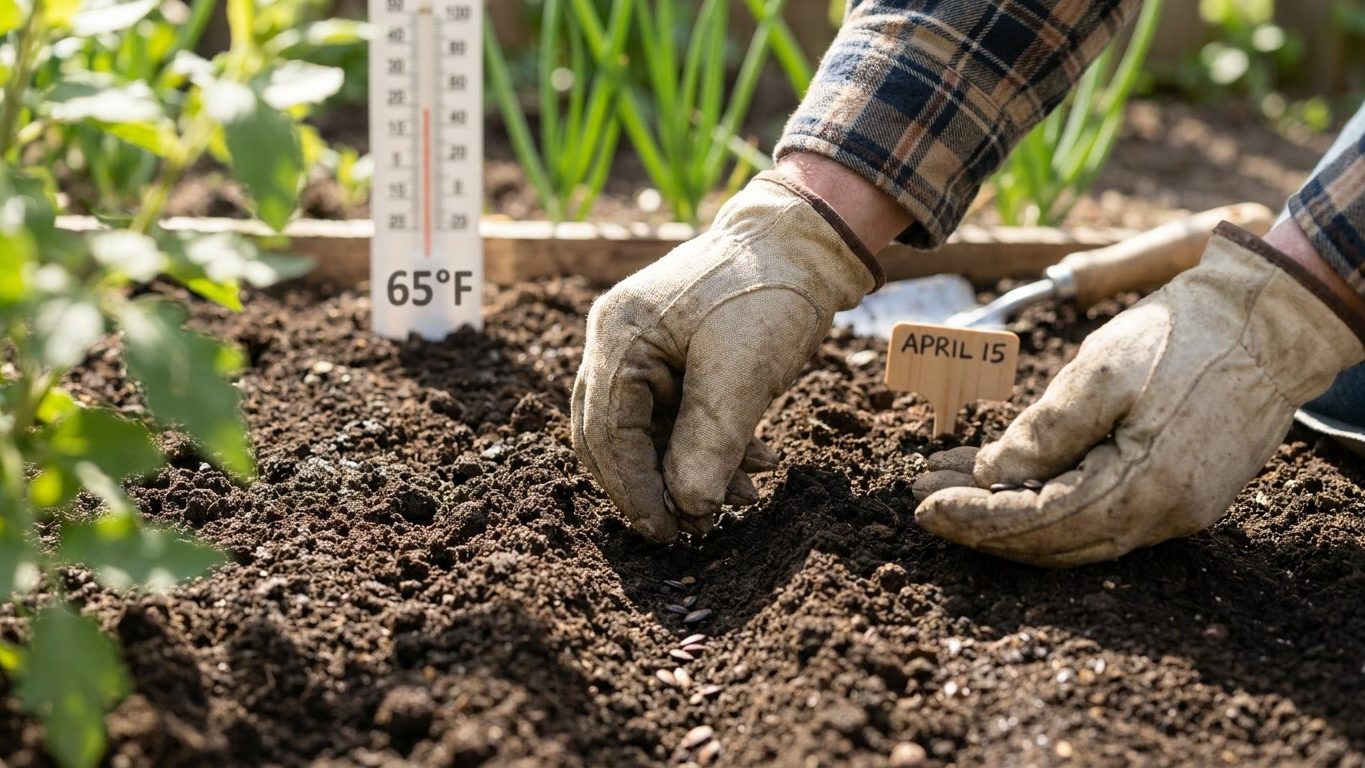

Melon seedlings go into Montana soil once the last spring frost clears, which at the state’s reference station in Billings lands somewhere between April 29 and May 10. But that date only starts the clock. With roughly 144 to 168 days before the first fall frost, and much of that stretch too cool for melon roots to do real work, the planting decision in Montana comes down to starting seed indoors weeks earlier, not dropping seed straight into the ground.
The short answer for Montana
Start melon seed indoors three to four weeks before the last spring frost window opens, then move transplants outside only after that window has passed, so anywhere from late April into mid-May depending on the year. That April 29 to May 10 range is a 30-70% probability band built from 1991-2020 NOAA climate normals at the Billings reference station, meaning it is a statistical spread of when a 32F freeze becomes unlikely, not a guarantee that a given calendar date is frost-free. Some years the last frost comes earlier, some years it lingers past May 10.
On the other end, first fall frost at that same station runs October 1 to October 14. Stack the two windows and the frost-free season stretches from as little as 144 days (last frost May 10, first fall frost October 1) to as much as 168 days (last frost April 29, first fall frost October 14). That sounds workable on paper. Melons typically need 70 to 100 days from transplant to harvest depending on the variety, so the math looks fine. The catch is that the first three or four weeks after that spring frost date, and the last two or three before the fall one, are rarely warm enough for melon roots to grow. Melon seed wants soil in the 70F range to germinate reliably, and Montana’s early-May soil is nowhere close to that most years.
That gap is why transplants, not direct seeding, are the standard approach here. A grower who starts seed indoors under warmth in early April and hardens off seedlings before the outdoor move effectively buys back those cool weeks at the front of the season, which matters more in Montana than in states with a longer natural runway.
The Billings station’s frost dates, heat load, and rainfall are the state’s reference point. It does not have soil temperature data or first-frost figures for other Montana valleys, so treat the answer above as the state’s reference point, not a county-specific instruction.
What will not work here
Long-season melon varieties, the ones bred for 90 to 100-plus days to maturity, are a poor bet against a 144 to 168-day window that already loses several weeks at each end to cold soil. A variety that needs 95 days from transplant, added to the three or four weeks of indoor start time before that, is racing a season that may close before the fruit finishes sizing. That is the single biggest cause of a Montana melon patch that produces plenty of vine and very little fruit.
Direct seeding outdoors before the frost window has closed is the second failure mode. Because the last spring frost date is a probability band, not a fixed line, seed or young seedlings put out in late April can still meet a 32F morning. The caution attached to these frost dates matters here: Billings is one of the milder valleys in the state, and mountain valleys elsewhere in Montana can see frost in any month of the year. A planting plan built only around the Billings dates and applied blindly to a colder valley invites exactly this kind of loss.
Watering on a weekly schedule
Summer rainfall at the reference station totals only about 4.3 inches across June, July, and August, and August itself averages just 0.87 inches, the driest month of the growing season. Meanwhile the station averages 28.3 days a year at or above 90F, which drives evaporation hard during exactly the weeks melon fruit is sizing up. A watering routine built around a fixed weekly schedule, the kind that might get by in a wetter or cooler state, tends to fail here because the demand on hot, dry weeks outpaces what a once-a-week soak delivers, especially on sandy soil that drains fast. Rain that does fall often arrives as a single summer thunderstorm that runs off rather than soaking in, which does little to bank moisture for the days that follow.
Close spacing aimed at managing humidity, a common concern in muggier states, is not the risk here. Montana’s dry summer air lowers fungal disease pressure compared to humid regions. The failure mode in this state runs the other way: not enough consistent water reaching the root zone during the hottest stretch of summer.
What changes across Montana
Montana is not one climate. The USDA Plant Hardiness Zone Map, built on average annual extreme minimum temperatures, places the state anywhere from zone 3a to zone 6a, a wide enough spread that there is no single frost-date or season-length answer that covers the whole state. That range alone should signal that the Billings figures above describe one reference point on a much larger map, not a state-wide constant.
A gardener farther north or at higher elevation than Billings should expect a shorter frost-free window than the 144 to 168 days cited earlier, a later safe date to move transplants outside, and an earlier first fall frost that shrinks the fruit-finishing period. In practice that usually means leaning harder on season-extension tools, starting seed indoors even earlier, using row cover or cold frames to buy extra warm days at both ends, and choosing melon varieties on the shorter end of the maturity range rather than splitting the difference.
A gardener in a warmer, lower-elevation valley closer to Billings’ own conditions has more room to work with, closer to the 168-day end of the range, and can consider varieties with a slightly longer days-to-maturity figure without as much risk.
The USDA Plant Hardiness Zone Map is the tool built for that question, and it is worth checking directly against a home address rather than guessing from a regional average.
Where to check this for your own county
Here is the corrected paragraph:
Montana State University Extension runs the state’s official Cooperative Extension service, and its site is the right next stop for anything more specific than the state-wide figures above. County offices under that extension system publish planting calendars built around local frost data rather than a single reference station, and they track which melon varieties have actually been trialled and performed well in that county’s soil and season.
Two things are worth looking for once there. First, a local planting calendar specific to the county or region, which will reflect actual frost patterns for that area rather than the Billings station. Second, any variety trial results or extension recommendations naming melon cultivars that have been grown and evaluated locally, since a variety that performs well in one Montana valley may struggle in another with a shorter season or heavier soil.
A county-level recommendation will always beat a state-level one, for the simple reason that it accounts for local frost timing, elevation, and soil that a state page can only generalize about. The Billings reference station’s frost dates, heat load, and rainfall make a usable starting point. But it is exactly that, a starting point, and the extension office serving a specific county is where that starting point gets corrected for local reality.
Some gardeners also time melons by the Moon: when to plant watermelon and cantaloupe by the moon, as almanac tradition rather than fact.
Checking this against your own garden
No frost date outranks what a garden itself is showing on a given morning. Three observations, all doable without any equipment beyond a hand and a pair of eyes, tell more about a specific plot’s timing than any regional average.
Soil warmth by feel is the first. Pushing a hand a couple of inches into the bed on a sunny mid-morning and feeling for real warmth, not just surface heat, is a rough but useful check on whether the ground has caught up to the air temperature yet. Cold soil that still feels chilled at that depth means melon roots will sit and sulk even if the calendar says the frost date has passed.
The first flush of male flowers is the second signal. Melon plants typically send out male blossoms before the female flowers that actually set fruit, and their appearance marks a plant that has settled into active growth rather than just surviving a rough transplant shock.
The first true leaves, the leaves that emerge after the initial seed leaves and start to look like the plant’s actual foliage, are the third. Their appearance and vigor say more about whether a specific bed’s combination of soil, sun, and drainage is working than any state-wide planting window can. A seedling with strong true leaves two weeks after transplant is a garden running ahead of the regional average; one still struggling at that point is a garden that needs another look at its own microclimate before the next planting decision gets made.