
Nebraska gardeners should plan on setting melon transplants outside only after both the soil and the calendar cooperate, which usually lands somewhere in the first half of June for most of the state. Direct-seeded melons need to wait even longer for warm soil. The exact date shifts by several weeks depending on where in Nebraska you garden, and that variation is worth understanding before you buy seed.
The short answer for Nebraska
The reference frost dates for this region put the last spring frost between April 12 and April 23, and the first fall frost between October 15 and October 26. Those dates come from the 30-70% freeze probability band recorded at the Omaha-area weather station used for U.S. Climate Normals 1991-2020. That band means something specific: on any given year, there’s a 30% to 70% chance of a 32F freeze occurring on those dates. It is not a guarantee that frost stops on April 23 or starts on October 15. It’s a probability window, and probability cuts both ways.
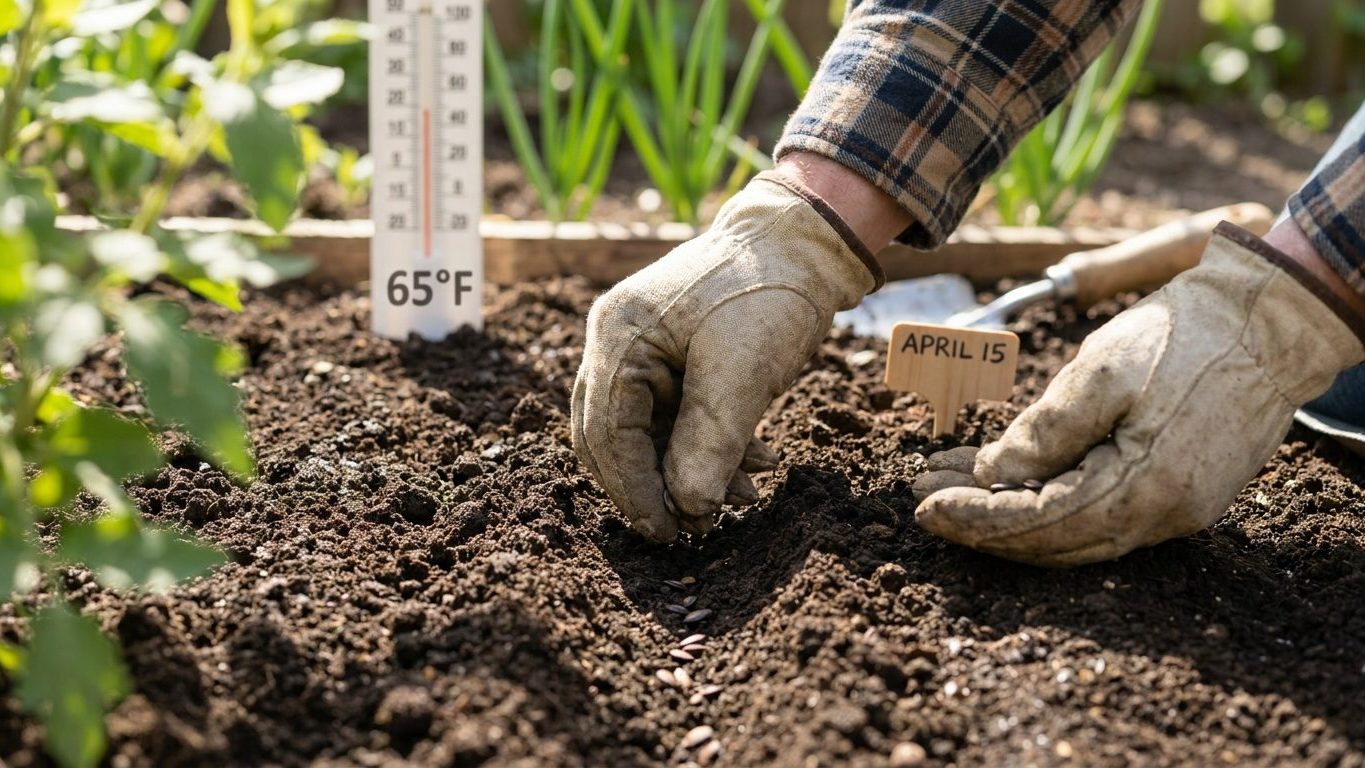
Melon seed germinates poorly in soil below 65F and stalls out entirely below 60F. Since soil temperature lags air temperature by two to three weeks after the last frost date, the practical planting window for Nebraska sits well past that April 12-23 mark. For transplants, most of the state is safer waiting until late May through the first two weeks of June. For direct seeding, push that later still, often into the first or second week of June, once nighttime lows have stopped flirting with the 40s.
Work backward from the fall side too. With first frost arriving as early as October 15 in a below-average year, the frost-free stretch between the two probability bands runs somewhere between roughly 175 and 197 days depending on which end of each band you land on. Melons need 65 to 90 days from transplant to harvest depending on variety, so there’s real room to work with, but not unlimited room. That’s the number that should drive variety selection more than the spring date does.
The 28.1 average days per year reaching 90F or higher, recorded at the same reference station, is good news for melons specifically. Fruit sugar development depends on sustained heat, and Nebraska’s summer heat load is solid enough to ripen most standard melon varieties without a struggle. The catch is that this same heat drives water loss fast, which is the subject of the next section.
What will not work here
Long-season melon varieties bred for 100-plus day maturity are the first thing to cross off the list if you’re gardening in most of Nebraska. Even using the generous end of the frost-free window, an early June planting of a 100-day variety pushes harvest into mid-September at best, and that’s before accounting for a cool, wet spring that delays planting further. A single early frost event inside the 30-70% probability band in mid-October can end the season before slow varieties finish sizing up. Shorter-season melons, in the 65 to 80 day range, give a real cushion against a season that isn’t always as long as the average suggests.
Watering on a weekly schedule is the second failure point. Summer rainfall across June, July and August averages about 12.6 inches at the reference station, but it doesn’t arrive evenly. July, the peak fruiting month for many melon plantings, is the driest of the three at 3.55 inches, compared to 4.44 in June and 4.6 in August. Combine that dry stretch with 28.1 days a year above 90F, and evaporation demand climbs right when rainfall drops. A gardener watering once a week on that schedule is very likely underwatering melons during flowering and fruit set, which is when inconsistent moisture causes blossom drop and misshapen fruit. Sandy soil worsens this further, since it drains within a day of a rain event rather than holding moisture through the dry stretch.
Direct seeding into cold, wet spring soil is the third common failure. Nebraska’s spring often swings between cold snaps and warm spells before settling into reliable warmth, and seed sitting in soil below 65F for more than a few days is prone to rot rather than germination. Rushing seed into the ground right after the April frost dates, rather than waiting for the soil itself to warm, is one of the more common and avoidable mistakes in this climate.
Finally, the summer rain pattern here tends to arrive as thunderstorms rather than steady soaking rain. That means foliage gets wet fast and stays wet for hours, which favors fungal disease on melon leaves if plants are spaced too tightly for airflow. Crowded vines that might get away with it in a drier, breezier climate are more exposed to disease pressure here after a heavy summer storm.
What changes across Nebraska
Nebraska spans USDA Hardiness Zones 4a through 5b, according to the USDA Plant Hardiness Zone Map built on 1991-2020 averages. That’s a wide spread for one state, and it’s built on a single variable: average annual extreme minimum winter temperature. It doesn’t measure summer length directly, but it’s a reasonable stand-in for how much colder and shorter the season runs in one part of the state versus another.
The frost dates and heat figures used above come from a single reference station in the eastern part of the state. Western Nebraska, including the higher-elevation Panhandle, runs colder on both ends of the growing season: last frost tends to arrive later in spring, first frost tends to arrive earlier in fall, and the zone 4a end of the range reflects that reality. Gardeners in that part of the state should treat the reference dates here as optimistic and shift both the spring planting date later and the variety choice toward shorter maturity windows.
Eastern and southeastern Nebraska, closer to the 5b end of the range and closer to the reference station itself, can generally trust the dates given above more directly, though even there, elevation and local terrain (a low frost pocket in a valley, for instance) can shift things by a week or more.
There is no single planting date that fits Nebraska as a whole, and this page can’t tell you which zone applies to your own yard. The USDA Plant Hardiness Zone Map lets you check your zone by ZIP code, and that’s the right next step before locking in a date based on state-level averages alone.
Where to check this for your own county
The University of Nebraska-Lincoln’s extension service is the source that goes past state averages into county-level detail. This page has laid out what the reference-station frost dates, heat load and rainfall normals suggest for Nebraska broadly. A county extension office can tell you what actually happens in your specific soil, elevation and microclimate, which is a different and more useful thing.
Two things are worth looking for once there. First, a local planting calendar, if the county office publishes one, that adjusts the general state guidance for local frost timing rather than relying on a single reference city. Second, and just as valuable, information on which melon varieties have actually been trialled or recommended for growers in that county. Extension offices often track what performs well locally, including which varieties handle the local disease pressure, soil type, and length of reliable warm season without a fight.
A county recommendation beats a state one every time, because it accounts for local elevation, local soil drainage, and local microclimate quirks that a statewide page like this one can’t capture. This page is deliberately the state-level view: useful for understanding the mechanics behind the dates (what a frost probability band means, how heat load and rainfall interact, why zone spread matters) but not a substitute for the county-specific detail your local extension office maintains.
Checking this against your own garden
Every date on this page is a normal built from thirty years of station data, not a forecast for your yard this year. Your own garden’s signals outrank all of it, and three of them are easy to read without any equipment.
Soil warmth by feel is the first and most direct check. Push a bare hand a few inches into the planting bed in mid-morning. If it still feels cold and slightly damp rather than dry and mild, the soil hasn’t reached the 65F-plus range melon seed needs to germinate reliably, regardless of what the frost calendar says. This test alone will save more seed than watching a date on a page.
The first flush of male flowers on any melon plants already growing nearby, or on a test planting from a prior week, tells you the plant has moved past establishment and into its reproductive phase. Male flowers typically open before female flowers by a week or two, so seeing them is an early sign that conditions have turned favorable, not yet a sign that fruit set is imminent.
First true leaves, the second set that emerges after the rounded seed leaves, signal that a seedling has moved past its most fragile stage and started functioning as a real plant. If true leaves are slow to appear or look pale and stunted, that’s a sign the soil is still too cool or too wet for the plant to establish well, even if the calendar says it should be fine. Watching for these three signs together gives a far more reliable read on your specific plot than any regional average can.