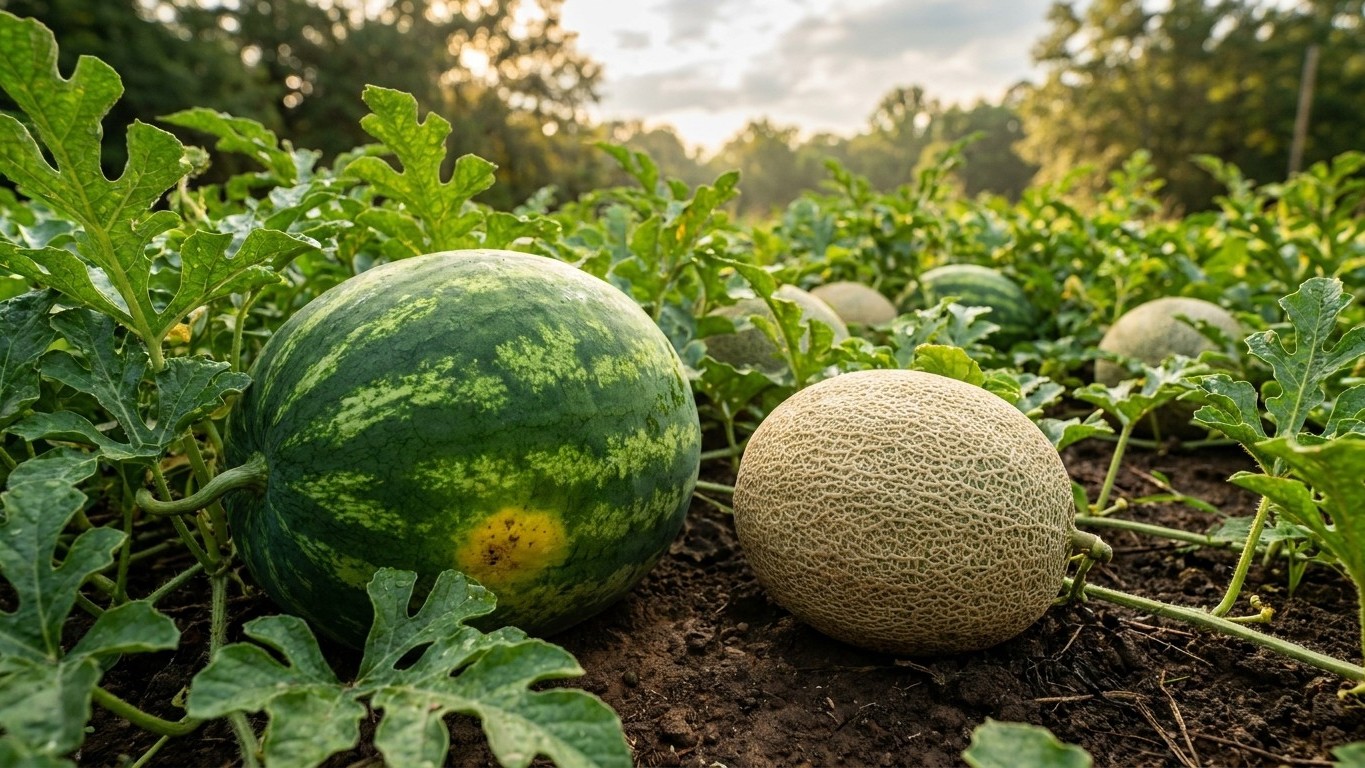

The season length here (roughly 175 to 197 days between the last spring frost and the first fall frost) favors melons that mature fast: short-to-mid season muskmelons and personal-size cantaloupes, harvestable in 75 to 85 days. Full-season 90-to-100-day watermelons are riskier unless started as transplants, because soil warms slowly enough that the calendar window shrinks before the vines ever get moving.
The short answer for Nebraska
Pick melon types by how fast they finish, not by how sweet the catalog photo looks. Nebraska’s frost-free window, measured at the reference station near Omaha, runs from a last spring frost of April 12 to April 23 to a first fall frost of October 15 to October 26 (NOAA NCEI 1991-2020 climate normals, 30-70% freeze probability band). That gives a theoretical growing season of about 175 to 197 days depending on which end of each probability band you plan around.
That sounds generous for melons, which typically need 70 to 100 days from transplant to ripe fruit. But the frost date isn’t the limiting factor here. Melon seed germinates poorly below 60°F soil temperature, and Nebraska soils don’t reliably hit that mark until two to three weeks after the last frost, even in a normal year. So the usable window for direct-seeded melons is shorter than the frost calendar suggests, and that’s what should drive variety choice.
The practical read: muskmelons and cantaloupes in the 75-to-85-day range are the safest bet across most of the state, especially direct-seeded ones. Personal-size or “icebox” watermelons, typically 80 to 85 days, fit the same logic and take up less space while you’re at it. Full-size watermelons that need 90 to 100 days can still work, but they benefit from being started indoors three to four weeks before transplanting, effectively borrowing time the frost dates alone don’t hand you.
Heat isn’t the constraint. The reference station averages 28.1 days a year at 90°F or higher, which is plenty of warmth to push sugar development once vines are established. The bottleneck is the front end of the season: getting seed or transplants into warm enough soil early enough that the melon still has 75-plus warm days ahead of it before frost returns in October.
What will not work here

Long-season heirloom watermelons bred for regions with six or seven warm months, think 100-to-110-day varieties common in the Deep South, are a poor match for a season that tops out around 197 days at the generous end and closer to 175 at the conservative one. Plant those from seed in late May after soil has finally warmed, and they’re often not ripening until well into October, right as the first fall frost probability climbs past 50%.
Dryland melon growing, meaning no supplemental irrigation, is the other common failure point. Summer rainfall at the reference station averages about 12.6 inches across June, July and August, but it isn’t spread evenly. July, the month when melon vines are setting and sizing fruit, averages only 3.55 inches, the driest of the three summer months. Pair that with 28 days a year above 90°F, and evaporation demand during the exact stretch when melons need consistent moisture outpaces what rainfall alone delivers. A garden on sandy soil in a dry July can see vines wilt and fruit abort within days if watering is left to chance.
Overhead watering on a tight schedule causes its own trouble. Melon foliage is prone to powdery mildew, and watering the leaves late in the day, then leaving them wet overnight, sets up the fungus even in a state that isn’t humid. Drip irrigation or soaker hoses at the base of the plant sidestep this, and they also make more efficient use of a rainfall total that’s already working with a deficit in the driest month.
Finally, planting too early to “beat the season” backfires. Melon seed sitting in soil below 60°F doesn’t germinate, it rots. Jumping the gun a full month ahead of the last-frost window doesn’t gain growing time, it just wastes seed and delays the real start by making a second planting necessary.
What changes across Nebraska
Nebraska spans USDA Hardiness Zones 4a to 5b, a range built entirely on average extreme minimum winter temperature (USDA Plant Hardiness Zone Map, 2023, based on 1991-2020 normals). That’s a wide spread for one state, and it matters for melons because the same zone difference that governs winter survival also tracks roughly with how early spring warms up and how long the frost-free window runs.
A garden in the colder end of that range, generally the higher-elevation western Panhandle, should expect a shorter effective season than the reference-station figures used above, which come from a station near Omaha in the warmer, lower-elevation eastern part of the state. That means leaning harder toward the shortest-season varieties, starting transplants indoors as standard practice rather than as insurance, and treating full-size watermelons as a stretch goal rather than a default choice.
A garden in the warmer end, closer to the reference station itself or further south along the Missouri River corridor, has more room to work with. Full-season watermelons become realistic from direct seed in a normal year, and a grower there can afford to experiment with a slower-maturing muskmelon variety without much risk of an unfinished harvest.
What it can say is that the spread is real and worth checking before locking in a variety list, especially for anyone gardening at elevation or well outside the eastern river valleys where the reference data was collected.
Where to check this for your own county
The University of Nebraska-Lincoln Extension service is the source built for exactly this gap between state-level normals and what actually happens in a specific county. Their site is extension.unl.edu, and it’s worth going straight to the county office listings rather than the general horticulture pages, since planting advice is often published at the county or regional level.
Two things are worth hunting for once there. First, a local planting calendar, if the county office publishes one, which will reflect actual local frost data rather than a single reference-station figure. Second, and more useful for melon selection specifically, any list of varieties that have been trialled in that county or region. Extension offices and their master gardener programs frequently run variety trials suited to local soil and microclimate, and those results beat any generic state-wide recommendation, including the one above.
The guidance above works from one reference station’s climate normals and a state-wide hardiness zone range. That’s useful for framing the decision (which melon type is realistic given season length), but it isn’t a substitute for a county-specific number. A grower in the Panhandle and a grower along the Missouri River are both technically in Nebraska, and both would get a slightly wrong answer from data built around the other one’s climate. The extension office is where that gets corrected.
Checking this against your own garden
Every date here is a normal, an average built from three decades of weather that this year may or may not repeat. The garden itself gives better information, and it doesn’t take a thermometer to read it.
Soil warmth by feel is the first check. Press a bare hand into the top two inches of planting bed in mid-morning; if it feels cool rather than merely cool-to-neutral, melon seed sitting in it is more likely to rot than sprout, regardless of what the calendar says about frost risk being past.
The first flush of male flowers is the second signal. Melon vines produce male blossoms well before the female flowers that actually set fruit, and a healthy flush of males is a sign the plant has settled into active growth rather than just surviving a cool stretch. If male flowers are slow to appear even weeks after emergence, the vine is likely running behind the season, not ahead of it.
Third, watch how fast true leaves follow the seedling’s first pair of round cotyledon leaves. Quick true-leaf development points to a warm, well-lit microclimate that can probably support a slightly longer-season variety next time. A sluggish stretch between cotyledons and true leaves is the garden itself saying to stick with the shortest-season melons on the list, whatever the zone map or the reference station happens to suggest.