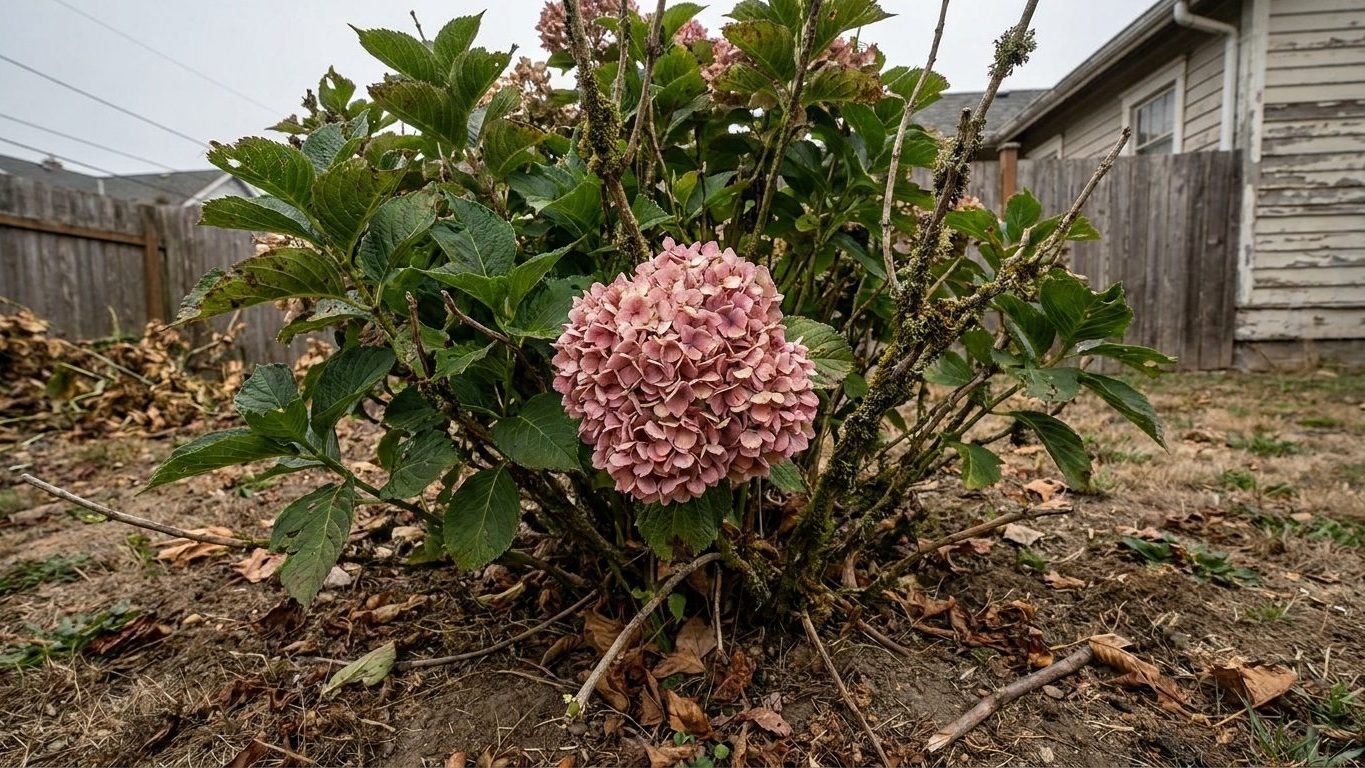

A hydrangea that stays pink, white, or stubbornly the same shade despite your best efforts is almost never sick. Most of the time it’s either the wrong species for a color change in the first place, or the soil chemistry around its roots hasn’t hit the threshold that flips the flower pigment. Neither problem threatens the plant’s health.
What you are looking at
Start with the flower itself, not the leaves. If the blooms are round mopheads or flat lacecaps sitting on woody stems, and they’re some shade of pink, white, or a muddy in-between color when you were expecting blue, you’re looking at a bigleaf hydrangea (H. macrophylla) or a mountain hydrangea (H. serrata). These are the only two types in the genus where flower color answers to soil chemistry at all.
If instead you’re staring at cone-shaped panicles, loose airy clusters that age from white to pink to tan, or flowers on a climbing vine clinging to a wall, you have a different plant entirely, and no amount of soil work will turn it blue. This matters because a huge share of “why won’t my hydrangea turn blue” frustration traces back to owning the wrong species for the job.
| Type | Flower shape | Does color respond to pH? |
|---|---|---|
| Bigleaf / mophead / lacecap (H. macrophylla) | Round or flat clusters | Yes |
| Mountain (H. serrata) | Lacecap, smaller | Yes |
| Panicle / peegee (H. paniculata) | Cone-shaped | No |
| Smooth (H. arborescens, incl. Annabelle) | Round, papery | No |
| Oakleaf (H. quercifolia) | Elongated panicle | No |
| Climbing (H. petiolaris) | Flat lacecap on vine | No |
What you’re not looking at is disease. Leaf spot, bacterial wilt, and powdery mildew show up as discoloration and lesions on foliage, not as flowers refusing to shift color. If the leaves look clean and the plant is otherwise growing normally, the color issue is chemistry, not pathology.
What actually causes it
The common explanation is that soil pH directly controls hydrangea color. That’s close but not quite right, and the distinction matters if you want a fix that actually works. Flowers turn blue below about pH 5.5, pink above about pH 6.5, and land somewhere purple in between on bigleaf and mountain types. But pH is really a proxy. What the plant needs to make blue pigment is available aluminum in the soil, and acidic conditions are what release aluminum into a form roots can absorb. Alkaline soil locks that aluminum up chemically even if it’s present in the ground.
Aluminum sulfate is the product that reliably acidifies soil and frees up aluminum at the same time, which is why it’s the standard treatment for pushing color toward blue. Garden lime does the opposite: it raises pH and pushes color toward pink by making aluminum less available.
There’s a second cause that gets overlooked entirely: fertilizer choice. High-phosphorus fertilizer binds aluminum in the soil, making it unavailable to the plant regardless of pH. A gardener can have acidic soil, apply aluminum sulfate faithfully, and still watch blooms drift pink because a bloom-booster fertilizer with heavy phosphorus content is quietly canceling the effort. To tell the causes apart: test soil pH first. If pH reads acidic and color still won’t shift, check what you’ve been feeding the plant before assuming the soil treatment failed.
What to do now
Flowers already open this season are essentially locked in. Bigleaf and mountain hydrangeas don’t recolor blooms mid-display the way a chemical indicator strip changes on contact; the pigment shift happens as buds develop and take up aluminum while forming, not after the flower is fully out. If this year’s blooms are already pink, they’ll stay pink. That’s not a failure on your part, it’s just the biology.
What’s worth doing now is testing soil pH with a basic soil test, since guessing wastes a season. If the reading comes back above 6.5 and you want blue, working in aluminum sulfate now starts shifting the soil chemistry so that next year’s buds, which form later in the season, develop in more favorable conditions. If you’ve already been applying aluminum sulfate and still see pink, stop and check your fertilizer label for phosphorus content before adding more amendment.
If you’ve discovered your plant is actually a panicle, smooth, oakleaf, or climbing hydrangea, there’s genuinely nothing to do here. These flowers age through white, cream, pink, or green tones on their own schedule as the season progresses, completely independent of soil pH. Redirecting effort toward soil acidification on one of these types is effort spent on a plant that was never going to respond.
What does not work
Coffee grounds and citrus peel scattered around the base are the most common home remedy, and they’re widely believed to work because the logic sounds reasonable: coffee is acidic, hydrangeas like acid soil, therefore coffee should turn flowers blue. In practice, the pH shift from kitchen scraps is too small and too temporary to move the needle. What the plant actually needs is available aluminum released by sustained acidity, not a brief dip in pH from decomposing grounds.
Adding aluminum sulfate without first checking soil pH is another common misstep. If the surrounding soil is naturally alkaline, above pH 6.5, the amendment gets bound up chemically before the plant can use it. You can add product after product and see no change, because the aluminum is present but the soil chemistry won’t release it until the pH itself comes down.
Adding lime to soil that’s already neutral or alkaline, hoping to “balance” it, does the opposite of what most gardeners intend when their real goal is blue. Lime raises pH and pushes color toward pink, so applying it while chasing blue flowers actively works against the goal.
And no soil treatment turns a panicle, smooth, oakleaf, or climbing hydrangea blue, ever, at any pH. These species simply don’t carry the pigment pathway that responds to aluminum uptake.
Preventing it next time
The single most important step is confirming the species before doing anything to the soil. Every other piece of advice depends on knowing whether you’re growing a bigleaf or mountain hydrangea, where color is soil-driven, or one of the other types, where it isn’t.
After that, test pH before amending rather than applying aluminum sulfate or lime on a guess. Since bigleaf hydrangeas are shallow-rooted, a layer of mulch helps keep the root zone at a stable moisture and temperature, which makes pH amendments hold more consistently rather than washing through erratically. Choose a balanced or low-phosphorus fertilizer if color is a priority, since high-phosphorus formulas undercut aluminum uptake no matter how carefully you’ve managed pH. Because bloom color responds to conditions during bud formation rather than after the flower opens, treat pH adjustments as a project for next year’s buds, not this year’s display, and expect the shift to take a full growing season to show clearly.
Common questions
How long does it take a hydrangea to change color after treatment?
Color develops as buds form and take up aluminum, not after flowers open, so a soil amendment applied this year typically shows its effect in next season’s blooms rather than the current display.
Can I turn a white hydrangea blue?
Only if it’s a bigleaf or mountain hydrangea; white varieties of these types can sometimes shift with aluminum sulfate and low pH, but panicle, smooth, oakleaf, and climbing hydrangeas that bloom white will never turn blue regardless of soil treatment.
Will an Annabelle hydrangea ever turn blue?
No. Annabelle is a smooth hydrangea (H. arborescens), and this species doesn’t respond to soil pH or aluminum availability at all; its color changes are just the natural aging from green to white and back to green.
Is aluminum sulfate or a bigleaf hydrangea harmful to pets?
Bigleaf hydrangea is documented as toxic if eaten in large quantities, causing nausea, stomach pain, vomiting, and sweating in pets and people, due to compounds called hydracyanosides found in the bark, flowers, leaves, and stems. It’s worth keeping curious dogs and cats from grazing on it, though serious poisoning requires eating a substantial amount.