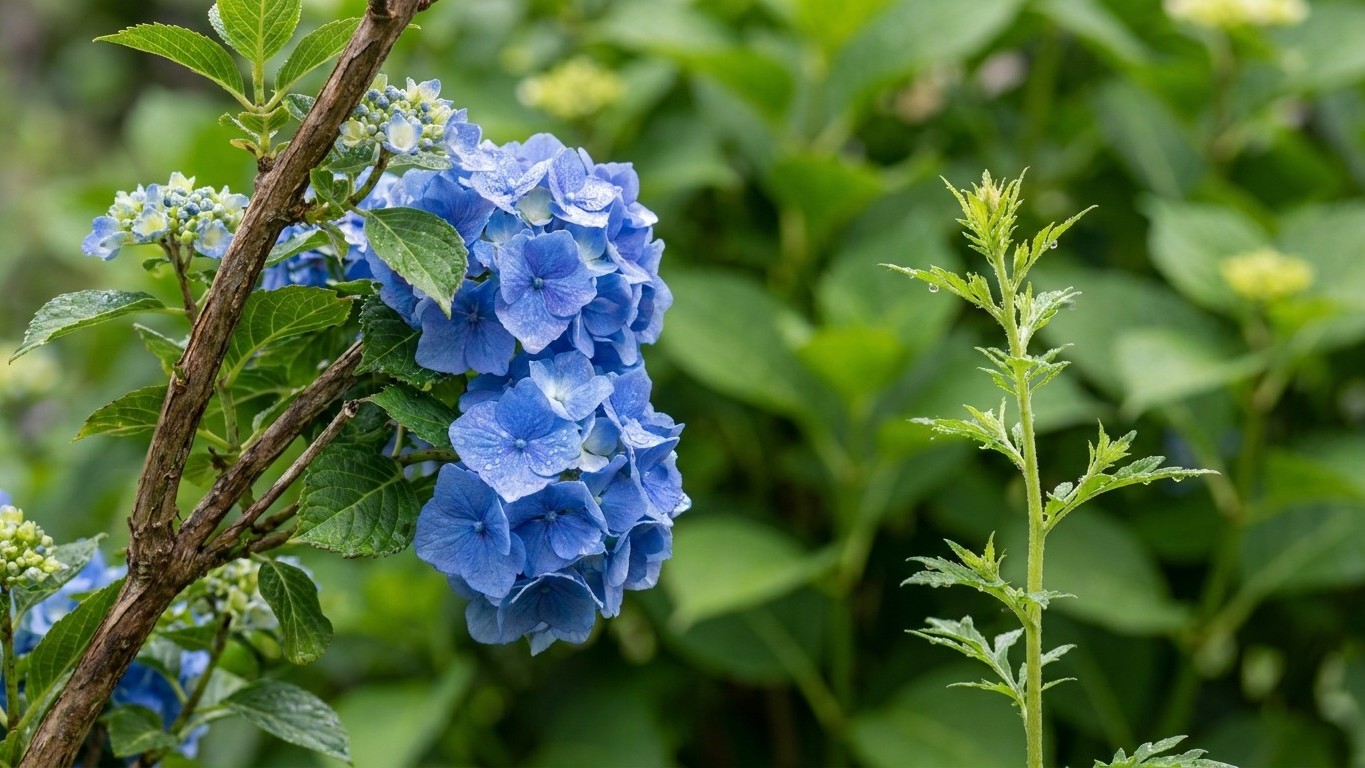

Hydrangeas turn pink in Utah because the soil is alkaline. At a high pH, the aluminum that makes blue pigment stays locked in the ground, and the plant can’t absorb it. Blue is possible, but only if you change the chemistry around the roots and keep it changed. Only bigleaf and mountain hydrangeas respond. The full routine is in the guide to growing hydrangeas in Utah. What follows is only about color.
What this comes down to in Utah

In Salt Lake City, the reference city, the last spring freeze typically falls in April and the first fall freeze between mid-October and early November (exact dates depend on the freeze threshold and data set used), so a bigleaf hydrangea has the growing season to take up whatever the soil offers. Utah’s alkaline ground offers very little aluminum, and the flowers come out pink.
Why are hydrangeas pink in Utah?
Hydrangea color is a chemistry result. Bigleaf (Hydrangea macrophylla) and mountain (Hydrangea serrata) hydrangeas make a pigment that looks blue when aluminum is present in the sepals and pink when it is not. Aluminum is abundant in most soils, but it dissolves only when the soil is acidic. Across much of Utah, soils are rich in calcium carbonate (lime) and sit well above neutral. The aluminum stays bound to soil particles, and the plant makes pink.
The usual thresholds hold here. Blue flowers need an acidic soil. Pink shows up in less acidic soil. Between the two you get purple, or a mix of pink and blue on one shrub. Most Utah garden soil sits above both ranges, so pink is the default and blue is a project.
Can you really turn them blue in Utah?
Yes, but lime-rich soil fights back. It buffers against change, which means a single dose of aluminum sulfate gives a short-lived shift. Plants in large containers with an acidic potting mix are a more reliable route to blue. In-ground plants need repeated, patient treatment. Hard, alkaline tap water can push the pH back up over time as you irrigate.
Which hydrangeas don’t respond to soil pH?
Panicle, smooth, and oakleaf hydrangeas ignore soil pH completely. White-flowered bigleafs hold their color regardless of pH, though the blooms may blush pink as they age. If you want blue, you need a pink or blue bigleaf or mountain type.
Working it out for your own garden
How do you predict when and what color your blooms will be?
Start with timing. Bigleaf hydrangeas break bud in spring as the weather warms, and a late freeze can damage the new growth. Flowers typically open after budbreak. Your own bloom window is a range of weeks, and it slides later at higher, colder sites. Bigleafs that bloom on old wood also depend on buds surviving winter, so a hard cold snap can erase the flowers before color matters. That’s covered in the piece on winter protection for hydrangeas, and a wrong pruning cut can remove those same buds, which is the subject of when to prune hydrangeas in Utah.
Color follows a similar logic, with soil chemistry doing the steering. The plant takes up aluminum while it grows and builds the flower, so the work has to happen during those months, not after the buds have opened. Treatments applied in early spring, as growth starts, have the best chance. Repeat them through early summer if your soil test says the pH is drifting back up.
What is the step-by-step method for turning pink to blue?
First, test the soil pH. Second, compare the reading to the blue range of roughly 5.0 to 5.5. Third, pick the amendment. Aluminum sulfate acts fast and also supplies aluminum, but it can burn roots if overapplied, so follow the label and water it in well. Elemental sulfur works slowly and needs time to move the pH. Fourth, retest after the soil has had time to change. Expect the first year to give purple or mixed blooms, with the cleaner shift showing later.
Avoid high-phosphorus fertilizer, which ties up aluminum. Reblooming bigleafs that flower on new wood follow the same pH rule. A bloom flush after midsummer shows the current soil conditions.
What changes across the state
Salt Lake City sits in a mild valley. Most of Utah is higher and colder, and southern Utah is warmer, so the frost window above shifts in both directions across the state. On the USDA Plant Hardiness Zone Map, which rests on one variable (the average annual extreme minimum temperature), Utah spans zones 4a to 9a. That is a wide gap for one state.
Elevation plays a large part. Higher sites generally have a shorter season, later budbreak, and a later bloom window. In cold mountain valleys, a bigleaf may spend the whole summer building leaves and fall frost may arrive before the flowers are fully open. Warm low-elevation sites in the south have a longer window but also hotter, drier conditions and often alkaline soils, where blue takes real effort.
Soil shifts with the landscape. Valley floors with calcareous, desert-origin soil lean strongly alkaline. Pockets under conifers or in mountain soils weathered from certain rock types may run less alkaline, which makes blue easier. The Great Salt Lake softens temperatures a little along the Wasatch Front, but it does nothing for soil chemistry. Irrigation matters too. Many Utah water supplies are hard, and a watering habit can undo an amendment as steadily as the soil does.
The mistakes this state punishes

A common error is treating the soil once and expecting a permanent result. Utah’s lime buffers hard, so a single spring application of aluminum sulfate fades. Plan on repeat treatments sized to a soil test, or move the plant into a large container with an acidic mix.
Dumping aluminum sulfate on dry soil or in heavy doses is the second error. It burns roots. Water the bed first, apply at label rate, and water in again. A third: amending right at the plant when the surrounding bed is limy, since roots spread well past the drip line and reach alkaline soil beyond your treated zone. Raised beds or large containers filled with acidic, peat-based mix keep the root zone under control.
Gardeners also overlook hidden lime sources. Concrete foundations, stucco, and masonry walls leach lime into the adjacent soil, and wood ash raises pH. A hydrangea planted along a foundation may stay stubbornly pink. Plant a few feet out where possible.
Timing errors cost a season. Amending after the buds are formed or open is too late for this year’s color. Apply as growth begins, once the soil has warmed beyond a brief early thaw, and expect results at the next flush. Also, choosing a late-blooming bigleaf at a cold, high site risks flowers that never finish before fall freeze. Match the plant’s bloom window to your local season before worrying about color.
Checking this against your county
A state-wide number is a starting point. Utah’s soil, water, and frost dates change from one county to the next, sometimes from one yard to the next. Utah State University Extension has county offices that can point you to soil testing and local advice. They can tell you what your soil pH is likely to be and how your water supply behaves. Pair that with our guide to growing hydrangeas in Utah for planting and care details.
Common questions
Do I have to change my soil to get blue hydrangeas?
Yes, if you want blue from a bigleaf or mountain hydrangea in alkaline soil. The plant cannot make blue without available aluminum. Container growing in acidic mix is the easiest way to do it.
Will coffee grounds or vinegar turn my hydrangeas blue?
Neither does much. Used coffee grounds are close to neutral and barely move pH. Vinegar in water gives a brief dip that the lime in the soil erases quickly. Aluminum sulfate or elemental sulfur, guided by a soil test, are the dependable choices.
Why did my blue hydrangea turn pink again?
The soil pH rose back up. Hard irrigation water, lime from nearby concrete, or simply too long between treatments will do it. Retest the soil and repeat the amendment as growth starts.
Is pink a problem or a sign of unhealthy plants?
Pink is a normal color response, not a sign of poor health. A pink bigleaf with green leaves and steady growth is a healthy plant. Many Utah gardeners simply embrace pink and save their effort for things soil can’t fix.