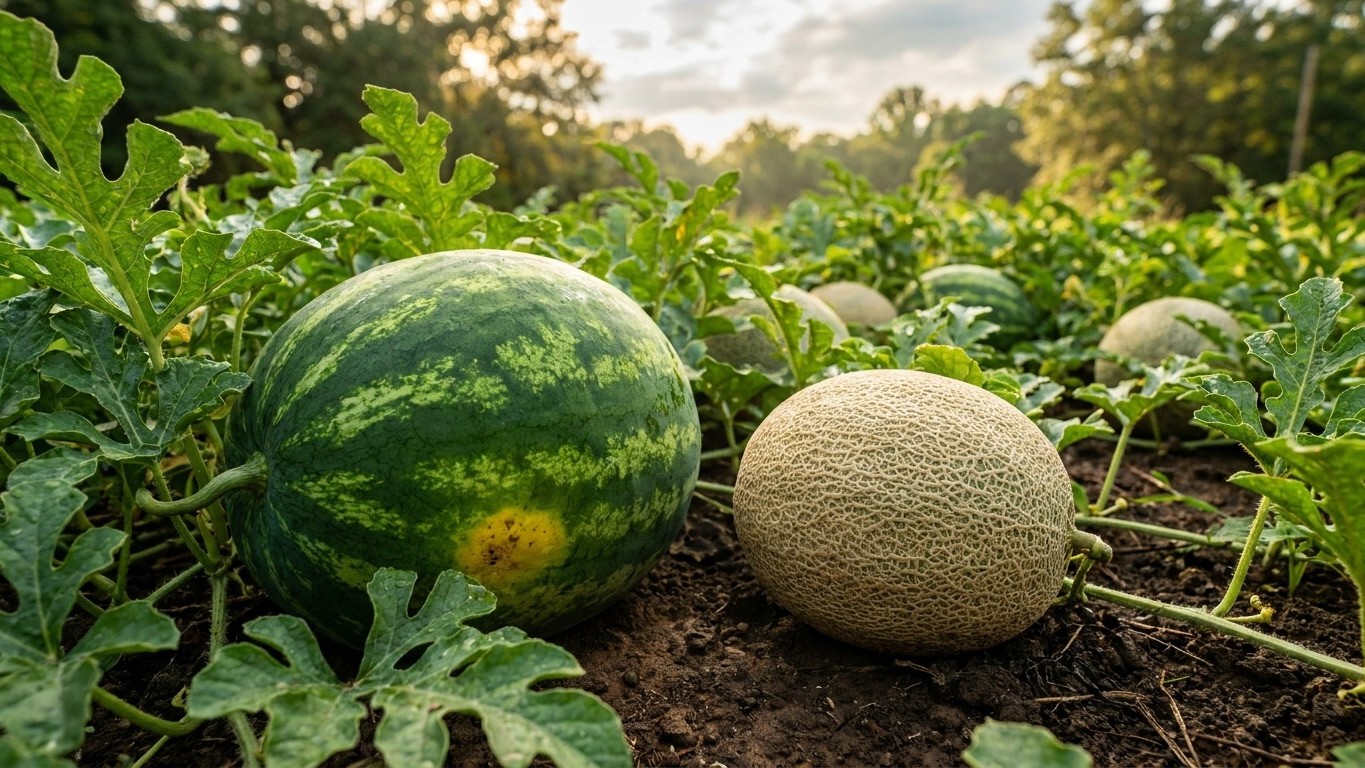

New Mexico’s frost-free window, measured at the reference station, runs somewhere between 200 and 223 days a year, which is more than enough time for almost any melon on the market. The variety that actually struggles here isn’t the one that needs a long season. It’s the one that can’t handle 42 days a year above 90°F on roughly 3.5 inches of summer rain.
The short answer for New Mexico
Start with the season math. Last spring frost at the reference station falls between March 31 and April 12, and first fall frost lands between October 29 and November 9. That gives a frost-free stretch of 200 to 223 days depending on the year, which covers even the slowest 100-day watermelon with room to spare. So the decision isn’t really about days to maturity. It’s about which type tolerates heat load and irrigation reality better than the others.
Muskmelons and cantaloupes bred for arid, high-heat growing regions are the safest starting point. They set fruit reliably under intense midday sun, and their moderate vine size makes drip irrigation easier to manage on a fixed schedule. Watermelon does fine with the heat itself, sometimes better than any other melon type, but it demands more total water across the season, and with June averaging only 0.57 inches of rain, that water has to come from somewhere other than the sky.
Honeydew and casaba sit at the riskier end. Both want a steadier, more even moisture supply to build sugar properly, and an inconsistent irrigation routine during a 90°F stretch tends to produce flat, underripe fruit rather than a failed vine outright. Short-season, personal-size melons (the smaller cantaloupe types that finish in 75 to 80 days) hedge against a rough year by getting off the vine before the hottest weeks pile up.
| Melon type | Season length needed | Heat tolerance | Water demand |
|---|---|---|---|
| Cantaloupe/muskmelon (desert-adapted) | Moderate (75-90 days) | High | Moderate, steady |
| Watermelon | Long (80-100+ days) | High | High, needs volume |
| Honeydew | Moderate to long | Moderate | Steady, low tolerance for gaps |
| Casaba/Crenshaw | Long | Moderate | Steady, sensitive to swings |
None of that is a season-length problem. New Mexico has the days. What it doesn’t hand a gardener for free is water on a schedule the melon actually wants.
What will not work here
The clearest failure mode isn’t frost. It’s a melon that needs consistent, even soil moisture getting watered once a week through a summer averaging 42.5 days at or above 90°F. Vines can survive a dry week, but flavor and fruit set don’t. Blossoms drop, fruit stalls at half size, or sugar never develops, and the gardener blames the variety when the actual cause was a watering calendar built for a wetter climate.
Varieties bred and trialed in humid growing regions, the kind that tolerate close spacing and rely on regular rainfall to fill in for irrigation, tend to disappoint here. Not because New Mexico’s dry air causes disease the way humidity does elsewhere, but because those varieties were never selected against a summer this dry. June’s 0.57 inches of rain is the driest month of the year at the reference station, and a vine expecting even light rainfall through that stretch gets none of it.
Melons that need a long, mild finish
Some late-season honeydew and casaba types want cooler evening temperatures to slow ripening and concentrate sugar in the final two or three weeks. In the parts of New Mexico that sit at lower elevation, where daytime heat stacks up through most of the 90-day-plus stretch, that cool finish doesn’t reliably show up until frost is close behind it. The fruit either rushes to ripen under heat stress, losing flavor, or runs out of season before it’s ready.
Overhead sprinkler irrigation on a once-weekly cycle is its own kind of failure, independent of variety. It wets foliage without delivering enough volume to the root zone during a 90°F stretch, and it does that on a schedule that doesn’t match how fast a sandy or fast-draining New Mexico soil loses moisture. Melons on a weekly overhead schedule in this climate tend to produce small, bitter fruit regardless of which seed packet was planted. Drip irrigation, run more often and in smaller amounts, matches this climate’s rainfall pattern far better than a weekly soak ever will.
What changes across New Mexico
New Mexico spans USDA hardiness zones 4b through 9a, under the USDA Plant Hardiness Zone Map system, which is built entirely on average extreme minimum winter temperature. That’s not a small spread. It’s the difference between a high mountain valley and a low desert basin, and it means there is no single melon recommendation that fits the whole state evenly.
In the northern and higher-elevation parts of that range, the effective growing season runs shorter and cooler than the reference-station numbers suggest, and the 42.5 annual days above 90°F common at lower elevations simply don’t happen as often. A gardener working that end of the range does better leaning toward the moderate, 75 to 90 day cantaloupe types rather than a full-season watermelon that needs every one of those 200-plus days to finish.
Toward the southern and lower-elevation end, both frost dates likely arrive closer to the earlier and later extremes of the ranges given for the reference station, stretching the usable season toward that 223-day ceiling, and heat load runs higher still. That’s where full-season watermelon and heat-driving muskmelon varieties have the room and the warmth to perform, provided the irrigation plan accounts for the added heat stress.
None of this tells an individual reader which zone applies to their own yard, and this page won’t guess. The zone spread across the state is wide enough that the only reliable move is checking the USDA Plant Hardiness Zone Map directly for a specific address before picking a melon type based on elevation assumptions.
Where to check this for your own county
This page describes New Mexico at the state level, using a single reference station’s frost dates and heat normals. That’s useful for understanding the pattern, but it’s not a substitute for a county-level recommendation, and a county recommendation will beat this page every time. The right next stop is New Mexico State University’s Cooperative Extension Service.
Two things are worth looking for there specifically. First, a county-level planting calendar, which adjusts for the local frost pattern rather than the airport-station numbers cited on this page, particularly if the county in question sits well away from the reference city or at meaningfully different elevation. Second, any variety trial results NMSU or a county extension agent has published for melons grown in that specific county, since those trials reflect real local heat, soil, and water conditions rather than a statewide average.
County extension offices also tend to know which melon varieties local growers have had consistent luck with over multiple seasons, information that doesn’t show up in climate normals at all. That’s the kind of detail worth a phone call or an email before committing a season’s water budget to a variety chosen from a seed catalog alone.
Checking this against your own garden
Every date and heat figure on this page describes a reference station, not a specific backyard, so the most reliable information a gardener has is what’s actually happening in their own soil. Three things are worth watching before trusting any calendar over direct observation.
- Soil warmth by feel: melon seed germinates poorly in cold soil regardless of the calendar date; if the soil still feels cool to the hand a few inches down, germination will be slow and uneven even after the average last frost date has passed.
- The first flush of male flowers: melons produce male blossoms before female ones, and a garden showing plenty of male flowers with no female flowers yet is simply not ready to set fruit, no matter how warm the air feels.
- The first true leaves: the seedling leaves that follow the initial pair are the plant’s own signal that it’s established and growing steadily rather than sitting stalled; slow true-leaf development after transplant usually points to soil that’s still colder or wetter than it looks on the surface.
A garden running warmer or drier than the reference-station numbers will show all three signs earlier than the state averages suggest. One running cooler, often the case at higher elevation or in a low spot that holds cold air, will show them later. Either way, the plant is giving a more accurate answer than any date range ever can.