
Most New Mexico gardens are ready for melon seed or transplants somewhere between late April and mid-May, but the honest answer depends on your elevation, your soil, and how much heat and water your particular patch gets through the summer. The state’s range of climates, from the low desert around Las Cruces to the high plains near Santa Fe, means no single calendar date works for the whole territory.
When the soil is warm enough in New Mexico
The reference station for New Mexico’s climate normals, the Albuquerque airport (station USW00023050), reports a last spring frost falling between March 31 and April 12, based on NOAA’s 1991-2020 Climate Normals and their 32°F freeze-probability band. That’s a probability range, not a promise: it marks the window where frost odds drop from 70% to 30%, meaning a frost after April 12 still happens some years.
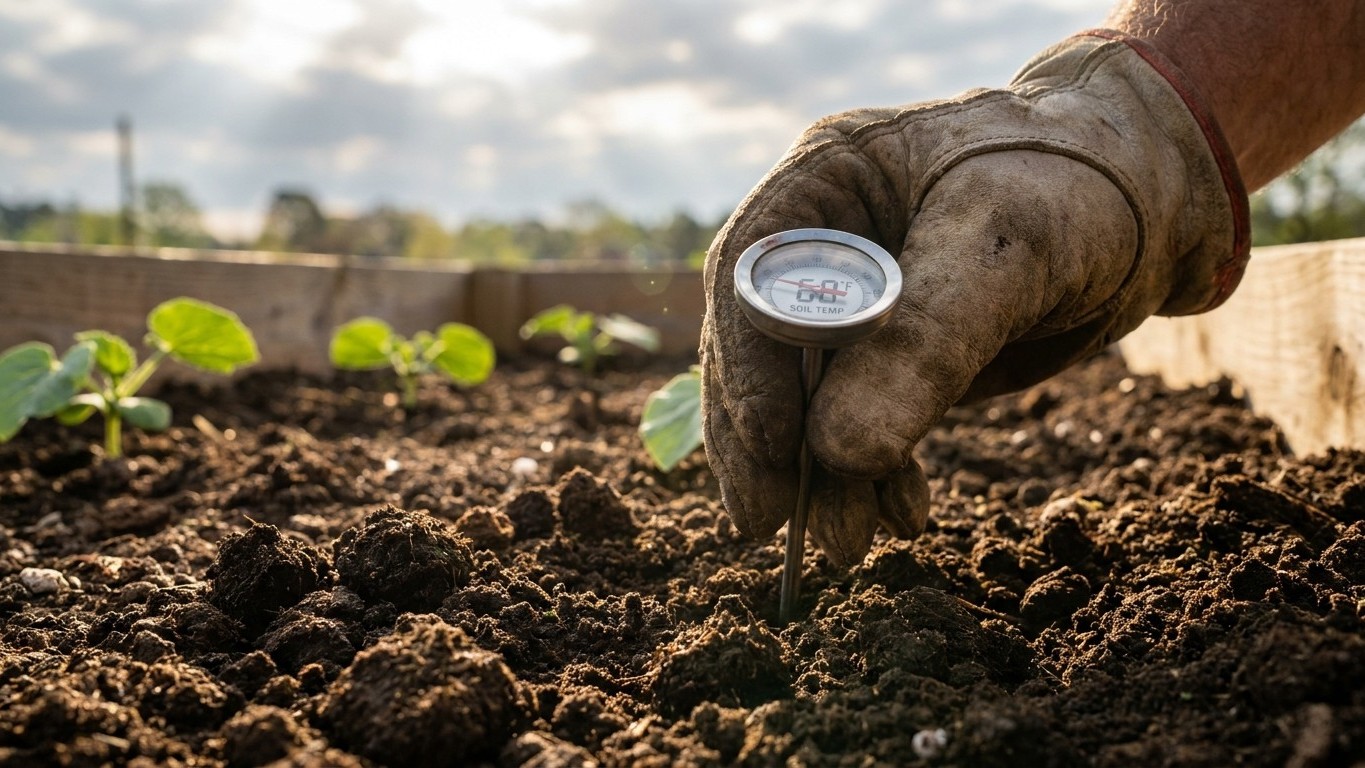
Frost dates matter, but they’re a proxy for the number melons actually care about, which is soil temperature. A melon seed dropped into cold ground will sit and sulk, or rot, even if the air hasn’t dipped below freezing in weeks. Soil at 4 inches deep needs to hold consistently in the mid-60s or warmer before melon roots do anything useful, and bare soil in New Mexico’s high desert can lag well behind the air temperature after a late frost, especially at elevation where nights stay cool into May.
Why the airport date isn’t your garden’s date
Suburban and rural yards typically see their last spring frost later than an airport station, sometimes by one to two weeks, and more the higher you sit above sea level. Albuquerque’s own metro area varies by a few hundred feet of elevation depending on the neighborhood, and a garden in the foothills will lag well behind one down in the valley. If you garden anywhere outside the Rio Grande valley corridor, treat the airport figure as a starting reference and check your own county’s frost history before committing seed to ground.
Practical technique matters more here than picking a magic date. Black plastic mulch, row cover removed during the day, or simply waiting an extra week after the “safe” date all warm soil faster than the calendar alone. Gardeners in the cooler northern counties or at higher elevation often start melons indoors under cover and transplant once nighttime lows stabilize, rather than direct-seeding into ground that’s still cold four inches down.
New Mexico spans USDA Hardiness Zones 4b through 9a on the 2023 Plant Hardiness Zone Map, itself built on the average annual extreme minimum winter temperature rather than spring warming. That range says more about which perennials survive winter than When to Plant Melons, but it’s a fair shorthand for how differently the northern high country and the southern desert behave. Use the Albuquerque dates as your anchor point and adjust toward “later” the further north or higher you garden.
How long the season lasts here
Pairing the two frost dates from the Albuquerque reference station gives a frost-free window of roughly 200 to 223 days, depending on which edge of each probability band applies to your particular year: from a last spring frost as early as March 31 to a first fall frost as late as November 9 on the generous end, or from April 12 to October 29 on the tighter end. Either way, that’s a long season by national standards, and it changes what’s worth attempting.
A window that long means most New Mexico gardeners aren’t racing the clock with a single sowing. There’s real room for a second planting, especially in the southern and central valleys where the frost-free stretch runs closest to the 223-day figure. A first sowing that fails to germinate, gets hit by hail, or simply underperforms doesn’t have to be the only shot at a melon harvest this year.
That extra margin also changes whether starting seed indoors and transplanting is worth the trouble. In a short-season territory, transplants buy weeks that matter. Here, with 200-plus days on the table, direct-seeding once soil has warmed is a perfectly reasonable choice for most of the state, and it avoids the root disturbance melons dislike. Transplants still make sense at higher, cooler elevations where the effective season runs shorter than the state average, or for gardeners who want an earlier first harvest and are willing to raise seedlings indoors for three to four weeks before the soil is ready outside.
For a full walk-through of staggering plantings to spread harvest and hedge against a failed first sowing, the site’s succession sowing guide lays out timing intervals in more detail than fits here.
Heat and water in New Mexico
Albuquerque’s reference station logs an average of 42.5 days a year at or above 90°F. That’s a substantial heat load, and it’s the number that drives water demand and heat stress in a melon patch far more than any single hot afternoon does. Melons are warmth accumulators: they respond to total heat units over the season more than to any particular calendar date, so a territory racking up over 40 days above 90°F is one where the vines will grow fast, but where soil moisture disappears fast too.
Summer rainfall at the same station runs about 3.5 inches total across June, July, and August, against 8.8 inches for the full year. That’s a small fraction of annual precipitation falling during the exact months melons are sizing fruit and drawing hardest on soil moisture, and it doesn’t arrive evenly.
The month-by-month gap
| Month | Average rainfall |
|---|---|
| June | 0.57 inches |
| July | 1.64 inches |
| August | 1.31 inches |
June, right as vines are establishing and starting to set fruit, is the driest of the three by a wide margin. July and August pick up with monsoon moisture, but that rain typically arrives as short, intense thunderstorms rather than steady soaking rain, which means a lot of it runs off a hard summer surface instead of reaching root depth. Combined with 42.5 days of 90°F-plus heat pulling moisture out of the soil through evaporation, this is a territory where irrigation, not rainfall, decides how large the fruit gets.
The final two to three weeks before harvest matter even more than the rest of the season, because that’s when sugar accumulates in the fruit. Inconsistent watering during that stretch, whether from a surprise monsoon downpour after weeks of dry heat, or from a gardener easing off irrigation too early, tends to produce melons that are large but bland, or that split from a sudden uptake of water. Steady, deliberate watering through that last stretch, rather than either drought or a deluge, is what separates a sweet melon from a watery one in a climate built like this one.
Soil type changes all of this further. Sandy soil common in much of the Rio Grande valley drains that occasional monsoon rain within a day, meaning a garden there can need water every other day even in a “wet” July. Heavier clay soil holds moisture longer but can crust and shed a hard thunderstorm rather than absorbing it. A rain gauge on your own plot, tracked over a season, tells you more about your actual watering rhythm than any regional average.
Which melons suit New Mexico
With a frost-free window running 200 days or more at the reference station, New Mexico gardeners aren’t limited to only the earliest-maturing melon types the way a short-season northern state might be. There’s enough season length here to grow types that need a longer stretch to ripen, provided the heat and water demands above are met.
What the state’s climate does push toward is choosing by heat tolerance and airflow rather than by speed. With over 42 days a year above 90°F, types bred or traditionally grown with some resilience to sustained heat, and given room for air to move around the foliage, tend to hold up better against the stress that dense, humid-feeling canopies suffer in a heat wave. Providing afternoon shade at the root zone, through mulch or careful spacing, matters more here than in a milder climate, since root temperatures under bare, sun-baked soil can climb high enough to stress the plant even when the air temperature reads normal for the season.
Because summer moisture arrives unevenly, as brief monsoon bursts rather than steady rain, disease pressure from powdery mildew or other fungal issues tends to spike specifically after those humid bursts rather than staying constant through the summer. Choosing types with some documented resistance to the fungal issues common in your specific county, and watering at the base rather than overhead during humid stretches, addresses this more directly than any calendar adjustment.
None of that is a recommendation for a specific variety, and this page won’t offer one. New Mexico’s growing conditions shift enormously between the low desert around Las Cruces, the Rio Grande valley through Albuquerque, and the higher, cooler counties to the north, and a variety that thrives in one performs poorly in another. New Mexico State University’s Cooperative Extension Service, at aces.nmsu.edu, publishes the variety trial results and county-specific guidance that actually reflect what grows well where you live. That’s the right next step for turning “melon type” into an actual seed packet.