
Plant Melons in New Mexico once your soil has warmed and the frost risk has genuinely passed, not on a fixed calendar date. At the state’s reference weather station, that window falls after roughly April 12, with harvest needing to wrap up before the first fall frost lands sometime between October 29 and November 9. Everything else in this piece explains how much that window shrinks or stretches depending on where you actually garden.
The short answer for New Mexico
The last spring frost at New Mexico’s reference station runs from March 31 to April 12, and that’s not a single date, it’s a probability band. NOAA’s 1991-2020 normals mark this as the stretch where the chance of a 32F freeze sits between 30% and 70%. Translation: even at the tail end of that window, on April 12, there’s still roughly a 3-in-10 shot of a freeze. Melons don’t tolerate that risk well. Their seedlings collapse at the first hard frost, and their seeds barely germinate in cold soil anyway.
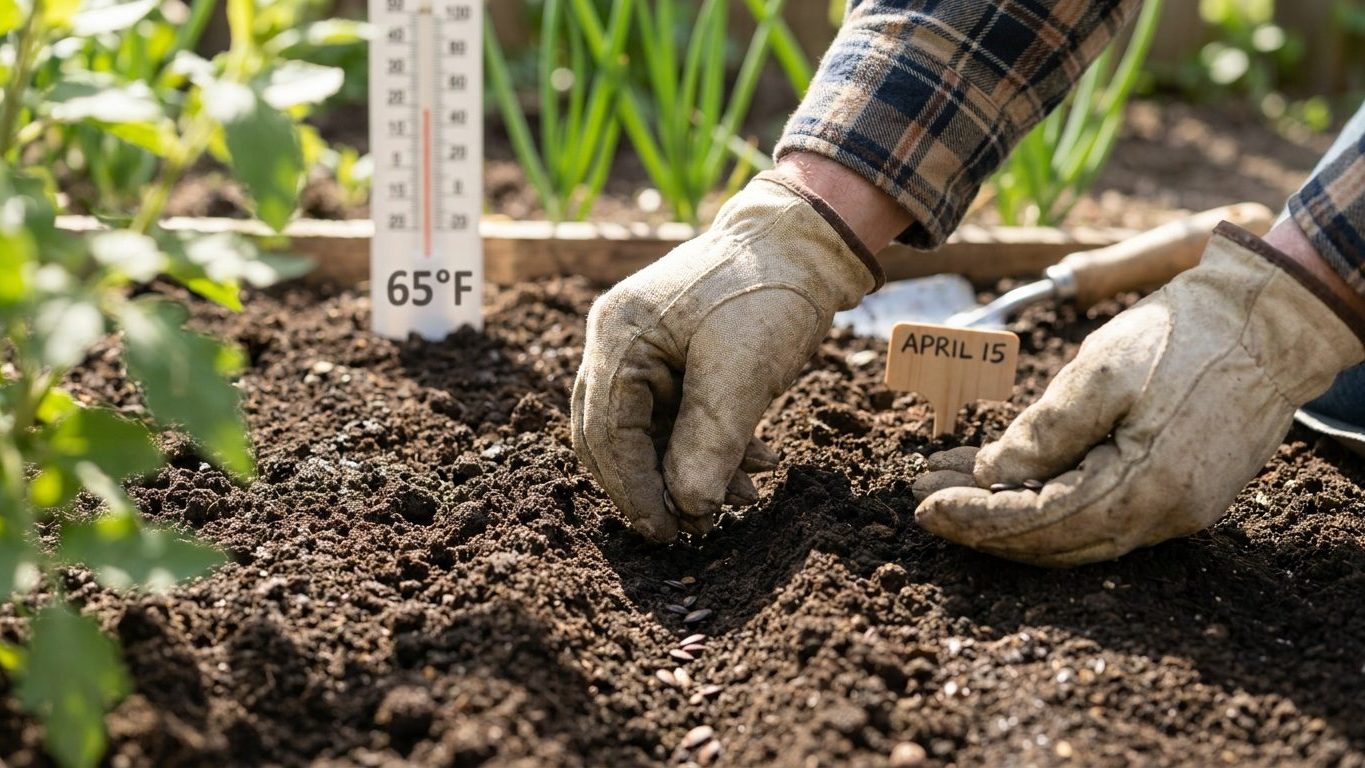
That’s the real gatekeeper for melons, more than the frost date itself. Melon seed wants soil in the mid-60s to 70F range to come up reliably. Cold, wet soil in early April will often rot the seed before it sprouts. So the practical answer for direct seeding is to wait until soil has caught up with the calendar, typically one to three weeks after the last-frost window closes, which lands most direct-seeded melon plantings in New Mexico somewhere in late April to mid-May.
Transplants buy a couple of those weeks back. Starting melon seedlings indoors three to four weeks ahead and setting them out right around the tail end of the frost window, with row cover or a cloche ready for a cold night, is the standard workaround gardeners use to squeeze a longer harvest out of a short season.
On the back end, the first fall frost at the reference station falls between October 29 and November 9. Melons need roughly 65 to 90 days from transplant to first fruit depending on the type, and cantaloupe-style melons on the shorter end of that range fare much better here than the slow 90-plus-day watermelon varieties. Count backward from the earlier end of that fall frost window, October 29, and a late-May planting still has room for a short-season melon to finish. A slow variety planted in early June is cutting it close in a year when the freeze arrives early.
None of this is a guarantee tied to your yard specifically. It’s the reference-station math, and the next two sections explain exactly where that math bends.
What will not work here
Two failure modes show up again and again in New Mexico melon patches, and both trace straight back to the numbers above.
Planting too early into cold soil
Jumping the gun on the last-frost window doesn’t just risk a frozen seedling, it risks seed that never comes up at all. Melon seed sitting in soil that hasn’t cleared the mid-60s tends to rot rather than sprout, so a gardener who seeds directly in late March, chasing an early harvest, often ends up reseeding in May anyway and loses the head start they were trying to gain. Waiting for the soil to actually warm, rather than for the calendar to hit a date, is what separates a stand of melon plants from a patch of bare dirt.
Watering on a weekly schedule through summer heat
The reference station averages 42.5 days a year at or above 90F, concentrated right in the middle of melon-growing season. That heat load drives evaporation hard, and it lands on top of a summer that’s naturally dry: June averages just 0.57 inches of rain, July climbs to 1.64 inches (New Mexico’s monsoon month), and August settles at 1.31 inches. Across the three months that’s about 3.5 inches total, against nearly 43 days of 90-plus heat pulling moisture back out of the soil.
A weekly watering routine, common advice for melons in milder climates, simply can’t keep up with that math in most New Mexico gardens, especially on sandy soil where water drains through within a day. Melon vines that are watered once a week here tend to show it through blossom-end problems, stunted fruit, and vines that wilt hard by afternoon even when the leaves look fine in the morning. The fix isn’t more water all at once, since July’s monsoon rain often falls as a hard thunderstorm that runs off rather than soaking in on packed or sloped ground. It’s shorter, more frequent watering, sized to the reader’s own soil rather than a generic schedule.
Slow, 90-day-plus watermelon varieties compound both problems: they spend more weeks exposed to peak heat and need more cumulative water to finish, which is exactly the resource this state’s summer doesn’t hand out for free.
What changes across New Mexico
New Mexico’s USDA hardiness zones span 4b to 9a, one of the widest ranges of any state in the Southwest. That’s not a rounding error, it’s the difference between a garden that barely gets a frost-free season and one that runs nearly frost-free most winters. The zone number is built on a single measurement, the average annual extreme minimum temperature, so it doesn’t describe summer heat or rainfall on its own, but it’s a fast signal for how long and how forgiving a growing season is likely to be.
| Zone range | What it signals for melons | Practical shift |
|---|---|---|
| Lower, warmer stretches (around zone 8-9a) | Longer effective frost-free season than the reference station | Slower 90-day watermelon varieties have more room to finish; earlier planting is often safe sooner than the state-wide window suggests |
| Higher, colder pockets (around zone 4b-5b) | Shorter frost-free season than the reference station, often by weeks | Stick to short-season melons, start transplants indoors, and expect the safe planting window to open later and close earlier than the dates above |
Elevation is doing most of that work. New Mexico’s terrain runs from low desert basins to mountain valleys a mile or more higher, and cold air behaves differently at altitude, both settling into low spots and arriving earlier in fall. A gardener at higher elevation should expect the last spring frost to land later than the reference station’s window and the first fall frost to arrive sooner, not the other way around.
There’s no single planting date that covers a range this wide, and this page won’t pretend otherwise. The right move is checking your own zone on the USDA Plant Hardiness Zone Map rather than assuming the reference-station numbers above apply directly to a mountain valley or a low desert flat.
Where to check this for your own county
New Mexico State University’s Cooperative Extension Service, at aces.nmsu.edu, is the source that actually knows your county rather than the state average. That distinction matters more for melons than for most vegetables, given how wide New Mexico’s zone spread runs.
Two things are worth hunting for on that site. First, a county-level or regional planting calendar, if the local extension office publishes one, that replaces the reference-station frost dates in this article with dates recorded closer to your own soil. Second, any list of melon varieties that county agents have actually trialled in local demonstration gardens. New Mexico’s growing conditions vary enough that a variety bred for a long, hot low-desert season can underperform badly in a shorter, cooler valley, and county trial notes usually flag exactly that kind of mismatch.
A county recommendation beats a state one every time, because it’s built on soil, elevation, and microclimate data specific to that ground. This page is deliberately the state-level view: useful for understanding the mechanics behind a planting date, but not a substitute for what your local extension agent has already tested against your actual conditions. If your county office runs a hotline or takes walk-in soil questions, a call or an email describing your yard’s elevation and soil type usually gets a much sharper answer than any statewide calendar can offer.
Checking this against your own garden
Every date in this article comes from a weather station, not from your backyard, and your own garden will tell you more than any calendar once you know what to look for.
Soil warmth by feel is the first check. Push a finger a couple of inches into the planting bed in mid-morning. If it feels cool to the touch rather than merely cool from overnight air, the soil likely hasn’t reached the mid-60s melon seed wants, no matter what the calendar says. Waiting another week costs far less than reseeding a rotted patch.
The first flush of male flowers is the second signal. Melon vines put out male blossoms before female ones, often by a week or two, and a healthy early flush of males tells you the plant is tracking normally toward fruit set rather than stalling from stress or cold shock.
The first true leaves, the second set that emerges after the rounded seed leaves, mark the point where a seedling has shifted from living off its seed reserves to actually growing on its own. Slow or yellowed true leaves after a normal-looking start often point to soil that’s still too cold or too wet, a clue worth trusting over any printed planting date. A garden that runs consistently a week or two ahead or behind the reference-station numbers in this article isn’t wrong, it’s just telling you what its own microclimate actually is.