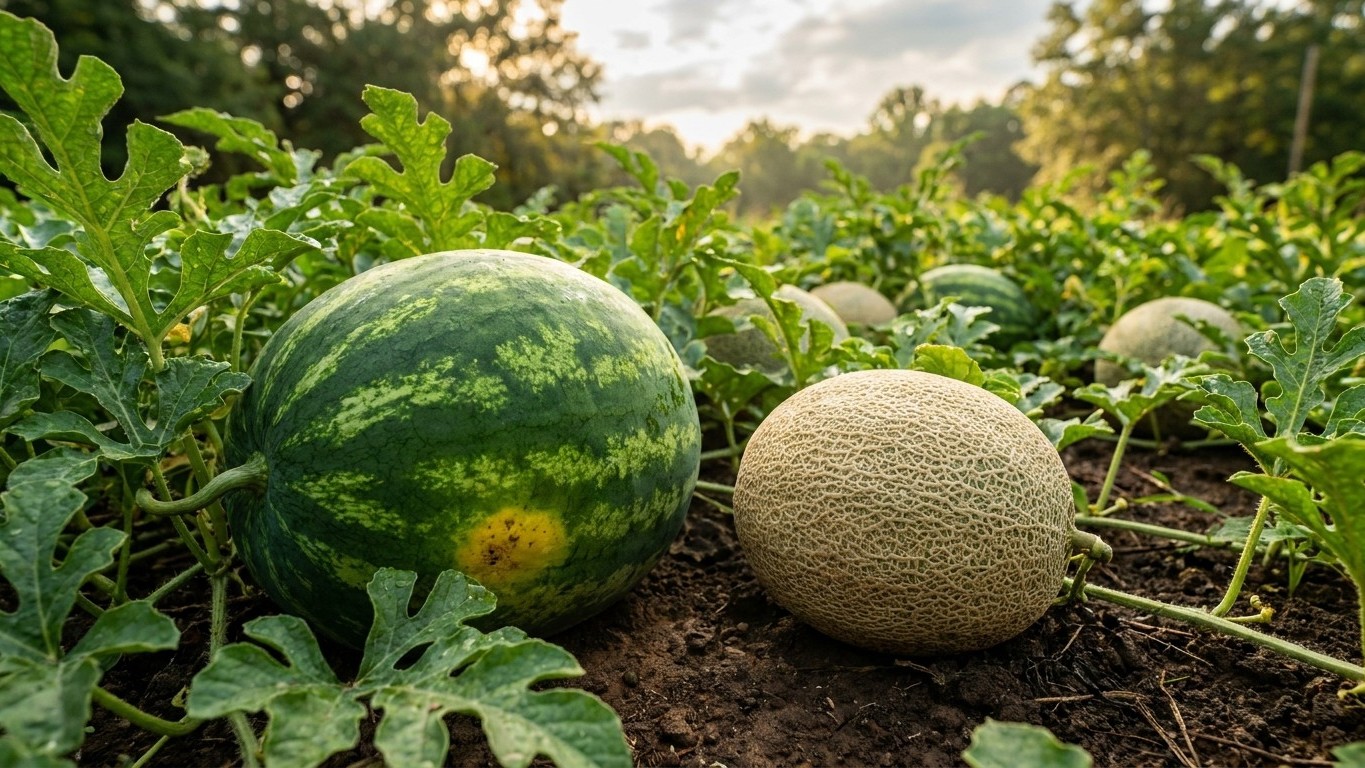

Cantaloupes and other short-season muskmelons are the safe bet across most of Ohio. Icebox-type watermelons come in a close second. Honeydews and other 100-plus-day melons are a gamble that only pays off in the warmest pockets of the state, in a warm year, with an early transplant.
The short answer for Ohio
Start with the season length, because that’s what actually decides which melon makes it to the plate. Using the zone 6a reference dates from Ohio State University Extension, last spring frost typically falls between May 5 and May 15, and first fall frost arrives between October 5 and October 15. That puts the frost-free window at roughly 143 to 163 days, depending on where in that range a given year lands. Sounds generous, but melons aren’t seeded outdoors the day frost lifts. Soil needs to warm first, so most Ohio gardeners aren’t setting transplants until mid-to-late May, which trims the usable window down closer to 120 to 140 days in practice.
That’s plenty for a cantaloupe or muskmelon running 75 to 90 days from transplant to harvest. It’s comfortable for an icebox watermelon in the 70-to-80-day range. It gets tight for a full-size watermelon pushing 90 to 100 days, and it’s a real stretch for a honeydew or casaba variety that wants 100 to 110 days of warmth to finish sweetening.
Heat matters here too, not just day count. Columbus averages 15.3 days a year at or above 90°F, according to NOAA’s 1991-2020 climate normals. That’s a moderate heat load, not a scorcher. Melons that depend on sustained high heat to build sugar, the way they might in Georgia or Texas, don’t get that kind of push in Ohio. So the decision by type looks like this: lead with cantaloupe and muskmelon varieties bred for shorter seasons, add an icebox watermelon if space allows, and treat honeydew as a bonus crop for a warm year rather than the backbone of the melon patch.
What will not work here

Long-season honeydew and casaba types are the first casualty. A variety that needs 105 or 110 days from transplant, started in late May, is trying to finish in early September at the earliest, and any cool stretch or late planting pushes that into October, right against the frost line. In a zone 5b pocket, or in a year where spring drags past May 15, that math doesn’t work at all. These melons aren’t impossible in Ohio, but they’re a bet on a warm year, not a reliable annual crop.
Humidity is the second failure point, and it’s easy to underestimate because it doesn’t show up as a frost date or a heat number. Summer rainfall across June, July and August runs about 12.7 inches, with July the wettest month at 4.67 inches. That’s not drought territory, but it means warm, humid air sits over the garden for long stretches, and melon foliage planted too close together doesn’t dry out between rains or dew. Powdery mildew and downy mildew both thrive in that combination, and a dense-vined variety planted at tight spacing to save space is exactly the setup that lets them spread fastest. Varieties bred for good air circulation, or simply given wider spacing than the seed packet’s minimum, hold up better through an Ohio summer.
Then there’s the dry-spell trap, which catches gardeners who watered fine all June and July. August is the driest summer month at 3.74 inches, and it’s also when fruit is sizing and sweetening on most varieties. Combine that with 15.3 days a year over 90°F, many of which cluster in late July and August, and a melon that depends on gardeners remembering to water without a fixed schedule is going to stress right when it matters most. A variety marketed as drought-tolerant doesn’t fix inconsistent watering; it just fails a little slower.
What changes across Ohio
Ohio isn’t one growing zone, and treating it like one is where a lot of frustration starts. The USDA Plant Hardiness Zone Map, built from 1991-2020 extreme minimum winter temperatures, places the state across a 5b-6b range. That’s a real spread, not a rounding error, and it reflects a meaningful difference in growing season between the southern edge along the Ohio River and the northern counties or higher elevations further from Lake Erie’s moderating effect.
A gardener in the warmer 6b pockets can generally expect an earlier practical planting date and a longer stretch of reliable heat, which makes the riskier 90-to-100-day watermelons and even some honeydew varieties worth trying. A gardener in a 5b area is working with a shorter effective season on both ends, spring and fall, and should lean harder toward the shortest-season cantaloupe and icebox watermelon varieties, and treat anything past 90 days as a genuine gamble rather than a safe second crop.
There is no single frost date or season length that applies to all of Ohio, and this page can’t tell an individual reader which zone their own yard sits in. Lake effect, elevation, and even a town’s local microclimate shift things by more than the state-level range suggests. The only way to know which side of that spread a given garden falls on is to check the USDA hardiness zone map directly for that address, rather than assuming the state average applies.
Where to check this for your own county
This page gives the state-level picture, built from a Columbus reference station and a zone 6a frost window. That’s useful for deciding which type of melon to plant, but it’s not a substitute for what Ohio State University Extension publishes at the county level. Their site, at extension.osu.edu, is organized by county office, and each office typically maintains its own planting calendar tuned to local conditions rather than a single statewide average.
Two things are worth looking for once there. First, the local planting calendar, which will often narrow the frost-free window and suggested planting dates than the state range this page uses. Second, and more useful for the variety question specifically, look for any variety trial results or extension bulletins covering melons grown in that county or the surrounding agricultural district. Ohio’s extension offices and affiliated research stations run variety trials most seasons, and those results say plainly which cantaloupe, watermelon or specialty melon varieties actually performed well in that soil and that year’s weather, not just which ones are marketed as suited to the Midwest.
A county-level recommendation beats a state-level one every time, because it accounts for local soil, local microclimate and local pest pressure in a way a statewide page can’t. This page is deliberately the state one: a starting point for narrowing down melon types before checking what the local office says about specific varieties. Treat it as step one, not the last word.
Checking this against your own garden
None of the dates above beat what the garden itself is showing on any given spring. Three things are worth watching before trusting a calendar date over what’s actually happening in the soil.
Soil warmth by feel is the first and most reliable check. Melon seed and transplants both stall in cold soil regardless of what the calendar says, so if the top few inches still feel cool and damp rather than warm and dry by midday, it’s worth waiting even past the state’s typical mid-May window. The second signal is the first flush of male flowers on an already-planted vine, which shows up before the female flowers that actually set fruit. Seeing males open early in a season is a sign the plant is running ahead of a typical year locally, which can mean the local microclimate runs warmer than the state average suggests. The third is how fast true leaves develop after the first seed leaves. Slow, stalled true-leaf growth after transplant usually points to soil that’s still colder than it looks, or nights still dropping further than the frost-date range implies.
Watching those three signals over a season builds a better sense of a specific yard’s actual timing than any state or even county date can offer, because they reflect the soil and air right where the melons are actually growing.