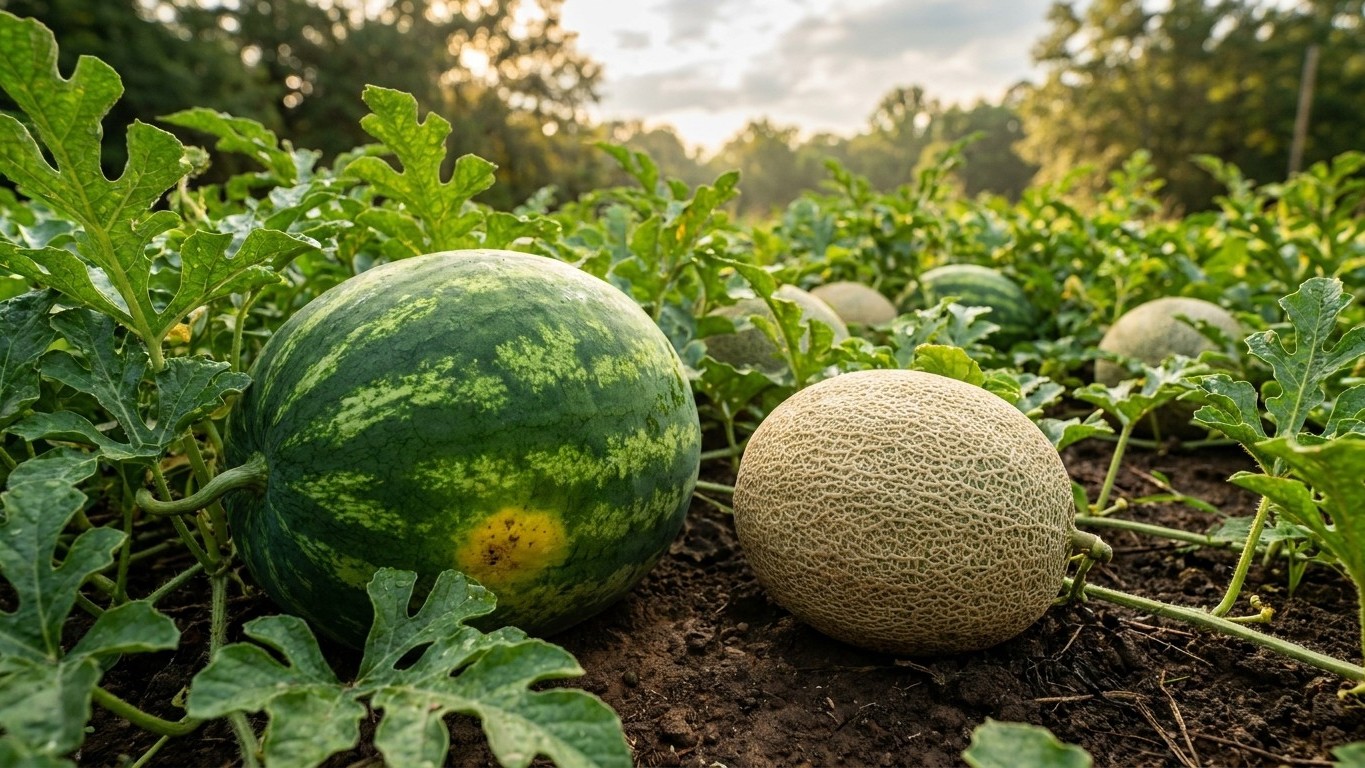

Saskatchewan‘s short, cool growing season limits realistic melon choices to fast-maturing types: quick-ripening cantaloupe and muskmelon varieties bred to finish in roughly two months rather than three, plus compact icebox-style watermelons. Full-size watermelons, honeydews, and other long-season melons rarely mature before frost returns. The reason comes down to two numbers: how many frost-free days the province gets on average, and how few of those days actually turn hot.
The short answer for Saskatchewan
Start with the calendar. At the Saskatoon reference station, the mean last spring frost falls on May 18 and the mean first fall frost on September 18. Counted out, that’s a 123-day frost-free window on average. Sounds workable for melons, until you remember what “average” means here: these are mean dates from Environment and Climate Change Canada’s 1981-2010 normals, not safe dates. In roughly half of all years, frost arrives later than May 18 in spring or earlier than September 18 in fall, which means the real, plannable window most gardeners should bank on is shorter than 123 days, not equal to it.
The bigger constraint is heat, not length. The same station records 0.0 days a year at or above 90°F. Melons don’t just need frost-free time, they need heat units to push sugar into the fruit. A vine can grow massive leaves and set fruit across a 123-day window and still turn out bland, watery melons if the days never get properly hot. That’s the piece a lot of variety descriptions gloss over: days-to-maturity numbers on a seed packet are usually written for a warmer climate, and they stretch out further here.
Put those two facts together and the decision by type looks like this:
| Melon type | Fit for Saskatchewan’s mean window and heat load |
|---|---|
| Fast cantaloupe / muskmelon types | Best fit; closest match to a ~123-day mean window with no reliable 90°F+ heat |
| Icebox-type watermelon (small, quick-finishing) | Workable second choice, but needs an early, warm start indoors |
| Full-size slicing watermelon | Poor fit; typically needs more heat and time than this climate reliably provides |
| Honeydew and other long-season melons | Not realistic; consistently needs a longer, hotter season than the local normals show |
Even the fastest types benefit from starting indoors rather than seeding straight into garden soil, since Saskatchewan’s short heat window leaves little room to lose to slow germination outdoors.
What will not work here
Long-season melon types are the clearest failure point. Honeydews and full-size open-pollinated watermelons often need more time from transplant to harvest than this climate reliably offers even in a generous year. Against a mean window of 123 days that’s already tight, and remembering that frost beats the mean date in roughly half of all years, planting a long-season type here isn’t gardening, it’s betting against the calendar every single season.
Direct-seeding into the garden the moment the mean last frost date passes is the second common mistake. Soil in a zone this cold warms up more slowly than the air does, and melon seed sitting in cool soil simply stalls rather than germinating on schedule. In a climate with zero reliably hot days, losing two or three of the warmest weeks to slow outdoor germination is a cost the season can’t absorb. Starting seed indoors and transplanting out once the ground has actually warmed protects the part of the season that matters most.
Counting on heat to finish the job is the failure mode that catches gardeners even when the vines look healthy. With 0.0 days a year reaching 90°F at the reference station, any variety marketed around “needs consistent hot weather to develop full sweetness” is working against the local climate from day one. The vine can look fantastic, sprawling and green with plenty of fruit set, and the melons can still come out underwhelming because sugar accumulation depends on sustained heat, not on plant size or fruit count.
Watering on faith is the last trap. Summer rainfall averages about 6.6 inches across June, July and August, and August, the driest of the three at 1.68 inches, is exactly when many fast-maturing melons are sizing up and ripening fruit. A gardener who assumes summer rain will cover things straight through harvest is gambling with the driest month landing right on top of the stage where water shortfall shows up fastest, as small or cracked fruit.
What changes across Saskatchewan
Every number above comes from one station: Saskatoon. The hardiness zone figure, 3a in the Canadian system, is specific to that reference city too, and it’s worth being precise about what that number even means. Natural Resources Canada builds its zone system from seven climate variables, not the single winter-minimum figure the USDA system uses, and NRCan says outright that there’s no simple conversion between the two: a single Canadian zone 4a, for instance, overlaps nine different USDA zones. So treat 3a as a description of Saskatoon’s climate specifically, not a stand-in for the whole province.
Saskatchewan is enormous, and its climate is not one garden. A location well north of Saskatoon, or sitting at higher elevation, will typically run behind Saskatoon’s mean frost dates on both ends, meaning a later last frost in spring and an earlier first frost in fall, which shrinks the already-tight 123-day mean window further still. A garden closer to Saskatoon, or tucked into a sheltered river valley, may track closer to the numbers cited on this page.
None of this can be settled from a province-wide article. The way to find out where a specific garden falls is to check Natural Resources Canada’s plant hardiness map for the local municipality directly, rather than assuming Saskatoon’s zone applies. That single lookup does more to sharpen these numbers for an actual garden than anything else on this page.
Where to check this for your own county
Saskatchewan organizes agricultural information by rural municipality rather than by county, but the principle is the same: a local recommendation beats a provincial one every time, and everything on this page is the provincial one. The place to start narrowing that down is the province’s own agriculture resource hub: saskatchewan.ca’s agribusiness, farmers and ranchers section.
Two things are worth looking for once there. First, any planting calendar or frost-date guidance specific to the reader’s own region rather than the Saskatoon-based normals used throughout this article, since local guidance accounts for the elevation and latitude differences described above in a way a single reference station can’t. Second, any record of melon varieties actually trialled by provincial agriculture staff or regional demonstration plots in the reader’s area, since real-world trial results for a specific district carry more weight than a general type-level recommendation built from climate normals alone.
This page draws on a single weather station to describe an entire province, which is a real limitation, not a minor caveat. It’s a reasonable starting point for deciding between melon types in broad strokes, but it isn’t a substitute for whatever the provincial agriculture office has on file for the reader’s own district. Treat the type-level guidance above as the first filter, and the provincial resource as the second, more locally accurate one.
Checking this against your own garden
Every date and figure above describes an average across three decades at one station. A reader’s own garden will tell them more than any of it, and three simple observations do most of that work.
Soil warmth by feel comes first. Press a hand a few inches into the planting bed in late spring: if it still feels cool and damp rather than warm and slightly dry, hold off on setting out transplants even if the calendar shows the mean last frost date has already passed. Melon roots set into cold soil tend to just sit rather than grow, no matter what the date says.
The first flush of male flowers comes next. Melon vines open male flowers days to weeks before the female flowers that actually set fruit, and the timing of that first flush is a direct read on how much heat the plant has banked locally. If male flowers show up noticeably later than a variety’s typical timing would suggest, the garden’s own microclimate is running cooler than the province-wide figures discussed here, and harvest will likely lag the seed packet’s estimate too.
Finally, watch how long it takes seedlings to push their first true leaves, the ones that actually look like small melon foliage, past the initial seed leaves. A longer-than-expected wait at that stage is a sign the local soil and air are colder than the reference numbers used across this page, and it’s a good cue to lean toward the fastest-maturing type available and start seed indoors the following season rather than direct-seeding outdoors.