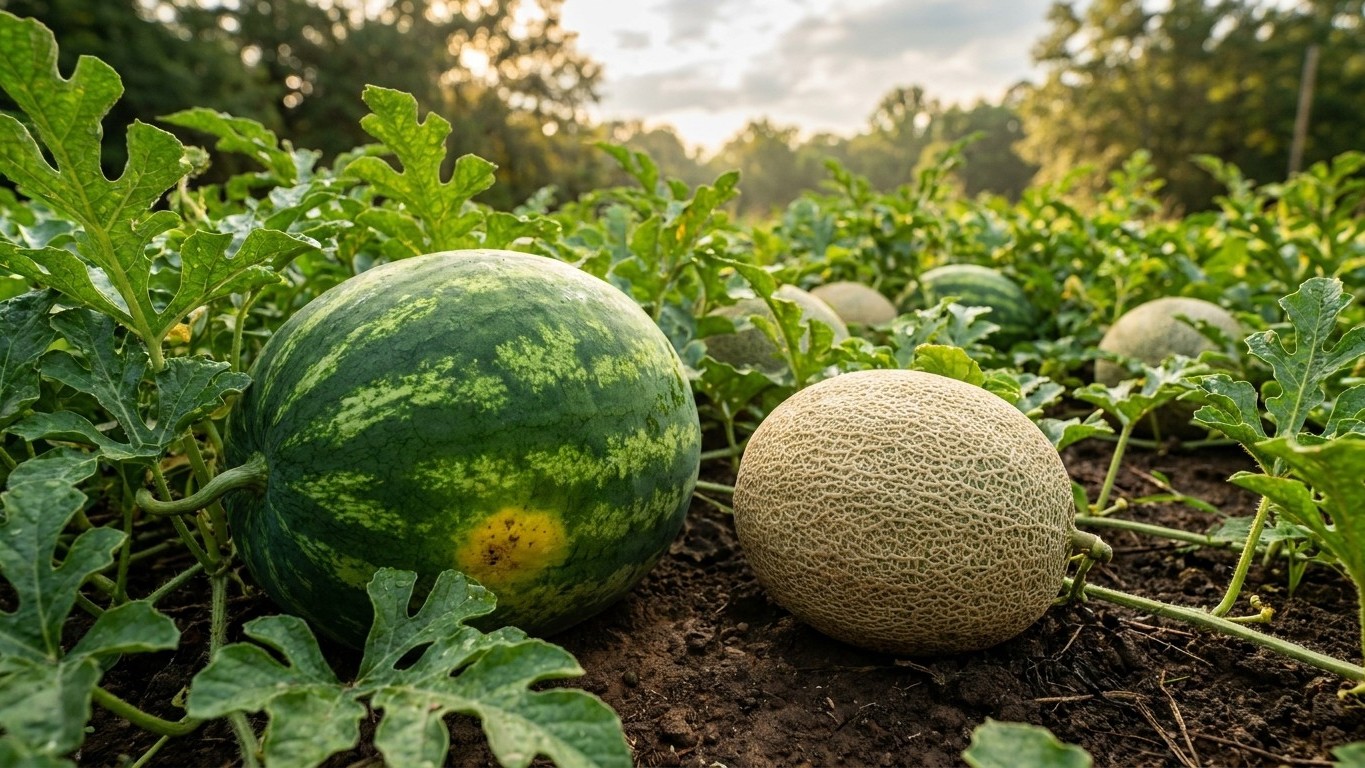

Cantaloupes and small “icebox” watermelons are the safest bets across most of Texas, thanks to their shorter time to harvest and their tolerance for long stretches of extreme heat. Honeydews and full-size watermelons can work too, but they ask more of the calendar and the water bill, and in parts of the state that’s a bet that doesn’t pay off.
The short answer for Texas
Texas doesn’t hand out a single melon answer, but the numbers point in a clear direction: pick by type, not by variety name on a seed packet. The reference station used for Texas climate normals here, Houston’s IAH airport, logs an average of 102.4 days a year at or above 90°F. That’s the number that should drive every decision on this page. A melon that needs steady, moderate warmth without long heat spikes is fighting the state’s own climate before it even sets fruit.
Cantaloupes (muskmelons) handle that heat load better than most melon types. Their vines set fruit fast, and a shorter path from flower to harvest means less exposure to the driest, hottest stretch of summer. Icebox-type watermelons, the compact, personal-size varieties, follow close behind for the same reason: less time between planting and picking means less time for a heat wave or a dry spell to derail the crop.
Full-size watermelons are the trickier call. Their vines run longer and their fruit takes weeks longer to fill out, which means more days spent depending on rain or irrigation during the exact window when Texas summers are driest. According to the monthly rainfall normals for the Houston reference station, July averages just 3.77 inches, the lowest of the three summer months, while June brings about 6.0 inches and August 4.84. A full-size melon still filling out in mid-July is running its most water-demanding stretch against the year’s driest month.
Honeydews sit at the other end of the risk scale. They want sustained, even warmth without big day-to-night swings, and they’re less forgiving of the kind of heat spikes that come with 100-plus days a year above 90°F. They can work in the hottest, most consistently warm pockets of the state, but they’re a harder sell almost everywhere else in Texas.
None of this comes from a statewide frost calendar, because this page doesn’t have one. The frost dates available here are specific to the Houston area (station USW00012960), and Texas is far too large a state to borrow that window for the Panhandle or the Hill Country. What the Houston numbers do reveal clearly is the heat load, and that heat load is the single biggest factor shaping which melon type has a real shot statewide.
What will not work here
Start with the melons bred for a different kind of summer. Some European-style cantaloupe strains and long-season heirloom melons were developed for climates with fewer extreme-heat days and steadier humidity. Against 102.4 days a year at or above 90°F, they struggle with blossom drop and poor pollination once daytime highs stay punishingly high for weeks at a stretch. The flowers open, but the heat keeps fruit set from following through.
Weekly watering doesn’t survive July
A watering routine built around one soak a week is a reasonable plan in a cooler, wetter climate. It’s a losing plan here. July’s 3.77-inch average is the lowest rainfall of the growing season, and it lands squarely inside the window when fruit is sizing up and needs the most consistent soil moisture. Combine that dry stretch with sustained 90-degree-plus heat driving fast evaporation, and a once-a-week schedule leaves melons swinging between too dry and briefly saturated, the exact pattern that produces blossom-end rot and cracked fruit.
Tight spacing fails in the wet months
June tells a different story: about 6.0 inches of rain on average, more than double July’s total. That combination of high humidity and warm, wet soil is exactly the environment powdery mildew, downy mildew, and anthracnose need to spread through a melon patch. Vines planted close together, the kind of spacing that might be fine in a drier state, trap moisture and block airflow. In Texas’s humid stretches, that spacing turns a healthy planting into a fungal outbreak within a few weeks.
Long-season, extra-large watermelon varieties compound both problems at once. They need more weeks in the ground, which means more exposure to the dry heart of summer, and their sprawling vines make dense, humid plantings even harder to manage during the wetter months. A melon that needs 90-plus days from transplant to harvest is asking the Texas climate for a kind of patience it generally doesn’t offer.
What changes across Texas
Texas isn’t one climate wearing one state line. The USDA Plant Hardiness Zone Map places the state across zones 6a to 10a, a spread of eight full zones from the coldest corner to the warmest. That’s the difference between a garden that sees hard, repeated winter freezes and one that barely sees frost at all. No single planting date or variety list can cover that range honestly.
The Houston figures used throughout this page sit at the mild end of that spread. A grower in the Panhandle, sitting toward the 6a end, is working with a dramatically shorter frost-free season and colder winter extremes than anything the Houston station records. Someone gardening in the Rio Grande Valley, closer to the 10a end, is often planting and harvesting on a completely different calendar, sometimes with a shot at a second melon crop where a colder-zone gardener gets exactly one window.
Heat load and rainfall patterns shift with that zone spread too, though this page can only speak with confidence to the Houston reference station’s own numbers. What’s fair to say is that the same heat-day count and the same July dry stretch that shape decisions near the Gulf Coast are unlikely to describe West Texas or the High Plains with the same precision. This page doesn’t have station-level data for those regions, and it won’t borrow Houston’s numbers to fill that gap.
The practical takeaway isn’t a zone number, since that’s not something to guess at from a state-level page. It’s a shift in expectation: a reader gardening well north or west of the Gulf Coast should expect a shorter frost-free window, cooler nights, and likely fewer of those 90-degree-plus days than the Houston figures show, all of which nudge the melon-type decision back toward faster, more heat-forgiving varieties, not away from them.
Where to check this for your own county
The Texas A&M AgriLife Extension Service is where the state-level guidance on this page turns into county-level guidance that actually applies to a specific garden. That’s the resource to search next, and it’s worth being specific about what to look for once there.
Two things matter most. First, the local planting calendar for the county in question, built around that county’s own frost dates rather than the Houston-area figures cited on this page. A county in the Panhandle and a county on the Gulf Coast are not working from the same calendar, and the extension office for each will say so plainly. Second, look for the melon varieties that county’s extension agents have actually trialled locally. Extension offices run variety trials precisely because state-level type recommendations, like the ones on this page, need a local reality check before a gardener commits a season to them.
A county recommendation beats a state one every time, because it accounts for local soil, local disease pressure, and a frost calendar that actually matches the garden in question. This page is deliberately the state-level layer: useful for narrowing melon type by heat tolerance and water demand, but not a substitute for what a county agent already knows about the specific patch of Texas a reader is standing on.
That local layer also tends to catch things a statewide page can’t, like a disease pressure specific to one region’s soil or a variety that’s quietly outperformed the standard recommendation in local trials for years. It’s worth the extra search.
Checking this against your own garden
Every date and figure on this page describes an average. A reader’s own garden will confirm or override it, and three simple signs are more reliable than any calendar.
Soil warmth by feel is the first. Melon seed germinates poorly in cold soil no matter what the calendar says. Pushing a finger a couple of inches into the planting bed and feeling real warmth, not just sun-warmed surface dirt, is a better indicator of planting readiness than counting days from a frost date that was measured at an airport miles away.
The first flush of male flowers is the second sign worth watching. Melon vines typically produce a wave of male flowers before female flowers, the ones that will actually set fruit, appear. Seeing that first flush confirms the plant has moved past early vegetative growth and is responding to the season’s real heat and light levels, whatever the calendar predicted.
The first true leaves, the second set that appears after the rounded seed leaves, tell a grower whether a seedling is thriving in its specific spot or struggling against a local microclimate, be it a shadier corner, a heavier soil, or a spot that stays cooler than the rest of the yard. Slow, pale true leaves are the garden’s own way of saying the local conditions don’t match the averages this page is built on, and that’s worth trusting over any printed date.