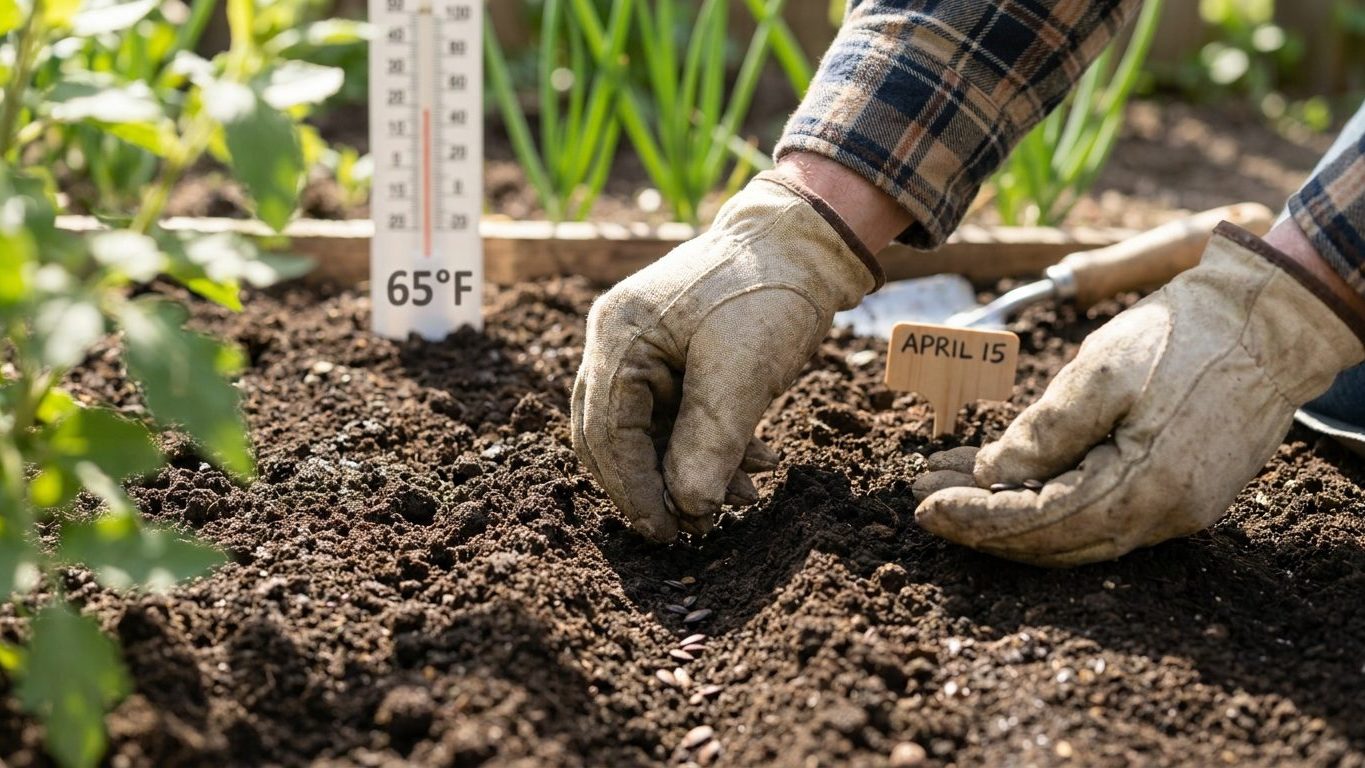

Plant Melons in Texas once your soil has warmed and the last hard freeze has passed for your specific location. On the mild Gulf Coast, that window runs from February 4 to March 1. Two hundred miles north or a few thousand feet higher, it shifts by weeks, sometimes months, which is exactly what the rest of this page sorts out.
The short answer for Texas
Melon seed goes into the ground once the freeze risk has genuinely passed, and for the Gulf Coast reference station used in NOAA’s climate normals (Houston, station USW00012960), that means a window opening between February 4 and March 1. That date range is not a guarantee. It marks the period when the probability of a 32°F freeze sits between 30 and 70 percent, the messy middle where the odds are falling but haven’t dropped to zero. Planting on February 4 still carries real frost risk; waiting until March 1 trims that risk considerably but doesn’t erase it.
Melons are frost-tender through and through, seed to seedling to vine, so gardeners who push earlier than this window are betting against the odds NOAA has already quantified. The safer play, especially for a first attempt, is to sit closer to the back end of the range and let the soil finish warming.
On the other end of the calendar, the same Houston station puts the first fall freeze between December 1 and December 19. That gives a working season stretching from early spring into early winter, generous by national standards, and it’s one reason melons do well along the coast when the summer heat is managed correctly (more on that below).
Here’s the catch, and it matters more for this crop than most: these dates come from a single station on the Gulf Coast. Texas runs from Brownsville to the Panhandle, from sea level to the Trans-Pecos highlands, and this page does not have a verified frost date for those inland and northern regions. Anyone gardening outside the Houston area is working with a different calendar entirely, and no figure on this page should be borrowed to stand in for it. What this page can say, reliably, is how the mild end of the state behaves, and how much variation to expect once you move away from it.
What will not work here
Weekly watering fails on a melon patch here, and the numbers explain why. The reference station averages 102.4 days a year at or above 90°F, a heat load concentrated almost entirely across the growing season melons need. Against that kind of evaporative demand, summer rainfall of about 14.6 inches across June, July and August sounds like a fair amount until you notice it isn’t evenly spread: June brings 6.0 inches, July drops to just 3.77, the driest month of the growing year, before August climbs back to 4.84. A vine crop with shallow, wide-spreading roots dries out fast in a July stretch with almost no rain and more than three months of 90-degree-plus days stacked against it. Gardeners who water once a week and expect the rest to be handled by rainfall are the ones pulling shriveled fruit off the vine come July.
Close spacing is the other common mistake, and it fails for the opposite-seeming reason: humidity, not drought. Ninety-plus-degree days paired with tropical-adjacent rainfall create the kind of muggy air that fungal disease thrives in, and melons planted shoulder to shoulder trap moisture around their leaves long after a storm has passed. Powdery mildew and downy mildew move fast through a crowded patch on the Gulf Coast in a way they simply don’t in a drier inland climate. The fix isn’t complicated, just wider spacing and airflow, but it’s the detail most first-time growers skip because it looks wasteful on paper.
Timing failures show up too, just not from a short season, since the Houston window runs frost-free from early February to early December. The mistake here is planting too early against the freeze odds already discussed, or trying to push fruit set through the hottest stretch of summer, when extreme daytime heat causes blossom drop and poor pollination regardless of how well-watered the plant is. A melon that flowers in peak July heat here often sets nothing at all, which is a scheduling problem, not a rainfall or spacing one.
What changes across Texas
Texas sits across USDA hardiness zones 6a through 10a, and that spread is enormous by any state’s standard. Zone 6a, found in the Panhandle and parts of the high plains, and zone 10a, found along the lower Rio Grande Valley and the immediate coast, describe places with wildly different average annual extreme minimum temperatures, the single variable the USDA system measures. A zone gap that wide translates into a frost-free season that can differ by two months or more between the northern and southern ends of the state, which means there is no single Texas planting date, only a Texas planting range.
The Houston frost dates cited above sit at the mild, southern end of that range, close to the zone 9b-10a territory. A gardener in the Panhandle or the Hill Country, sitting in zone 6a or 7a, should expect the last frost to land considerably later in spring and the first fall frost to arrive considerably earlier, compressing the whole growing window from both directions. Elevation plays into this too: Texas isn’t flat everywhere, and higher ground in the Trans-Pecos and parts of the Hill Country runs cooler than its latitude alone would suggest.
None of this means guessing. It means checking. This page won’t tell an individual reader which zone they garden in, because that number depends on the exact county and sometimes the exact town, and misapplying a neighboring zone’s dates is how frost damage happens in the first place. The USDA Plant Hardiness Zone Map is the tool built for that lookup, and it takes under a minute to find a specific zip code on it.
Where to check this for your own county
Texas A&M AgriLife Extension (agrilifeextension.tamu.edu) is the source built to close the gap this page can’t close. State-level pages like this one work from a single reference station and a statewide hardiness range, useful for understanding the mechanism but too coarse for a planting date you’d actually commit seed to. County extension offices work the other direction: they publish planting calendars built from local frost records, not a single distant airport station, and they track which melon varieties have actually performed well in trials run in that specific county’s soil and climate.
Two things are worth pulling from a county extension page specifically. First, the local recommended planting window, which will likely differ from the February 4 to March 1 Houston figure by anywhere from a few days to several weeks depending on how far the county sits from the coast. Second, the variety list, since Texas AgriLife trials cantaloupe, watermelon and specialty melon varieties across different regions of the state precisely because a variety that shrugs off Gulf Coast humidity may not be the one recommended for a drier Trans-Pecos county, or vice versa.
A county recommendation beats a state one every time, for the same reason a tailored answer beats a general one. This page describes how the mechanism works statewide, the frost probabilities, the heat load, the rainfall pattern, and why they interact the way they do. The county extension office takes that same mechanism and runs it through decades of local observation to hand back an actual date and an actual variety list. Both are useful. Only one is specific to a single backyard.
Checking this against your own garden
No calendar, state or county, replaces what the plant and the soil are already telling you, and three simple checks catch what a printed date can’t. Soil warmth by feel is the first: press a hand into the planting bed a few inches down, and if it feels cool or damp-cold rather than mild all the way through, the soil hasn’t caught up to the calendar yet, whatever the date says. Melon seed sitting in cold soil doesn’t die outright, it just stalls, rotting more often than it germinates.
The first flush of male flowers is the second signal, and it tells you something the frost date never could: how your particular microclimate has handled the season so far. Melons produce male flowers before female ones, often by a week or two, and a strong early flush usually means the vine has settled into steady warmth rather than the up-and-down swings of a late cold snap. A thin, hesitant flush is worth reading as a sign the plant is still catching up.
Third, watch the first true leaves, the ones that appear after the rounded seed leaves and actually look like a melon plant. Slow, pale true leaves point to soil that’s still too cool or too wet; fast, deep-green ones confirm the timing worked. Taken together, these three checks read a single backyard’s actual conditions in a way no station-based date range ever can, and they’re the final word once the seed is already in the ground.