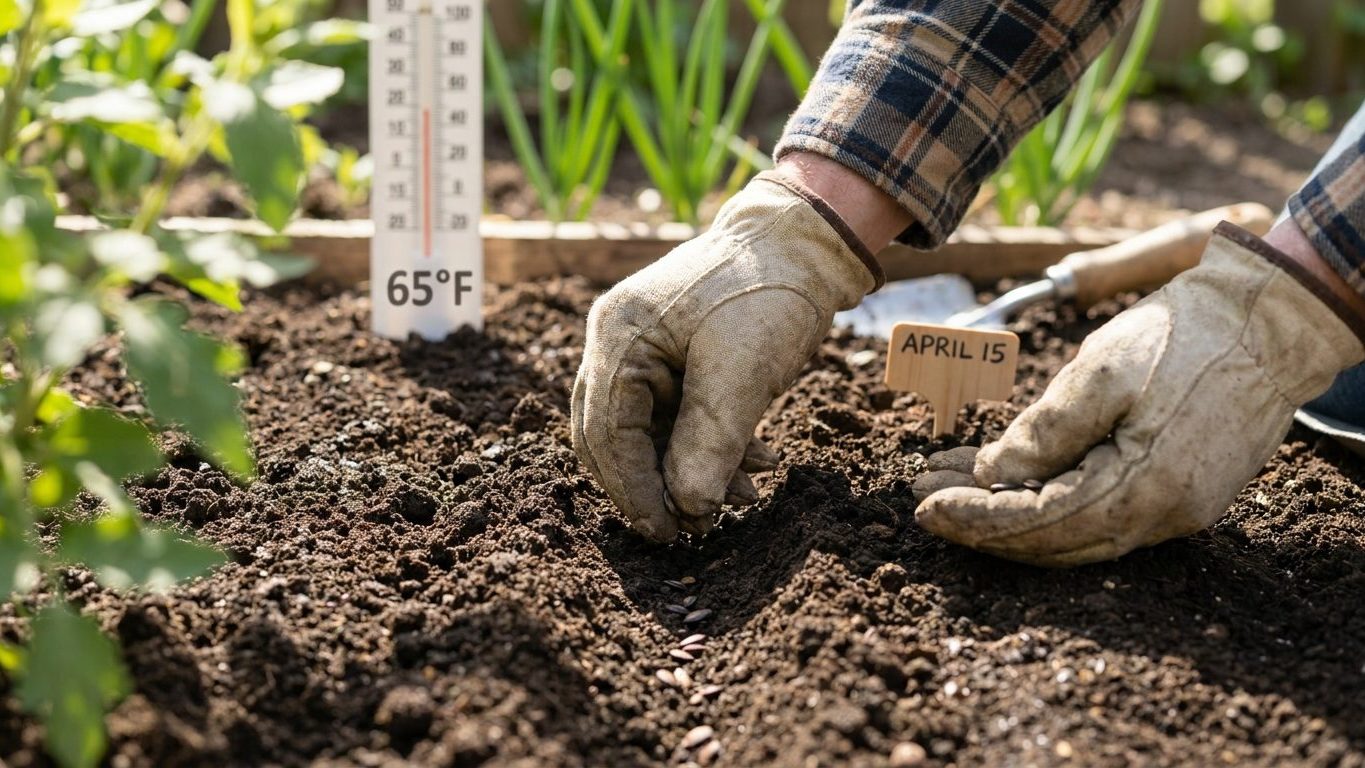

In Vermont, melons go into the ground as transplants, not seeds, and only after the frost risk tied to the region’s late spring has passed, generally from mid to late May. Harvest has to wrap up before the first fall frost, which lands between October 3 and October 13 at the Burlington reference station. That leaves a working season of roughly 145 to 155 days, tight for anything but the fastest melon varieties.
The short answer for Vermont
The last spring frost at the Burlington reference station (USW00014742) falls between April 30 and May 10, based on NOAA’s 1991-2020 Climate Normals. That window is the 30-70% probability band for a 32F freeze, meaning even on May 10 there’s still a real chance of frost, just a smaller one than on April 30. The first fall frost sits between October 3 and October 13, the same probability band. Neither date is a promise. Both are odds.
For melons, that math points to one practical move: start seed indoors, don’t sow outside. Melon seed germinates poorly in cold soil, and waiting for outdoor soil to warm enough to sow directly would burn through weeks Vermont doesn’t have to spare. Starting seedlings indoors three to four weeks before the intended transplant date, then setting them out once the frost probability has dropped near the low end of that band, usually lands transplanting in the second half of May for most of the state.
The other number that shapes the answer is heat, not frost. Burlington averages only 5.4 days a year at 90F or hotter. Melons ripen on accumulated warmth, and a season with barely five days of real heat doesn’t leave much margin to make up for a late start or a slow-maturing variety. That single fact does more to narrow the choice of what to plant than the frost dates alone: the calendar sets the outer edges of the season, but the heat total decides how much actually happens inside those edges.
Put together, the short answer is: transplant, don’t direct-seed; aim for the second half of May in most locations; and pick varieties bred to finish fast, because the region simply doesn’t generate the heat load to bail out a slow one.
What will not work here
A handful of habits that work fine in warmer states fail predictably in Vermont’s climate, and each one traces back to a specific number in the local record.
- Long-season melon types. Anything needing 85 to 100 or more days to reach ripeness is racing a season that, at best, runs about 145 to 155 days from frost to frost, and a good chunk of that window is too cool at either end for real melon growth. There isn’t slack for a slow finisher.
- Direct seeding outdoors. Waiting for garden soil to hold steady warmth pushes sowing into late May or June in most of the state, which then pushes harvest past the first fall frost. Transplants recover that lost time.
- Counting on hot days to sweeten fruit. With only 5.4 days a year at 90F or above, a garden that depends on stretches of real heat to build sugar in the fruit will come up short most years. Black plastic mulch or row cover to trap ground heat does more work here than it would in a hotter state.
- Watering on a fixed weekly schedule. Summer rainfall averages about 11.9 inches across June, July and August, with August running driest at 3.54 inches. That number never reads alone: on sandy soil, an inch of rain drains through in a day, so a garden can still need water every second day even in a summer that looks wet on paper. On clay, the same rain sits for a week. A calendar-based watering routine ignores both.
- Planting melons close together for a longer row. Vermont’s summers aren’t tropical, but the combination of overnight cooling and periodic rain can hold humidity around dense foliage long enough to favor fungal disease, especially in low spots or valley gardens with poor air movement. Wider spacing and good airflow matter more here than the seed packet spacing chart suggests.
What changes across Vermont
Vermont’s USDA hardiness zone, based on the Plant Hardiness Zone Map’s 2023 update, spans 3b to 5b across the state. That’s built on one measurement only: the average annual extreme minimum winter temperature. It doesn’t describe frost dates or summer heat directly, but it’s a useful marker for how much the state’s climate actually varies within its own borders.
Burlington, sitting on the shore of Lake Champlain, is the mildest corner of Vermont and lands toward the warmer end of that range. That lake moderates temperature swings in both directions, softening the coldest winter nights and slowing the spring warm-up less than higher ground does. The Green Mountains and the Northeast Kingdom run substantially colder, sitting toward the 3b end. That gap between 3b and 5b is not a rounding error. It’s the difference between a frost-free season that starts and ends close to the dates cited above, and one that starts noticeably later and ends noticeably earlier at higher elevation or further from the lake’s influence.
There is no single planting date that covers all of Vermont accurately. A grower near the lake can often push transplanting a little earlier than someone in a mountain valley or in the far northeast, and should expect the first fall frost later too. A grower at higher elevation should plan around a shorter effective season on both ends, not just a colder winter.
This page can’t tell an individual reader which zone applies to their own plot, because the range spans two full zone bands and elevation, water proximity and local topography all shift it further. The right move is checking the USDA Plant Hardiness Zone Map directly, by ZIP code, rather than assuming a location based on the state average.
Where to check this for your own county
The state-level dates in this article come from a single weather station in Burlington, and they’re the best available reference for Vermont as a whole. But a single station can’t speak for a county in the Northeast Kingdom or a valley floor in the Green Mountains. That’s what county-level extension guidance is for.
The University of Vermont Extension, the state’s land-grant extension service, publishes region-specific growing information. Two things there are worth checking before finalizing a melon planting date: the local planting calendar for the reader’s own county or growing region, and any list of melon varieties that have actually been trialled by extension staff or master gardeners in that area. A variety that performs well in a county trial has already proven it can finish within that county’s real season, which tells a reader more than a seed catalog’s national days-to-maturity number ever will.
A county-level recommendation will always beat a state-level one, because it accounts for the elevation, lake effect or valley cold pockets that a statewide average smooths over. This page works from statewide climate normals. It’s a starting point for understanding the pattern behind Vermont’s melon season, not a substitute for what UVM Extension knows about a specific county’s soil and microclimate.
Checking this against your own garden
No planting calendar, state or county, replaces what’s actually happening in a particular yard. Three simple observations tell a grower more than any date on a chart.
- Soil warmth by feel. Push a hand a few inches into the planting bed. Soil that still feels cold to the touch, even on a sunny afternoon, isn’t ready for melon transplants regardless of the calendar date. A bed that feels warm through and through, especially by mid-morning, is running ahead of the regional average, likely thanks to sun exposure, raised beds or lighter soil.
- The first flush of male flowers. Melon plants produce male flowers before female ones, and their timing tracks accumulated warmth, not the calendar. An early flush of male flowers suggests the plant is banking heat faster than the regional average would predict. A long delay suggests the opposite, and it’s a signal to watch water and sun exposure rather than wait passively.
- The first true leaves. The pace between germination or transplant and the appearance of true leaves (the ones that look like mature melon foliage, not the rounded seed leaves) reflects how quickly a specific spot is warming. A fast turn to true leaves points to a warmer-than-average microclimate; a slow one points to a cooler pocket, maybe from shade, wind exposure or heavier soil.
Together, these three signs outrank every frost date and probability band in this article, because they come from the actual plot rather than a station miles or valleys away.