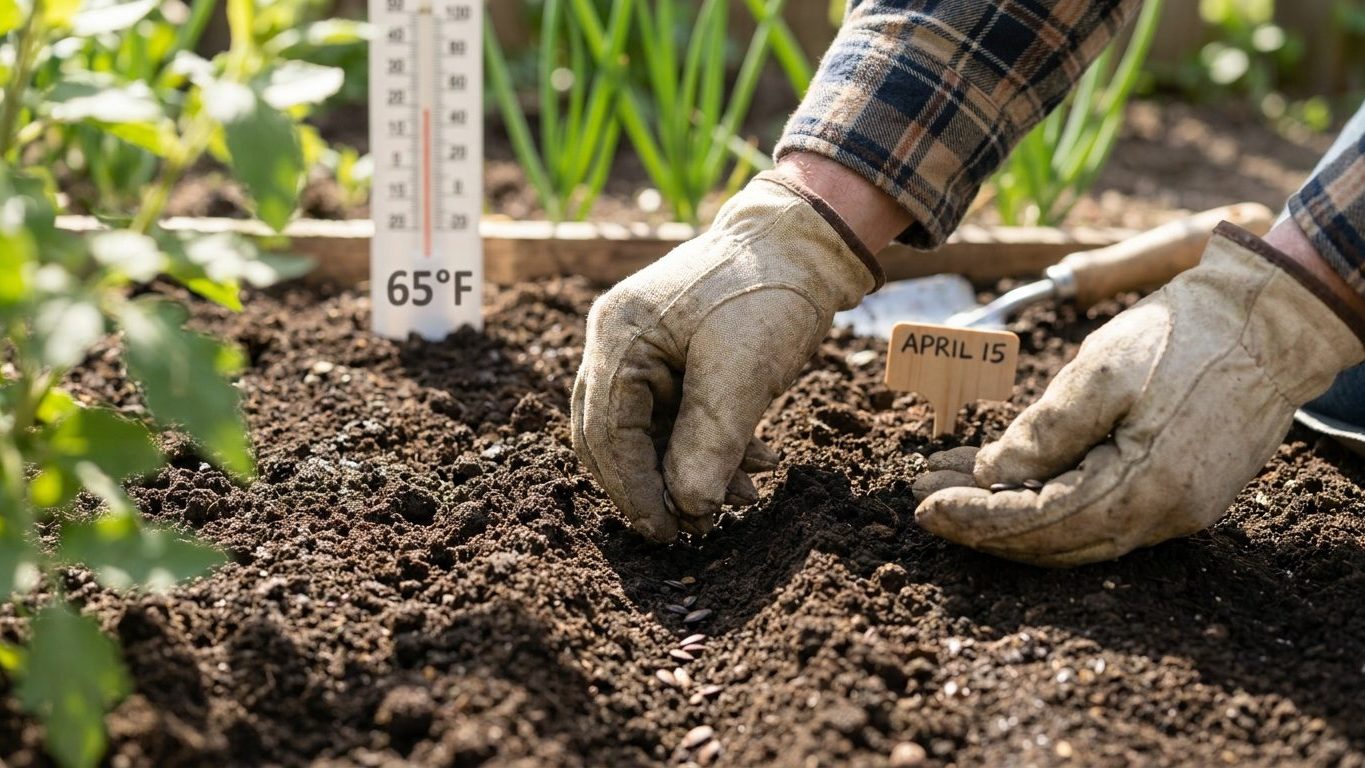

In western Washington, melons go into the ground once soil is reliably warm, typically late May into early June, well after the last spring frost of February 27 to March 18. That frost date is a probability window from 30-year NOAA averages, not a planting trigger: melons need heat the frost date can’t promise.
The short answer for Washington
Plant melon transplants outdoors in western Washington from roughly the last week of May through the first two weeks of June, once nighttime lows sit reliably above 50°F and soil at a 4-inch depth feels warm to the wrist, not just frost-free. The February 27 to March 18 last-frost window from NOAA’s 1991-2020 normals at the Seattle-area reference station (USW00024233) tells you the date range in which a 32°F freeze has a 30 to 70 percent chance of still happening. It says nothing about whether the ground is warm enough for melons, and in this region that gap matters more than almost anywhere else in the country.
Here’s why the frost date and the planting date pull so far apart. Western Washington’s spring soil stays cold and wet long after the air stops freezing, because low light and persistent cloud cover slow ground warming even as daytime highs climb. Melons germinate poorly and sulk visibly below 60°F soil temperature, so a gardener who plants right after the last frost date is usually planting into ground that won’t support real growth for another month. The practical fix, borne out across the region, is to wait until late May at the earliest and treat early June as the safer target.
On the back end, the first fall frost arrives between November 13 and November 30 at the same reference station. That’s a wide cushion on paper, but it’s largely irrelevant to melons here, for a reason the frost dates alone don’t reveal: heat, not cold, is what runs out first. The station averages only 3.0 days a year at or above 90°F. Melons ripen on accumulated heat units, and a maritime Puget Sound summer supplies few of them, so the effective growing window for fruit to actually mature and sweeten is much shorter than the frost-free period suggests.
One caution belongs here in bold terms: these frost and heat figures describe western Washington, the mild, marine-influenced side of the Cascades. Eastern Washington is high desert with a shorter, hotter season and different frost dates entirely, and this page does not have verified figures for that side of the state. Anyone gardening east of the Cascades should not borrow the western window described above.
What will not work here
The single biggest mismatch in this region is planting a long-season, high-heat melon variety and expecting it to ripen on a Puget Sound summer. Varieties bred for 90 to 100+ days of hot-summer maturation are working against a climate that delivers, on average, just 3.0 days a year above 90°F. That’s not a shortage of a few hot days; it’s a near-absence of the heat spikes that push sugar development and rind maturity in the final weeks before harvest. A melon that needs a Georgia or Central Valley summer to finish simply runs out of season here, frost or no frost. The workaround gardeners in this region actually use, black plastic mulch, row cover early on, and shorter-season varieties, exists precisely because the stock advice from hotter states doesn’t transfer.
Watering habits fail here too, but not for the reason people assume. Summer rainfall averages only about 3.0 inches across June, July and August combined, with July, the exact stretch when melon vines are setting and sizing fruit, delivering just 0.6 inches. A gardener who waters once a week and otherwise trusts “it rained recently” is underwatering through the driest month of the growing season at the worst possible time for fruit development. Inconsistent moisture during fruit set is a common cause of blossom drop and stunted melons in this climate, and it traces straight back to that July rainfall number, not to any lack of rain earlier in spring.
Close spacing, which causes real problems in hot, humid states through fungal disease, is less of a hazard here for the opposite reason: this is a comparatively dry summer climate, not a humid one. That doesn’t mean spacing doesn’t matter, though. In a region already short on heat and light, crowded vines shade each other and the soil, which slows the ground warming melons depend on. The spacing failure here isn’t disease, it’s plants competing for the limited warmth the season actually offers.
What changes across Washington
Washington’s USDA hardiness zone range runs from 4a to 9a, a spread of five full zones within one state’s borders, and that number alone should stop anyone from treating this page’s dates as uniform statewide guidance. A 4a-to-9a range, drawn from the USDA’s 2023 Plant Hardiness Zone Map, reflects only average annual extreme minimum temperatures, but it’s still a useful flag for how differently the calendar plays out from the Puget Sound lowlands to Cascade foothill towns and the colder pockets east of the mountains.
The frost and heat figures cited above come from a single reference station representative of the mild, marine-influenced western lowlands. Move north within that same western region, or gain elevation on the western slopes, and both frost dates shift later and the already-thin allotment of 90°F days shrinks further. A gardener in a cooler northern pocket or up in elevation should plan on pushing the transplant date later than early June, leaning harder on black plastic mulch and cloches to bank extra soil heat, and choosing the shortest-maturing melon variety available rather than a mid-season one.
There is no single planting date that fairly represents a state spanning five hardiness zones, and this page is built around one reference station in the mild western part of it. A reader gardening in a colder or higher pocket, or on the eastern side of the Cascades, is working with a meaningfully different season length and heat load than the numbers above describe. Rather than guess which zone applies to a specific yard, the right move is checking the USDA Plant Hardiness Zone Map directly for that address, since a mislabeled zone leads to a wasted transplant far more often than a late-but-correct one.
Where to check this for your own county
Washington State University’s Extension service is the source built for the gap this page can’t close: what actually happens in a specific county rather than at one reference weather station. State-level frost and heat data, like the figures used throughout this page, describe averages at a single site; county extension offices layer local trial results, microclimate notes and grower feedback on top of that, which is exactly the detail that decides whether a melon variety is worth planting in a specific yard.
Two things are worth looking for once there. First, a local or regional planting calendar, if the county office publishes one, since it will reflect actual local frost patterns and soil-warming timelines rather than a statewide average pulled from one station. Second, and often more useful for melons specifically, any list of varieties that have been trialled in that county or region. Extension offices frequently track which melon varieties reliably mature before fall frost in local conditions, information that matters far more than a generic seed-catalog “days to maturity” number, since that number assumes a heat load the local site may never actually deliver.
A county-level recommendation beats a state-level one every time, and it’s worth being direct about what this page is: a state-level starting point, built from one reference station’s climate normals, meant to frame the general timing question rather than settle it for any one address. The frost dates, heat totals and rainfall figures cited here apply specifically to the mild western part of the state; a county office in a different part of Washington, or even a different part of the western lowlands, may work from a noticeably different local pattern. Treating this page as the first stop rather than the last one is the intended use.
Checking this against your own garden
None of the dates above outrank what’s actually happening in a specific yard, and melons give three fairly reliable signals worth checking by hand before trusting a calendar date over local reality.
Soil warmth by feel is the first and most direct check. Push a finger a few inches into the planting bed in the morning; if it feels cool rather than merely damp, the ground likely hasn’t reached the range melon roots need to establish, regardless of what the calendar says about frost risk having passed. This single check catches the exact gap described earlier, between a frost-free date and an actually-warm-enough one, better than any regional average can.
The first flush of male flowers is the second signal, and it matters because male flowers typically open several days to a week before the female flowers that actually set fruit. Seeing male blooms confirms the plant has moved into reproductive growth, but it’s not yet time to expect fruit, and a gardener who sees only male flowers and assumes something’s wrong is usually just early in a normal sequence.
The appearance and vigor of the first true leaves, the second set that emerges after the rounder seed leaves, is the third check. Slow, pale true-leaf growth after transplant is a fairly reliable sign the local soil or air temperature is still lagging behind what the plant needs, and it’s a better real-time indicator of a slow local spring than any single date on this page. Vines that push out true leaves briskly, by contrast, are a sign the local microclimate is running warmer than the regional average, and that the planting window described above can likely be treated as a conservative starting point rather than a hard rule.