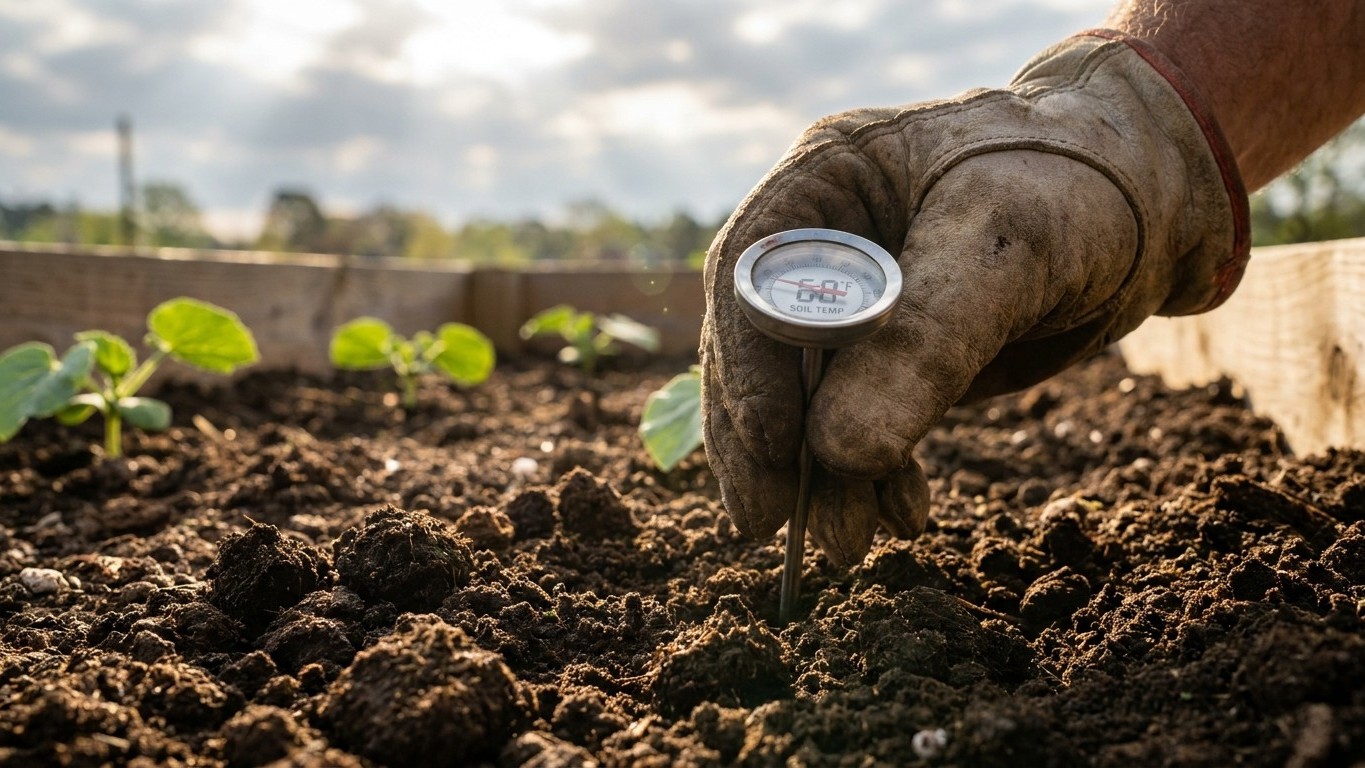

Melons in Washington mean two very different growing realities: a cool, marine-influenced west side where heat is the limiting factor, and a high-desert east side where heat is abundant but the season itself runs shorter. The answer for most home gardeners west of the Cascades comes down to warming the soil early, choosing fast-maturing types, and accepting that some years simply won’t produce a sweet melon.
When the soil is warm enough in Washington
The last spring frost for the Seattle area (NOAA station USW00024233) falls somewhere between February 27 and March 18, based on 1991-2020 Climate Normals. That’s a genuinely mild window by national standards. But melon growers who treat that date as their planting cue are setting themselves up for disappointment.
Frost is a proxy, not the real signal. Melon seed germinates poorly, and melon roots sulk visibly, in soil below roughly 65-70°F. In western Washington, air temperatures can clear the frost threshold weeks before the soil itself warms, because low spring light and persistent cloud cover keep ground temperatures sluggish even after the freeze risk has passed. A frost-free date in early March tells you almost nothing about when the soil under a raised bed actually reaches melon-friendly warmth, which is often closer to late May in a typical year.
This is also where the caution in the climate data matters most: the frost window above describes western Washington, the mild maritime side of the state. East of the Cascades, the growing world changes completely, sliding into high-desert conditions with a shorter, sharper season and much hotter summer days. A gardener in Spokane or the Yakima Valley is working with a different calendar entirely, and should treat any western Washington planting guide as background reading, not a schedule.
For the maritime side of the state, the practical fix is warming the soil artificially rather than waiting on the calendar. Black plastic mulch laid several weeks ahead of transplanting captures solar heat and can push soil temperature up meaningfully faster than bare ground. Cloches, low tunnels, or floating row cover over young transplants buy additional weeks of protected warmth, and raised beds drain and warm faster than flat, heavy garden soil, which matters enormously here given how slow native clay-loam soils are to shed spring moisture.
Remember that the frost date itself is a probability drawn from thirty years of data, not a guarantee for any single spring — some years arrive warm early, others stay wet and cold into April regardless of what the normals say. For which specific melon types have performed well in trial gardens near you, the state’s extension service maintains current, region-specific variety recommendations, which is a far more reliable source than any general guide can be.
How long the season lasts here
Run the two frost dates together and the western Washington growing window stretches long, at least on paper. Using the latest spring frost date (March 18) against the earliest fall frost date (November 13) gives a frost-free stretch of roughly 240 days. Push toward the earlier spring end (February 27) and the later fall end (November 30), and the window opens to something closer to 276 days. Either way, that’s one of the longest frost-free calendars in the continental United States.
A season that long normally invites succession sowing, staggering plantings every couple of weeks to spread the harvest and hedge against a bad stretch of weather. For most warm-season crops in this region, that strategy works well. Melons are the exception that proves the rule.
The frost-free window isn’t what limits melons here, the accumulated summer heat is, and that’s a fixed, short resource regardless of how many frost-free days surround it. A second sowing made in July would still need to mature during the same narrow stretch of warm weeks as the first, competing for the same limited heat rather than getting a season extension. In practice, that makes the first, carefully timed planting the one that matters most, and it raises the question of whether to direct-sow or transplant.
Transplants started indoors and hardened off carefully give melons a head start on a short heat season, but only if the root ball is checked before it goes in the ground: melon roots resent disturbance, and a plant that’s been pot-bound too long will stall rather than take off. In a long-season, cool-summer territory like this one, that root check before transplanting matters more than the calendar math around succession sowing. For a full breakdown of how to stagger plantings where the season allows it, the site’s succession sowing guide covers the timing principles that do apply to companion crops in the same bed.
Heat and water in Washington
The Seattle reference station averages just 3.0 days a year at or above 90°F. That number is the real story for melon growers on the west side, more than any frost date or season length. Melons don’t ripen on a calendar, they ripen on accumulated warmth, and a territory that clears 90°F three days a year simply doesn’t generate much of it.
That reshapes the whole growing strategy. Sowing date becomes less important than heat-capture technique: black plastic mulch, south-facing raised beds, cold frames, and siting melons against a warm wall or fence all do more for a western Washington melon crop than tweaking the planting date by a week or two. Choosing the earliest-maturing types available (again, best confirmed through the state extension service’s local trial data) matters more here than in almost any other part of the country, because there simply isn’t a heat surplus to compensate for a slow-ripening type.
Summer rainfall tells a related story. The region averages about 3.0 inches of rain across June, July and August combined, with July running driest at just 0.6 inches, June at 1.45 inches, and August at 0.97 inches, against an annual total of 39.3 inches. That’s a genuinely dry summer pattern layered under a genuinely cool one, which sounds like it should favor melons (dry ripening conditions are usually a plus) but the low heat load undercuts that advantage. A cool, damp spring followed by a dry but mild summer is a recipe for powdery mildew on melon foliage, slow sugar development in the fruit, and a ripening window that can drag on past what the remaining season allows.
Watering strategy should follow the heat, not just the rainfall numbers. Because evaporative demand stays low without frequent 90°F days, established melon plants here need less supplemental water than the same crop would in a hotter territory, but consistent moisture during fruit set still matters, and July’s 0.6-inch average means irrigation shouldn’t be left to chance during that stretch. This is also where the caution around the reference station applies directly: these are normals for one monitoring point, not a guarantee for a particular yard, and a slope, a nearby building, or a rain shadow can shift the real numbers meaningfully.
Which melons suit Washington
Everything in this territory’s climate profile points toward one conclusion by type, if not by name: the shortest-maturing, most heat-efficient melon types are the ones with a realistic shot at ripening here, and disease resistance should sit right alongside earliness as a selection criterion, given the cool, damp spring conditions and modest but persistent summer moisture already outlined above.
Muskmelon and cantaloupe types generally carry a lower heat requirement than large watermelon types, which makes them the more forgiving choice where accumulated warmth is scarce. Airflow around the vines, achieved through trellising or generous plant spacing, helps counter the mildew pressure that a cool, humid spring sets up. None of that is a substitute for checking what’s actually performed in trial plots near a given garden, though, and this is where a general guide has to stop short.
Naming a specific variety on a page like this would be a disservice, not a shortcut. Variety trials shift from year to year, seed availability changes, and what performed well in a coastal trial garden may behave completely differently forty miles inland or on the dry side of the Cascades. The Washington State University Extension service, at extension.wsu.edu, maintains the kind of locally tested, regularly updated variety data that this page simply can’t replicate or guarantee.
That’s also the honest answer to why this section talks in types and not names: a melon recommendation only means something when it’s tied to a specific microclimate, a specific season’s trial results, and often a specific county’s growing conditions. Reasoning from the territory’s own numbers, a short heat season, a wet spring, a dry but mild summer, gets a gardener most of the way to a smart choice. The extension service closes the gap the climate data can’t.