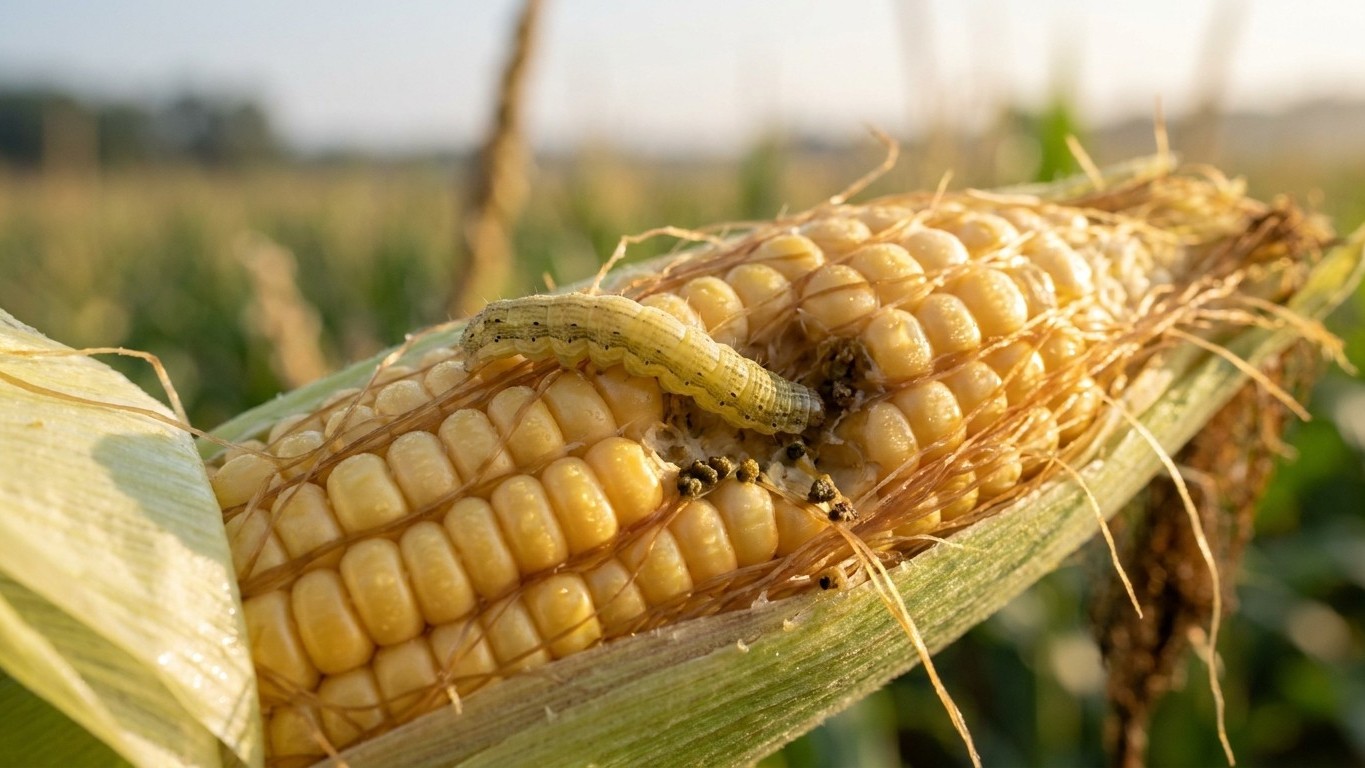

Three insects account for the corn damage documented in Kentucky gardens: spotted cucumber beetle, Japanese beetle, and brown marmorated stink bug. Spotted cucumber beetle works underground on roots and seedlings early. Japanese beetle clips silks during the hottest weeks of summer. Brown marmorated stink bug punctures developing kernels late, right up to the first fall frost.
Which pests attack corn in Kentucky
University of Kentucky Extension Entomology documents ten pests across the landscape and garden plants it tracks statewide: Azalea lace bug, Bagworm, Brown marmorated stink bug, Eastern tent caterpillar (Malacosoma americanum), Fall webworm, Japanese beetle, Spotted cucumber beetle, Squash bug, Squash vine borer, and Striped cucumber beetle. That’s the full list this service publishes for the region, and it isn’t a corn-specific list, so most of the names on it have no business anywhere near a corn row.
Azalea lace bug feeds on azalea and rhododendron foliage, sucking chlorophyll from broadleaf evergreens. It has no reason to cross into a vegetable bed. Bagworm builds its spindle-shaped case on arborvitae, juniper, and a range of ornamental trees, chewing needle and leaf tissue there, not on grasses like corn. Eastern tent caterpillar spins its silk tents in the forked branches of wild cherry, apple, and crabapple, feeding in colonies on tree foliage through spring. Fall webworm does something similar later in the season, wrapping hardwood branches in loose webbing. Neither ever touches a corn plant.
Squash bug and squash vine borer both target cucurbits, meaning squash, pumpkin, zucchini, and their relatives; their mouthparts and egg-laying habits are built around vine crops, not corn stalks. Striped cucumber beetle belongs to the same cucurbit-feeding guild, chewing leaves and transmitting bacterial wilt in melons and cucumbers. It will wander through a garden, but corn isn’t what draws it there.
That leaves three species that actually feed on corn: brown marmorated stink bug, Japanese beetle, and spotted cucumber beetle. The last one matters twice over, because its larval stage is the corn rootworm familiar to anyone who has grown field corn, feeding underground on roots before the adult beetle ever shows up on foliage. Only three of the ten pests University of Kentucky Extension Entomology tracks statewide actually feed on corn, which means treating a corn problem for anything else on that list wastes time and money on the wrong plant.
When each one shows up, and what it does first
Corn can’t go into the ground until the soil itself warms past 60°F, and that point arrives well after the last spring frost, which runs March 24 to April 4 at the reference station used for this territory. It’s in that gap between frost and warm soil, and the days right after planting, that spotted cucumber beetle larvae start their damage. The first sign isn’t a beetle at all: it’s a thin stand, seedlings that wilt in the heat of the day even with adequate soil moisture, or young plants that lodge over because their root systems have been pruned underground. Adult spotted cucumber beetles show up on the same seedlings a little later, chewing ragged notches along leaf edges.
Summer heat brings the second wave. The reference station averages 37.2 days a year at 90°F or above, and that stretch of sustained heat lines up with tasseling and silk emergence on most plantings. Japanese beetle adults become active in exactly that window, and their first sign is unmistakable once you know to look for it: silk strands clipped short and browned at the tips, sometimes chewed back far enough to interfere with pollen catching the silk at all. Beetles cluster on the ear tips in daylight, often in visible numbers, which is different from most corn pests that hide their feeding.
Brown marmorated stink bug arrives last, working on ears as they fill through the back half of the season and up toward the first fall frost, which falls November 2 to November 12. Its feeding is the hardest to spot early, because the insect pierces through the husk to reach individual kernels, leaving the outside of the ear looking untouched. The first real sign usually only shows up when the husk is pulled back: scattered kernels that are shriveled, discolored, or missing entirely from what should be a full, even row.
Telling the damage apart from everything else
Corn problems that look like insect feeding often aren’t. A stand that comes up thin and uneven can mean cucumber beetle larvae pruning roots, but it can just as easily mean seed that rotted in cold, wet soil before germination, or a planting depth that was too deep for the seed size. Digging up one weak plant and checking the roots for actual pruning or tunneling is the step that separates the two, and it’s a five-minute job most gardeners skip.
Ragged or browned silks raise the same kind of question. Japanese beetle feeding produces a clipped, chewed silk tip with the beetles often still present on the ear. Drought stress produces something that looks similar from a distance, but the leaves tell a different story: they roll lengthwise along the stalk to conserve moisture, and that rolling shows up whether or not any silk damage is present.
Kernel damage inside the husk is the trickiest call. Brown marmorated stink bug feeding leaves individual, scattered kernels shriveled or discolored, with a visible puncture mark if you look closely. A potassium or other nutrient deficiency tends to affect the ear more uniformly, often showing poor fill concentrated at the tip rather than scattered through the row. Storm damage or a pass too close with a mower or tiller produces a clean snap or shredded stalk tissue, not the chewed, frass-marked leaf margins that come from an insect actually feeding there.
| Symptom | Possible insect cause | What tells it apart |
|---|---|---|
| Thin stand, wilted seedlings | Spotted cucumber beetle larvae on roots | Dig up a plant; check roots for pruning or tunneling |
| Clipped, browned silks | Japanese beetle feeding | Beetles visible on ear tips vs. leaves rolled from drought |
| Discolored, scattered kernels under husk | Brown marmorated stink bug | Individual puncture marks vs. uniform tip fill failure from deficiency |
| Torn leaves, broken stalks | Not insect feeding | Clean snap or shred pattern from wind or equipment |
None of this replaces a local diagnosis. When two causes look plausible side by side, that’s the point to send a photo or a sample to a county extension office rather than guess.
What actually works here, and what is a waste of time
Physical barriers do the most reliable work on a short season, and timing is what makes or breaks them. Fine mesh row cover over newly planted seedlings keeps spotted cucumber beetle adults off the plants while the soil is still warming toward that 60°F planting threshold and roots are getting established. Removing the cover before tasseling isn’t optional, because corn depends on wind to carry pollen from tassel to silk, and a cover left on past that point can cost the ear its pollination window entirely.
Japanese beetles are sluggish in cool morning air, which makes hand-removal into a bucket of soapy water more effective at that hour than at any other time of day. It’s slower than spraying, but on a garden-scale planting it works, and it avoids killing pollinators that visit the same tassels.
Planning for the sweet corn types themselves matters as much as any pest control. Su, se, and sh2 varieties lose their sweetness if they tassel at the same time, since cross-pollination between types changes kernel quality on the ear. Staggering plantings so the types don’t tassel together, and setting sweet corn out in blocks of three or more rows rather than a single line, both improve pollination and reduce how concentrated any one pest population gets in a single tasseling window, according to Utah State University Extension.
What doesn’t work is spraying broadly once ear fill has already started. Brown marmorated stink bug feeds through the husk, so by the time damage shows up on opened ears, the feeding that caused it happened days earlier and can’t be undone. Waiting for visible exterior damage before acting is, for this particular pest, waiting too long.
Where to check this for your own county
Everything documented above comes from University of Kentucky Extension Entomology, and it’s published at the state level. A pest list built for the whole state doesn’t say what’s actually present in one backyard, since populations of spotted cucumber beetle, Japanese beetle, and brown marmorated stink bug all vary county to county and even garden to garden depending on nearby crops, tree cover, and past-season pressure.
The county cooperative extension office is the next step for anything that doesn’t match cleanly with the symptoms above, or for a pest that seems to be doing damage without matching any of the three species covered here. Extension staff can confirm an identification from a sample or a clear photo, and they know what’s currently active in that specific county, which a statewide list can’t provide.
It’s also worth remembering that the frost dates driving this whole calendar come from a single reference station, and NWS Louisville has noted that this urban station runs later in spring and earlier in fall than the surrounding rural county. A garden outside town should expect a tighter frost-free window than the dates above suggest, which shifts every pest window earlier or later along with it. Calling ahead of a suspected problem, rather than after damage is already done, is what actually saves a stand of corn.
Common questions
Does Japanese beetle really hurt corn yield, or just look bad?
It can cut yield directly. If beetles clip silks heavily during the short window when pollen is shedding, kernels fail to form along the affected part of the ear, not just cosmetically but in actual kernel count.
Can I plant sweet corn and field corn near each other?
The source behind these facts, Utah State University Extension, gives no isolation distance between corn types. What it does say is that su, se, and sh2 sweet corn lose sweetness if they tassel at the same time as each other or as field corn nearby, so staggering planting dates to separate tasseling matters more than any specific distance.
What is the earliest safe date to plant corn in Kentucky?
There’s no single calendar date published here. Soil needs to be above 60°F, and that point comes well after the last spring frost of March 24 to April 4 at the reference station, with rural areas likely reaching it a bit later still.
Do all three pests show up every year?
University of Kentucky Extension Entomology documents these three as present in the state, but presence and pressure aren’t the same thing every season. A county extension office is the source for how heavy a given year’s activity actually is locally.