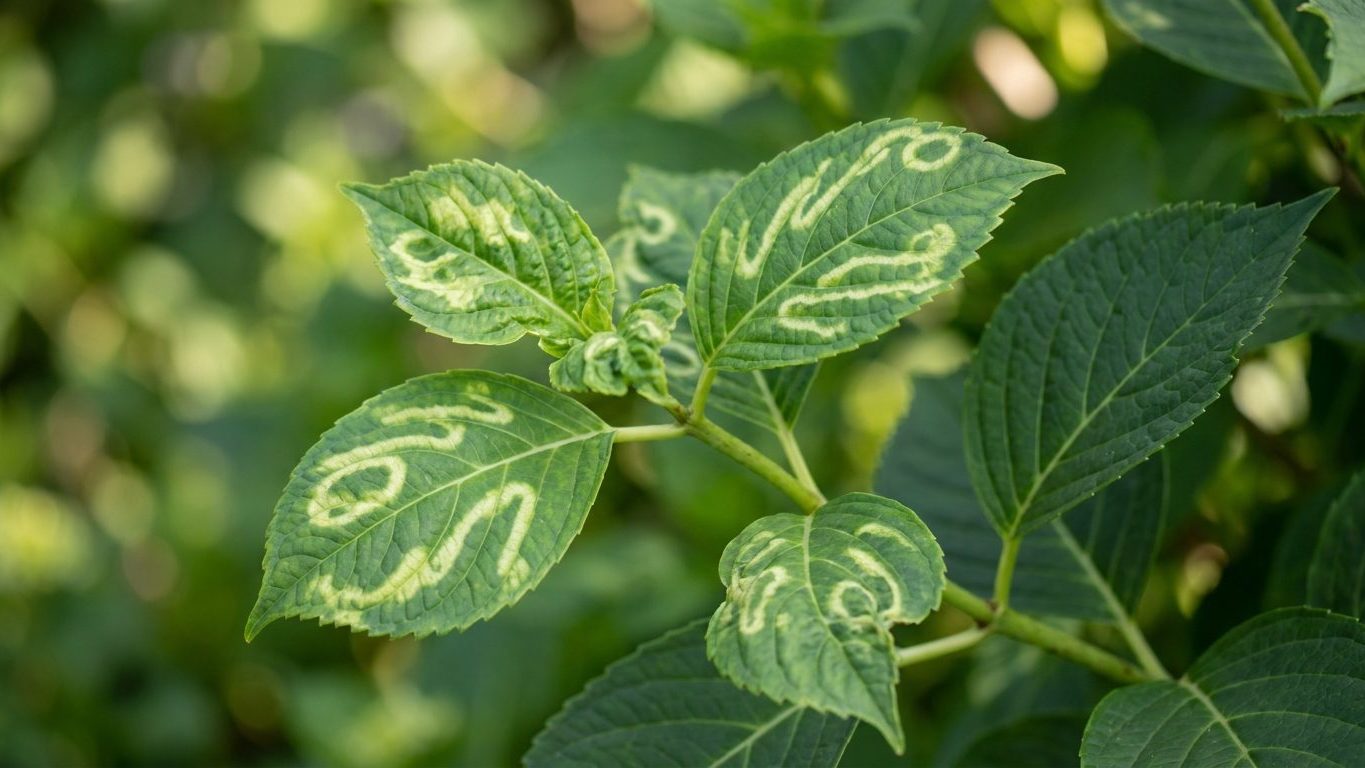

A hydrangea showing pale rings, mottled bands, or wavy green-and-yellow patterns across its leaves usually is not dying, and it is not something a fungicide will fix. Ringspot symptoms are cosmetic and chronic rather than fatal, but they do not clear on their own, and they do not respond to a spray program built for a fungus or bacterium.
What you are looking at
Yes, this is worth identifying correctly, and no, it does not move fast. A viral pattern like this settles into a plant and stays, sometimes for years, without killing it outright. The tell is the shape of the marking itself: not a discrete spot with a hard border, but a diffuse ring, arc, or oakleaf-shaped band of lighter tissue set against the normal green. It often shows first on leaves that were expanding when the plant was infected or propagated, which means older growth and newer growth can look different on the same shrub at the same time.
Chlorotic rings and mottled bands on the leaf blade
Look for pale yellow-green rings, sometimes closed like a target and sometimes broken into arcs, scattered across an otherwise healthy-colored leaf. The ring itself has no raised edge and no dead center the way a fungal lesion does. The color inside the ring is usually just a lighter shade of green, not brown or tan, and the pattern can shift slightly from leaf to leaf on the same stem.
Leaf puckering and slight distortion
On some leaves the ringed tissue grows a little slower than the surrounding blade, which pulls the leaf into a mild pucker or wave. It is subtle, not the dramatic curling of a herbicide injury, and the leaf stays attached and functional.
Uneven vigor between shoots on one plant
One cane may show strong, evenly colored growth while the cane next to it carries every ringed leaf on the shrub. That patchiness, symptoms on some shoots and not others, is itself a clue, because a soil-borne or airborne pathogen usually spreads more evenly across a plant than a virus already circulating unevenly through its vascular tissue.
What it is not
Two conditions get mistaken for this one constantly, and a third, non-disease cause gets blamed just as often. Getting the wrong answer here matters because one path leads to a fungicide that does nothing, and the other leads to yanking a plant that only needed a season to settle down.
Leaf spot (fungal)
Leaf spot produces a discrete lesion with a defined margin, often purple to reddish-brown at the edge with a tan or gray center where the tissue has actually died. Cut that lesion open with a fingernail and the center crumbles, because it is dead. A ringed viral pattern has no dead center to speak of; the tissue inside the ring is simply pale, still alive, still functioning. Leaf spot is on the disease list documented for hydrangea, and it responds, at least partially, to cultural cleanup and fungicide timing. A virus does not.
Powdery mildew
Powdery mildew shows up as a white to gray dusty film sitting on top of the leaf surface, most visible in the cooler part of the morning before it dries down. Wipe a finger across it and the powder smears. There is nothing to wipe off a ringspot pattern, because the color change is inside the leaf tissue, not a coating on it. Mildew is also named as a documented hydrangea disease and, like leaf spot, is manageable with airflow and fungicide; mistaking a virus for mildew means spraying a plant that was never going to respond.
Herbicide drift or nutrient blotching
Drift injury and nutrient issues both tend to hit new growth uniformly across the whole plant rather than in isolated rings on scattered leaves, and the pattern usually follows the direction of spray drift or matches a soil deficiency pattern rather than a leaf-by-leaf ring shape. A drift-injured leaf often shows overall bleaching or strapping of the whole blade, not a contained ring within otherwise normal green tissue.
| Condition | Lesion shape | Tissue state inside marking | Responds to fungicide |
|---|---|---|---|
| Ringspot pattern | Diffuse ring or arc, no hard edge | Alive, just pale | No |
| Leaf spot | Discrete spot, defined dark margin | Dead center | Partially |
| Powdery mildew | Dusty surface film | Coating, wipes off | Yes |
| Herbicide drift | Whole-leaf bleaching or strapping | Uneven, not ringed | Not applicable |
Where it comes from and when it strikes
This is the part that gives the pattern its name in this piece: it came in with the plant. Viruses that produce ringspot symptoms in hydrangea are not picked up from this season’s rain or this year’s soggy soil the way a fungal spot is. They travel inside the plant’s own tissue, which means they move from a mother plant into every cutting or layered piece taken from it. Hydrangeas are commonly propagated by stem cutting or layering, and a virus already present in the parent goes along for the ride into every new plant made that way.
Mechanical spread within a planting is the other route: pruning shears, grafting tools, or even repeated handling can carry infected sap from one shrub to a healthy one at the cut surface. Some plant viruses in ornamentals also move via aphids feeding first on an infected plant and then a clean one nearby, and aphids are already a named pest of hydrangea, so that path is plausible even where it has not been specifically confirmed for this pattern.
Weather does not create the virus, but stress makes existing symptoms easier to see. A plant under drought pressure or recovering from a hard prune often shows its ringed patterning more clearly than the same plant growing under steady, unstressed conditions, simply because the contrast between healthy and infected tissue becomes more visible when overall vigor drops.
What to do about it now
There is no spray, soil drench, or systemic treatment that clears a plant virus from a hydrangea, and saying otherwise would only cost you money and a season of false hope. What actually changes the outcome from here is containment, not cure.
Sanitize pruning tools between plants with isopropyl alcohol or a diluted bleach solution, every time you move from one hydrangea to another, since this is the single most controllable route of new infection in an established bed. Stop taking cuttings from any plant showing this pattern; propagating from it only multiplies the problem into new pots. If the shrub is otherwise healthy, flowering normally, and the ringing is mild, most gardeners choose to leave it in place and simply avoid propagating it, since removal is a management decision, not a medical necessity. A plant that is badly distorted, stunted, or an eyesore in a prominent spot is a reasonable one to dig out and replace, particularly if it sits near other hydrangeas you would rather protect.
None of this changes the plant’s own separate safety profile. Bigleaf hydrangea foliage, bark, and flowers contain cyanogenic compounds and can cause nausea, stomach pain, vomiting, and sweating if eaten in quantity, a risk for pets, dogs, horses, and children pulling at fallen leaves, and it has nothing to do with the virus itself. Rake and dispose of removed leaves away from where animals graze regardless of the reason for the pruning.
Keeping it out next season
Sourcing is the real control here, more than spacing or airflow. Buy from a nursery that can speak to clean propagation stock rather than taking a free cutting from a neighbor’s questionable shrub, since the virus rides in on the tissue itself and no amount of good soil or sunlight will screen it out afterward. There is no published list of ringspot-resistant hydrangea cultivars to point to here, so the honest answer is that resistance breeding for this pattern is not documented the way it is for some fungal diseases; clean stock is the substitute for a resistant variety.
Keep pruning tools dedicated or sanitized between plants as routine maintenance, not just a response to symptoms already showing. Watch for aphids as a general good practice, since they are a known hydrangea pest and a plausible carrier for plant viruses generally, even without airflow or spacing offering the same protection it does against fungal leaf spot and powdery mildew, both of which do respond to sunlight and circulation in a way this pattern does not.
If you are replacing a shrub rather than nursing it along, remember the type dictates everything else about its care: bigleaf hydrangea flowers on the previous year’s wood and needs pruning finished before new buds set, while panicle hydrangea flowers on the current season’s growth, tolerates a hard cutback, and handles full sun and colder winters better, making it a reasonable substitute where a bigleaf hydrangea has struggled anyway.
Common questions
Will ringspot virus kill my hydrangea? Rarely on its own. Symptoms are typically cosmetic and chronic, and most affected plants keep flowering for years; severe, generalized decline points toward a different problem worth checking separately.
Can I still take cuttings from a hydrangea with mild ringspot symptoms? Avoid it. Propagation carries the virus into every new plant made from that tissue, even if the parent looks otherwise healthy.
Does removing the affected leaves cure the plant? No. The virus is systemic, present throughout the plant’s tissue, not confined to the leaves you can see it on, so leaf removal only tidies appearance.
Is it safe to compost the pruned material? Home composting that reaches a sustained hot phase generally breaks down plant pathogens, but if you are unsure your pile gets hot enough, bagging and trashing infected prunings is the lower-risk choice, especially near other hydrangeas.