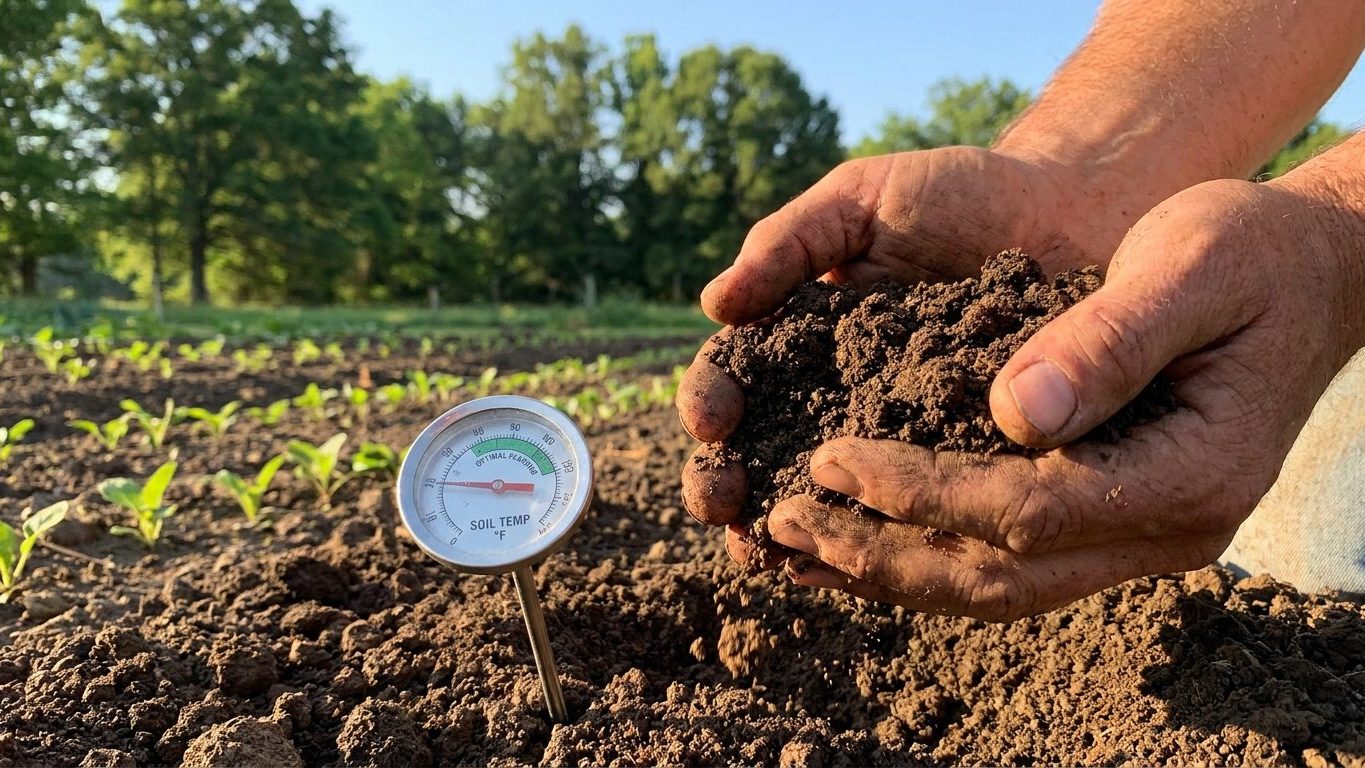

Winter squash goes into Pennsylvania ground once the soil has warmed past the last spring frost, typically late April into May depending on where you garden, and it needs roughly seven months of open season to mature fully before the first fall frost. The state’s moderate heat and humid summers make squash type and disease resistance bigger factors here than in hotter, drier regions.
When the soil is warm enough in Pennsylvania
The question gardeners actually ask is “when do I plant,” but the honest answer starts with a different question: when does the soil stop being cold? At the reference station in Philadelphia, NOAA’s 1991-2020 Climate Normals put the last spring frost between March 29 and April 6. That’s a 30-70% probability band, not a guarantee, and it’s worth saying once, clearly: a frost date is a probability, not a promise. Some years the last freeze comes earlier, some years later, and no calendar page changes that.
Frost is a proxy, and a rough one for winter squash. This is a warm-season vine crop that germinates poorly and grows sluggishly in cold soil, so the real trigger isn’t the frost-free date on the calendar, it’s soil temperature climbing well above where a squash seed will simply rot instead of sprout. In practice that means waiting two to three weeks past the last frost date before direct-seeding or setting out transplants, letting the ground catch up to the air.
Philadelphia is the mildest corner of Pennsylvania. The northern tier and the Alleghenies run two to four weeks later in spring, which matters enormously for a crop that needs every week of the season it can get. A gardener in Erie County or up in the Poconos isn’t working with the same calendar as someone in Chester County, even though both are technically “Pennsylvania.”
What the hardiness zone actually tells you
Pennsylvania spans USDA Hardiness Zones 5a to 7b, based on the 2023 Plant Hardiness Zone Map (built on 1991-2020 normals). That range is wide enough to be nearly meaningless as a single number for the whole state, and it’s worth remembering what the zone system actually measures anyway: the average annual extreme minimum winter temperature, nothing about summer heat, nothing about frost dates, nothing about rainfall. It tells you what survives winter, not when to plant squash in spring. For a dated planting recommendation, the reference city (Philadelphia, at the milder end of that range) is more useful than the statewide zone span. Beyond that, the state’s own extension service, at extension.psu.edu, publishes planting calendars adjusted for local county conditions, and that’s the resource worth checking before committing seed to soil.
How long the season lasts here
Subtracting the two frost windows gives a working season length, and because both dates come from the same NOAA source, the math holds. Using the more cautious pairing (latest last-frost date, earliest first-frost date) gives about 213 days from April 6 to November 5. Using the more generous pairing (earliest last-frost, latest first-frost) stretches to about 232 days, from March 29 to November 16.
| Scenario | Spring frost end | Fall frost start | Approximate window |
|---|---|---|---|
| Cautious (shorter) | April 6 | November 5 | ~213 days |
| Generous (longer) | March 29 | November 16 | ~232 days |
That’s a real range, and it’s shaped as much by county as by year. A gardener in the northern tier, running two to four weeks behind the reference station in spring, is closer to the shorter end of that table, sometimes tighter still.
What does that length actually allow? For most vegetables, a 200-plus-day window is generous enough to fit two plantings, an early crop followed by a second sowing once the first is harvested. Winter squash doesn’t work that way. The vines need the bulk of that window just to flower, set fruit, and cure the rind before frost, so in Pennsylvania the first sowing is usually the only sowing. That single-shot reality changes the transplanting calculus too: winter squash resents root disturbance, and where the season is tight, many growers direct-seed rather than risk the setback of a transplant shock eating into weeks they don’t have to spare. Where the window runs closer to 232 days, there’s a little more room to gamble on an early transplant start indoors. For crops where succession really does pay off in Pennsylvania’s calendar, the site’s succession sowing guide lays out which vegetables can fit a second round and which, like winter squash, can’t.
Heat and water in Pennsylvania
Winter squash lives or dies by one rule: the fruit has to mature fully on the vine before frost. An immature squash doesn’t cure properly and doesn’t store, no matter how good it looks sitting in the garden. That makes season length the dominant factor everywhere this crop grows, and Pennsylvania’s roughly 213-to-232-day window sits in the middle range nationally, tight enough that type selection matters, not so short that only the fastest types have a chance.
Heat load here is moderate, not extreme. At the Philadelphia reference station, the 1991-2020 normal counts 24.0 days a year at or above 90°F. That’s a real but modest number, nowhere near the desert Southwest’s summer stretches, and it means Pennsylvania isn’t a territory where irrigation has to carry squash through weeks of punishing heat stress. Where this figure runs into the triple digits elsewhere, growers plan around shading roots and constant watering just to keep vines alive; that’s not the Pennsylvania story.
The Pennsylvania story is water abundance paired with humidity. Summer rainfall averages about 12.7 inches across June, July, and August, broken down as June 4.04 inches, July 4.38 inches, and August 4.29 inches, fairly even across the three months. That’s a wet summer by national standards, and it comes with a tradeoff: consistent rain and humid air are exactly the conditions that favor powdery mildew and other fungal disease on squash foliage, along with slower ripening in a cool, damp stretch. This isn’t a hot, dry territory where the gardener’s main job is hauling water. It’s a territory where airflow between plants, morning watering instead of evening, and keeping foliage as dry as practical matter more than irrigation volume.
None of this is a forecast for any single backyard. Rain that falls as one heavy thunderstorm behaves differently than the same total spread over a week of drizzle, and a sandy plot drains what a clay plot holds for days. A rain gauge on the actual growing site, tracked through a season, tells a gardener more than any regional normal ever will.
Which winter squash suit Pennsylvania
Given a season in the low-to-mid 200s of days and summers that are humid more than scorching, the type of winter squash matters more here than in places where heat alone decides everything. Earlier-maturing types, acorn and delicata among them, carry less risk in a state where the northern counties are working with the tighter end of the frost window. Longer-season types like some hubbard and kabocha selections need the full stretch of the growing window and are safer bets in the milder southeastern counties than up near the New York border.
Because Pennsylvania’s summers run wet and humid rather than dry and hot, disease resistance deserves to be the first filter applied, ahead of size or shape. Powdery mildew pressure builds through a humid Pennsylvania summer regardless of squash type, and vines planted too close together, with poor airflow between them, tend to show it first. Spacing that lets leaves dry out after rain does more for a squash patch here than any amount of extra watering.
Common squash groupings worth knowing when comparing options with local growers or the extension office include:
- Acorn types, generally earlier maturing, well suited to shorter windows
- Butternut types, a common middle-season choice with reliable storage qualities
- Delicata, quicker to mature, thinner-skinned, less suited to long storage
- Hubbard and kabocha types, longer season, larger vines, benefit from the fuller end of the frost window
- Spaghetti squash, moderate season length, distinct texture rather than sweetness
What this page won’t do is name a specific cultivar, and that refusal is deliberate rather than an oversight. Variety trial results shift year to year and county to county, and the only recommendation worth trusting is one built from local trial data. Penn State Extension, at extension.psu.edu, runs and publishes exactly those trials for Pennsylvania conditions, county by county, and that’s the resource that turns “winter squash type” into an actual seed packet worth buying for a specific garden in a specific corner of the state.