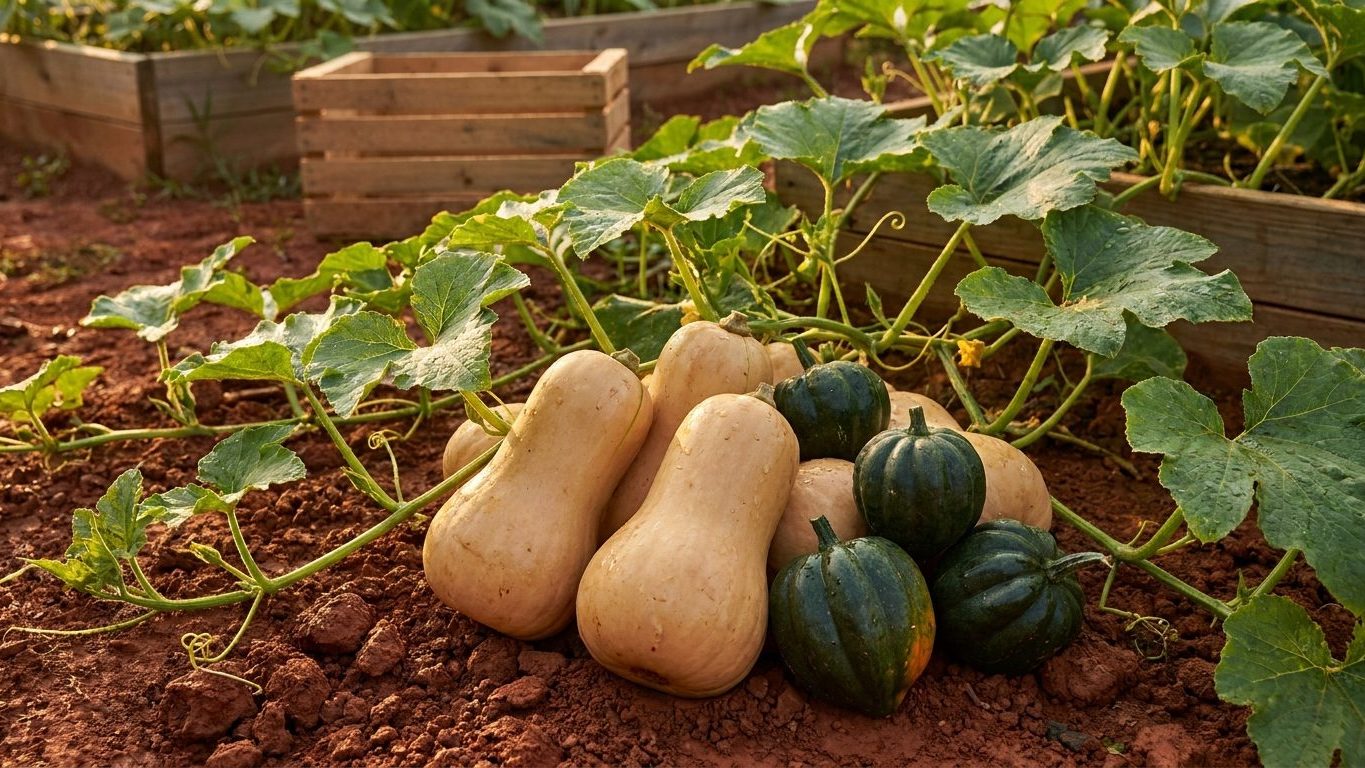

Massachusetts gardeners do best with mid-season winter squash, the 80- to 100-day types like acorn, delicata, and butternut, because the state’s frost-free window rewards a plant that finishes before mid-autumn rather than one racing a long-season clock. Slower storage pumpkins and giant Hubbard types work only along the coast.
The short answer for Massachusetts
Start with the type, not the variety name on the seed packet. The reference station for this state, Boston’s Logan Airport, sees its last spring frost between April 1 and April 8 and its first fall frost between November 3 and November 14. That gives a frost-free window of roughly 210 to 225 days at the mildest point in the state, and it is worth repeating: that’s the mildest point, a waterfront urban station, not a number that travels inland.
Inside that window, a winter squash that needs 80 to 100 days from seed to harvest has real margin, even allowing for a cool, slow spring. That covers most acorn squash, delicata, buttercup, and the standard butternut varieties sold at any garden center in the state. These are the safe default for a first-time grower or for anyone gardening somewhere colder than the coast, because they still mature comfortably even if the season runs two or three weeks short of the Boston average.
Longer-season types, the 100- to 120-day Hubbard squash and the biggest storage pumpkins, fit the math only where the frost-free window runs long, meaning the coastal strip and the Cape. Plant one of these inland or at higher elevation and a normal fall frost can catch the fruit before the rind has hardened and the sugars have set, which is the difference between a squash that stores through February and one that rots by Thanksgiving.
Heat is a secondary factor here, not the deciding one. Boston averages 10.2 days a year at or above 90°F, a moderate load that supports full ripening for classic Northeast varieties without pushing them into heat stress. That number matters less for variety choice than for timing: it means there is no long stretch of blazing weather to accelerate a slow-maturing squash, so the days-to-maturity figure on the seed packet should be trusted rather than assumed to run faster than advertised.
What will not work here
The clearest failure mode in Massachusetts is planting a slow variety on a short calendar. A 120-day Hubbard sown in early June, after the soil has finally warmed, is racing a fall frost that can arrive as early as November 3 even at the mild coastal reference point, and considerably earlier than that inland. Add a cool, wet spring that delays germination by a week or two, and that squash simply runs out of season. This is not a marginal risk in the Berkshires or the interior valleys; it is the single most common reason a winter squash crop fails to size up or fails to cure properly before storage.
Humidity is the second trap, and it catches gardeners who assume more rain always helps. Massachusetts summers bring about 10.4 inches of rain across June, July, and August, with August, the critical ripening month, still delivering 3.23 inches on average. That is enough moisture, combined with typical summer humidity, to keep foliage damp for long stretches, and winter squash vines planted at tight spacing or trained up a shaded trellis without airflow are prone to powdery mildew and downy mildew by late summer. A variety bred for dry Western growing conditions, or a planting laid out the way a Southwestern garden would be, invites disease pressure this state’s summers are set up to deliver.
The third mismatch runs the other direction: assuming this is a hot-summer state and choosing a squash bred for Deep South or desert heat, the way some Seminole pumpkin or heat-adapted cushaw varieties are. With only 10.2 days a year above 90°F, Massachusetts does not deliver the sustained heat those varieties use to concentrate sugars and cure quickly. They can still grow here, but expect a longer, less certain path to full ripeness than the seed packet, written with a hotter climate in mind, describes.
Finally, a watering routine built around a dry-climate assumption underperforms here too, just less dramatically. August is the driest summer month at 3.23 inches, and on sandy, fast-draining soil that is not enough to carry a heavy-fruiting squash vine through the final weeks of sizing without supplemental water, even though the state as a whole is not considered drought-prone.
What changes across Massachusetts
Massachusetts spans USDA hardiness zones 5a to 7b, one of the widest spreads packed into a single small state, and that range is built on average extreme minimum winter temperature, not on frost dates or growing-season length directly. Still, the pattern tracks: the 7b end sits along the immediate coast and the Cape and Islands, the 5a end sits in the higher Berkshires, and the frost dates cited above, drawn from the Boston reference station, describe something close to the mild end of that spread, not the average.
No single frost-free window applies to the whole state. A gardener at the milder end can lean on the 100- to 120-day varieties, the big Hubbards and storage pumpkins, with reasonable confidence that the season will carry them to full maturity. A gardener toward the colder end should shift the whole plan earlier and faster: start seed indoors two to three weeks before the average last frost rather than direct-sowing, choose the 80- to 95-day end of the acorn and delicata range, and consider black plastic mulch to warm the soil ahead of transplanting, since cold soil delays germination more than cool air delays vine growth.
Elevation compounds the zone difference inside the Berkshires and the hill towns of the interior, where valley bottoms collect cold air on clear nights and can frost weeks earlier in fall than a hillside just a few hundred feet higher. None of this can be resolved from a state-level page. The right move is to check the USDA Plant Hardiness Zone Map for a specific address, treat this article’s frost-date range as an outer bound rather than a personal forecast, and adjust variety choice toward the faster end of the spectrum whenever there is real uncertainty about local season length.
Where to check this for your own county
UMass Extension is the land-grant service for Massachusetts, and it is reachable at ag.umass.edu. This state-level article can describe frost-date ranges and general variety categories, but it cannot know the microclimate of a specific county, a specific hillside, or a specific backyard, and it should not pretend to.
Two things are worth looking for once there. First, a regional or county-level planting calendar, since UMass Extension research spans coastal, Connecticut River Valley, and Berkshire growing conditions that differ meaningfully from the Logan Airport frost dates. Second, any variety trial results for winter squash specific to Massachusetts growing conditions, which carry more weight than a national seed catalog’s days-to-maturity figure, because trial data reflects how a variety actually performs under the state’s rainfall and heat pattern rather than under ideal test-plot conditions elsewhere.
A county recommendation beats a state one every time, and that is worth saying plainly rather than glossing over. Across Massachusetts as a whole, mid-season varieties are the safe default, longer-season types are reserved for the mildest coastal areas, and disease pressure from summer humidity is a real design constraint. But a Berkshire County frost date, a Cape Cod soil type, or a Connecticut River Valley extension bulletin will always be more precise than a statewide range built from a single reference station. Treat what is written here as the starting framework, and treat the county-level source as the correction.
Checking this against your own garden
No planting calendar, including this one, outranks what the plant itself is doing in a specific yard. Three signs are worth tracking by direct observation, no thermometer or gauge required beyond a hand pushed into the soil.
Soil warmth by feel is the first and most reliable check. Winter squash seed germinates poorly in soil that still feels cool and damp rather than warm and slightly dry to the touch, regardless of what the calendar date says. A garden that runs cold, whether from clay soil, shade, or a low spot that collects night air, needs a later sowing date than the state’s average frost dates suggest, even if a neighbor a mile away is already planting.
The first flush of male flowers, which typically appear before the female flowers and don’t set fruit, signals that the plant has shifted into active reproductive growth. If that flush arrives noticeably later than the days-to-maturity figure on the seed packet would predict from the sowing date, it is a sign the local season is running behind the regional average, and it’s worth mentally pushing back the expected harvest date rather than assuming the plant will simply catch up.
The pace of true-leaf development in the first few weeks after germination is the third marker. Squash that sits at the two-leaf stage for an unusually long stretch, compared to what the seed packet’s timeline implies, is responding to a cooler or shadier microclimate than the state average, and that observation, made directly in the garden bed, matters more than any frost date pulled from a distant airport station.