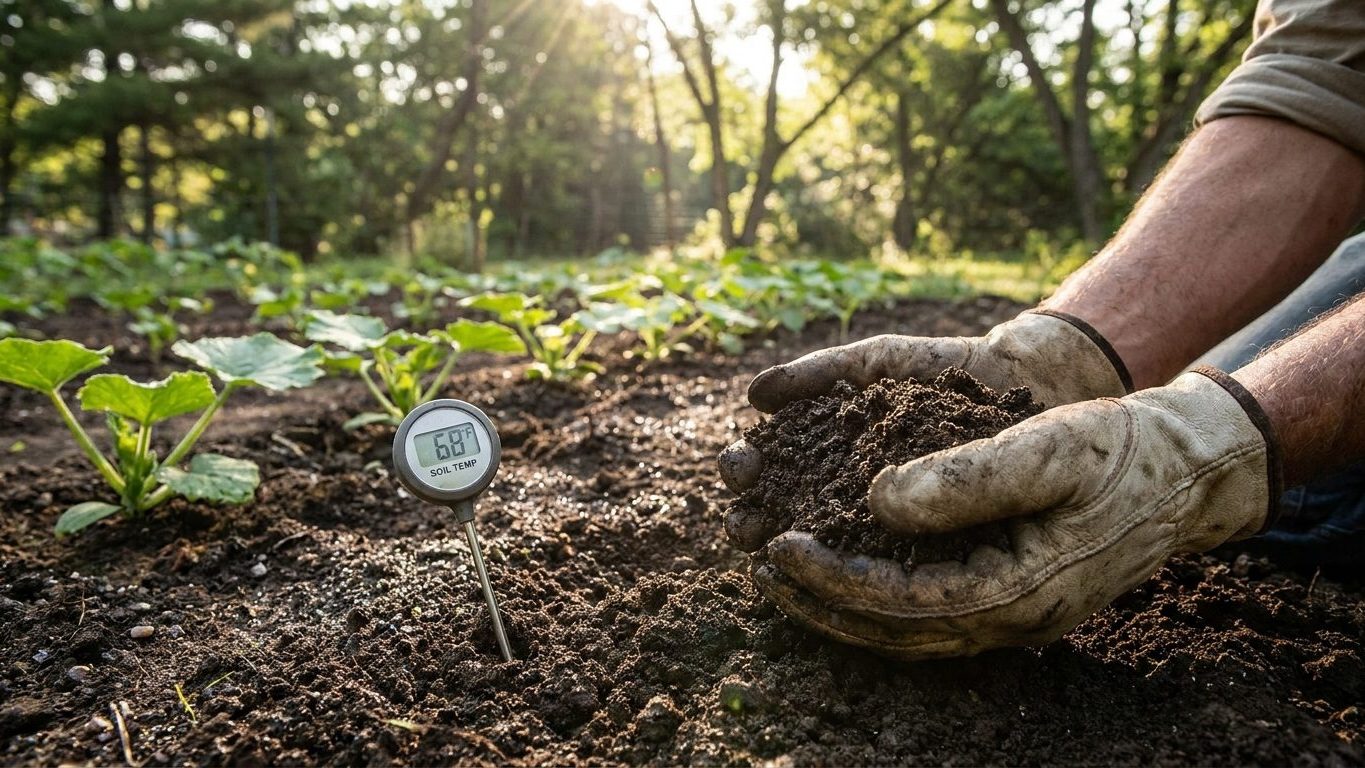

Winter squash goes into Massachusetts ground once soil has warmed well past the state’s last-frost band, typically mid-May into early June for most of the Commonwealth. That window shifts later for gardeners in the Berkshires or other cool interior pockets, and it can start sooner on the Cape. The frost dates behind that answer, and where they stop applying, are what actually decide whether a butternut or a Blue Hubbard finishes before the first hard freeze.
The short answer for Massachusetts
Start with what the frost dates actually measure. The state’s last spring frost falls between April 1 and April 8, and the first fall frost lands between November 3 and November 14, both drawn from NOAA’s 1991-2020 climate normals at the Boston reference station. Those aren’t fixed dates. They mark the window where a 32°F freeze has a 30 to 70 percent chance of happening, a probability band, not a guarantee that frost stops or starts on any single day.
Winter squash doesn’t care about frost risk alone. Its seeds rot in soil below roughly 60°F, so the real starting line sits several weeks after the last-frost band closes, once soil at planting depth has actually warmed. In practice, that pushes direct-seeding or transplanting to somewhere between mid-May and mid-June across most of the state.
Counting backward from the fall side matters just as much. Winter squash needs 80 to 110 days from seed to a cured, storable fruit depending on the type, plus time for the rind to harden before frost. Working back from November 3, the earlier end of the fall-frost band, a 100-day squash needs to be in the ground by late July at the very latest, and gardeners who want a safety margin plant well before that.
| Milestone | Massachusetts date band | What it tells you |
|---|---|---|
| Last spring frost (32°F, 30-70% chance) | April 1 to April 8 | Freeze risk starts easing, but soil is still too cold to seed squash |
| Soil warm enough to plant (60°F+) | Roughly mid-May to early June | The practical starting line, three to five weeks after the frost band closes |
| First fall frost (32°F, 30-70% chance) | November 3 to November 14 | Finish line; fruit needs to size and cure before this arrives |
One caveat worth repeating: these frost dates come from a waterfront station at Logan Airport, the mildest spot in the state. Anyone gardening away from Boston Harbor should treat both ends of that window as tighter than stated here.
What will not work here
Three habits fail specifically in this climate, not in some generic garden anywhere.
- Sowing a 100-to-110-day variety after the soil-warm window closes. If planting slips to mid-June in a cooler interior county, that squash is racing a first frost that can arrive as early as November 3. There’s no margin left for curing the rind properly.
- Trusting the summer rain total to cover irrigation. Massachusetts gets about 10.4 inches of rain across June, July and August, but it doesn’t arrive on a schedule squash can count on. August, the driest month at 3.23 inches, is exactly when fruit is sizing and curing. With 10.2 days a year hitting 90°F or hotter driving evaporation, a dry stretch in that window causes blossom drop and misshapen fruit even in a state that isn’t dry overall.
- Spacing vines the way a hot, dry-climate seed packet suggests. Tight rows trap humidity, and Massachusetts summers keep foliage damp often enough that dense plantings invite powdery mildew and give squash vine borer easy cover. Wider spacing than the package minimum, especially for sprawling types like Hubbard, buys the airflow this climate needs.
Seeding right at the close of the frost band, in early April, is its own separate mistake. Frost-free is not the same as warm enough. Cold, wet spring soil rots squash seed before it ever germinates, regardless of whether a freeze actually shows up.
What changes across Massachusetts
Massachusetts spans USDA hardiness zones 5a to 7b, based on the 2023 Plant Hardiness Zone Map’s 1991-2020 normals. That system tracks one thing only, the average annual extreme minimum temperature, but the spread it shows here is wide: five half-zone steps between the coldest interior pockets and the mildest coastal edge. There is no single planting date for a range like that.
The frost dates already cited come from the Boston reference station, the mildest point in the state. A garden near the coast, on Cape Cod or the Islands, sits toward the warmer 7b end of that spread and can often push both the spring start and the fall finish a bit later than the stated bands suggest. A garden in the Berkshires or another higher-elevation interior spot sits closer to 5a, where last spring frost commonly runs later into May and first fall frost can arrive well before November 3, shrinking the whole season from both directions.
That’s not a small adjustment. For someone gardening at the cooler end of the state’s range, the safe planting window calculated in the first section should shift earlier at the fall end and later at the spring end, which squeezes the total days available for a long-season squash. The USDA hardiness zone map, searchable by ZIP code, does that job; use it to see which end of the 5a-7b spread applies to a specific address before locking in a planting date.
Where to check this for your own county
Statewide frost bands and hardiness zones are a starting point, not a local forecast. UMass Extension, the Commonwealth’s land-grant university extension service, is where that gets corrected for a specific county.
Two things are worth looking for once there. First, a local or regional planting calendar, which accounts for soil type, elevation and microclimate in a way a state-level frost band cannot. Second, variety trial results from local growing conditions. Extension programs regularly track how different winter squash varieties perform under regional pest pressure, humidity and season length, information that goes well beyond what a seed catalog’s days-to-maturity number can tell a Massachusetts gardener.
A county-level recommendation will beat a state-level one every time, because it’s built on local frost records, local soil surveys and local pest and disease patterns rather than a single reference station at Logan Airport.
Some gardeners also time this by the Moon: when to plant winter squash by the moon, as almanac tradition rather than fact.
Checking this against your own garden
None of the dates above outrank what’s actually happening in a specific plot of soil. Three observations settle it better than any calendar.
Soil warmth by feel comes first. Pushing a hand into the planting bed at around four inches deep tells more than a calendar date ever will. If that soil still feels cold and damp in late May, something in that particular yard, shade, poor drainage, a low spot that holds cold air, is running behind the regional average, and seed sown into it now will likely rot rather than sprout.
The first flush of male flowers is the next signal. Winter squash plants typically open male flowers before female ones appear, and that first flush marks the point where the plant has shifted into its reproductive phase on its own internal clock, not a fixed number of days from planting. It’s also the cue to start watching for the female flowers, and for pollinator activity, a few days later.
First true leaves, the growth that follows the two rounded seed leaves, are worth noting because they mark when the plant is actually established rather than just germinated. Counting a variety’s days-to-maturity from that point, instead of from the sowing date, gives a more accurate read on harvest timing, especially in a spring where a cold snap slowed germination down.