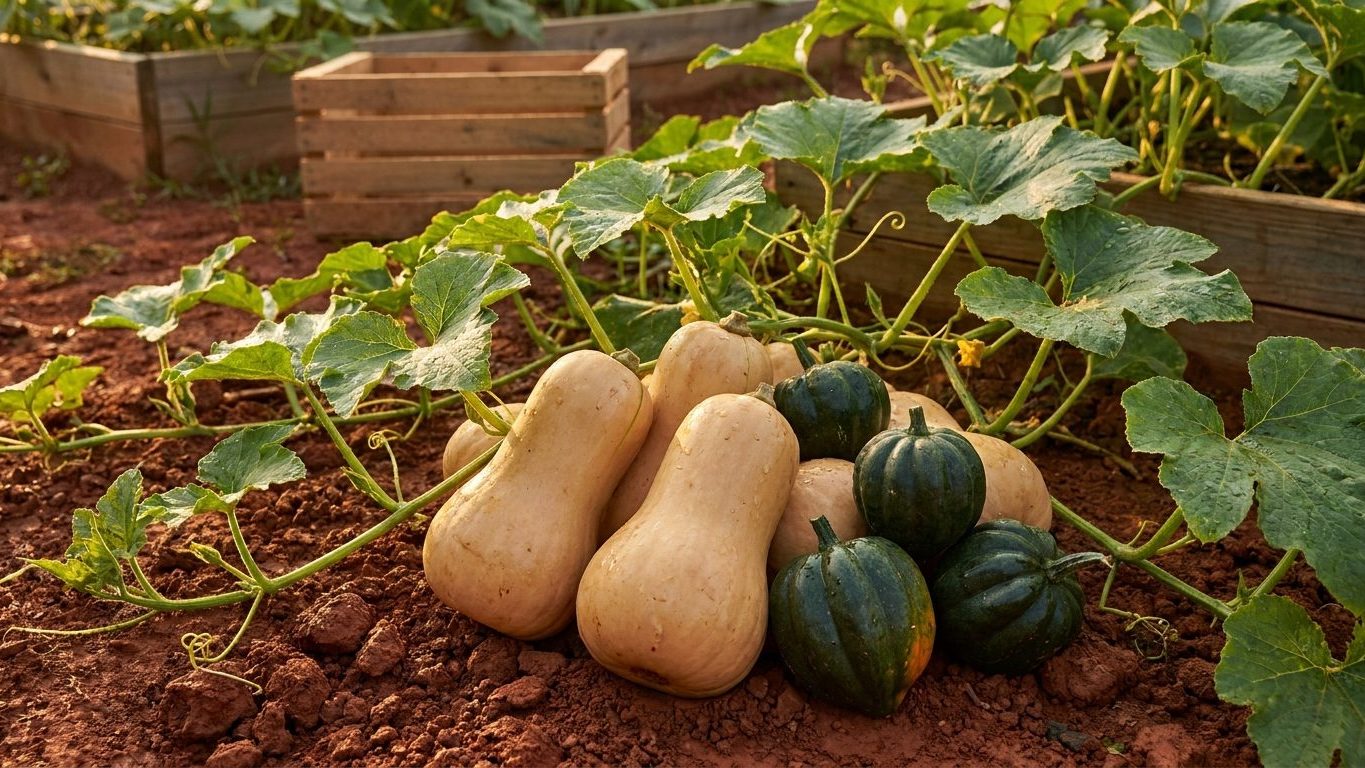

South Carolina gardeners get the best results from squash bred to handle heat and humidity rather than speed: butternut, hubbard, and kabocha types consistently outperform acorn and delicata across the state. The reason isn’t how fast a variety matures. Nearly every South Carolina county has season length to spare. What decides the winner is what happens during the 55-plus days a year the state spends above 90°F, and how much of that heat and moisture the vines have to survive before the fruit cures.
The short answer for South Carolina
Start with the numbers that actually run this decision. The frost-free window at the reference station runs from a last spring frost of February 28 to March 17, out to a first fall frost of November 20 to December 5. Even taking the tightest reading, that’s roughly 250 days of growing season. Most winter squash need somewhere in the range of 80 to 110 days to mature. South Carolina isn’t short on time. That single fact flips the whole decision: this isn’t a state where you pick a variety because it finishes fast. You pick one because it survives the middle of the summer.
The middle of a South Carolina summer means 55.1 days a year at or above 90°F, measured at the Charleston reference station. That’s close to two months where squash vines are dropping blossoms in the afternoon heat, and where humidity off the Atlantic keeps foliage damp long after a storm has passed. Powdery mildew and squash vine borer both thrive in exactly that combination. So the varieties that hold up in South Carolina aren’t the fastest ones. They’re the ones with tougher stems and a track record of pushing through disease pressure without collapsing mid-season.
Butternut and its relatives (species Cucurbita moschata) tend to do best here because the stem is solid rather than hollow, which makes it harder for vine borer larvae to tunnel through and kill the plant outright. Hubbard and kabocha types, also generally vigorous growers with tougher rinds, follow close behind. Acorn, delicata, and spaghetti squash (all Cucurbita pepo) share the hollow stem that makes borer damage more likely to be fatal, and their thinner skin is more prone to rot in humid, wet conditions before it fully cures.
| Type | Species | Heat/humidity tolerance | Vine borer risk | Fit for South Carolina |
|---|---|---|---|---|
| Butternut | C. moschata | High | Lower (solid stem) | Strongest overall choice |
| Hubbard | C. maxima | High | Moderate | Reliable, needs room to sprawl |
| Kabocha | C. maxima | High | Moderate | Good, less common locally |
| Acorn | C. pepo | Moderate | Higher (hollow stem) | Workable with disease watch |
| Delicata / spaghetti | C. pepo | Lower | Higher (hollow stem) | Most vulnerable of the group |
What will not work here

The failure most South Carolina gardeners actually run into isn’t a squash that never had time to finish. It’s a squash that finished rotting before it finished curing. With about 19.8 inches of rain across June, July and August, and June alone averaging 6.21 inches, the state’s summer isn’t dry, it’s the opposite problem: wet, humid, and delivered in heavy thunderstorm bursts rather than gentle steady rain. That kind of rainfall mostly runs off rather than soaking in evenly, but it leaves leaf surfaces and fruit skins damp for hours afterward, which is exactly the condition powdery mildew and fruit rot need.
Acorn and delicata squash take the hardest hit from this pattern because their skin is thinner and their vines grow in a tighter, bushier habit than a sprawling butternut or hubbard vine. Tight growth traps humid air around the leaves instead of letting it move through, and that’s what turns a manageable mildew infection into a vine that collapses in August, weeks before the fruit is ready to store. Wider spacing than the seed packet suggests, well beyond the minimum, is often the difference between a working patch and a wasted one in a South Carolina backyard.
Squash vine borer is the other consistent failure point, and it hits hollow-stemmed C. pepo varieties (acorn, delicata, spaghetti, and most summer squash) far harder than solid-stemmed butternut. A borer larva that tunnels into a hollow stem can wilt and kill the whole vine within days; the same larva in a solid butternut stem does far less damage. Gardeners who’ve had good luck with acorn squash in a cooler, drier climate often assume the same variety will perform the same way here. It usually doesn’t, because the pest pressure and the humidity load are both higher in a South Carolina summer than in most of the country.
Finally, don’t lean on a “northern fast-maturing” variety bred for a short growing season somewhere with a tight frost window. South Carolina doesn’t need the speed, and those varieties are often bred with less attention to heat and disease tolerance since their home climate never demanded it.
What changes across South Carolina
South Carolina spans USDA Hardiness Zones 7a to 9a, a system built entirely around the average extreme minimum winter temperature. That’s a wide spread for one state, and it means there’s no single squash recommendation that fits Charleston, the Midlands, and the Upstate equally well. The frost-date figures above come from the Charleston-area reference station, and the caution attached to them matters: peninsular Charleston itself runs milder than even that airport reading, while the Upstate runs several weeks tighter at both ends of the season.
Practically, that shift changes two things. First, the frost-free window: Upstate gardeners work with several fewer weeks on both the spring and fall side compared to the coast, which trims the cushion for a late planting or a second succession sowing. Given how much surplus season South Carolina has overall, that trim rarely threatens a squash crop outright, but it does mean Upstate gardeners have less room to recover from a delayed start than someone gardening near the coast.
Second, the heat load itself likely differs. The 55.1-day figure for days above 90°F comes from the Charleston reference station specifically; inland and upland areas of the state generally run cooler in summer than the immediate coast, which would ease some of the disease and heat-stress pressure that pushes coastal and Midlands gardeners so firmly toward butternut and hubbard types. That doesn’t make acorn or delicata a sure thing further inland, but the pressure against them likely eases somewhat as you move away from the coast and up in elevation.
None of this substitutes for knowing where your own garden sits inside that 7a-to-9a range. Check the current USDA Plant Hardiness Zone Map for your specific location rather than assuming from the state average.
Where to check this for your own county
The county you actually garden in has its own microclimate, its own soil, and often its own set of variety trial results, and that county-level information beats anything written here. Clemson Cooperative Extension is the land-grant extension service for South Carolina, and it’s the right first stop.
Once there, look for two specific things. The first is a county-level or regional vegetable planting calendar, which will translate the frost-date ranges cited above into dates that actually apply to your county rather than to the airport station used for the statewide normal. The second is the Home & Garden Information Center’s vegetable gardening publications, which periodically cover variety performance and disease pressure specific to South Carolina growing conditions, including notes on squash vine borer and powdery mildew management that go well beyond what a general state overview like this one can offer.
Your county extension office is also worth a direct call or visit. Clemson maintains an agent presence in every South Carolina county, and many of those offices track which squash varieties have actually performed well in local demonstration gardens or through Master Gardener volunteer plots. That kind of on-the-ground trial data, gathered in your own soil and your own summer, is the single most reliable upgrade on anything a statewide page can tell you.
Checking this against your own garden
Every date and figure for South Carolina describes an average. Your own garden will tell you something more specific, and it’s worth trusting that over the calendar once the season is underway. Three things to watch, none of which need any equipment beyond your own hands and eyes.
First, soil warmth by feel at planting depth. Push a finger a few inches into the bed where you intend to sow. Squash seed wants soil that feels warm and dry enough to crumble, not cool and damp. If it still feels cold in early April even though the calendar says the last frost has passed, your particular bed, whether it’s shaded, low-lying, or heavy clay, is running behind the county average, and waiting another week or two will save you a poor germination rate.
Second, the first flush of male flowers. Squash plants typically send out a round of male blooms before any female flowers appear, and that first flush is a decent sign the vine has enough energy to start setting fruit soon. If male flowers keep coming with no female blooms following within a couple of weeks, that’s usually a heat-stress or nutrient signal worth investigating before assuming the plant will fruit on its own schedule.
Third, the pace between the seed leaves and the first true leaves. A quick turnaround, often just a matter of days, suggests your microclimate is running warm and vigorous compared to the county norm. A slow, stalled turnaround usually points to cooler or more compacted soil than the surrounding area, and it’s a fair warning that the rest of the season may run a little behind schedule too.