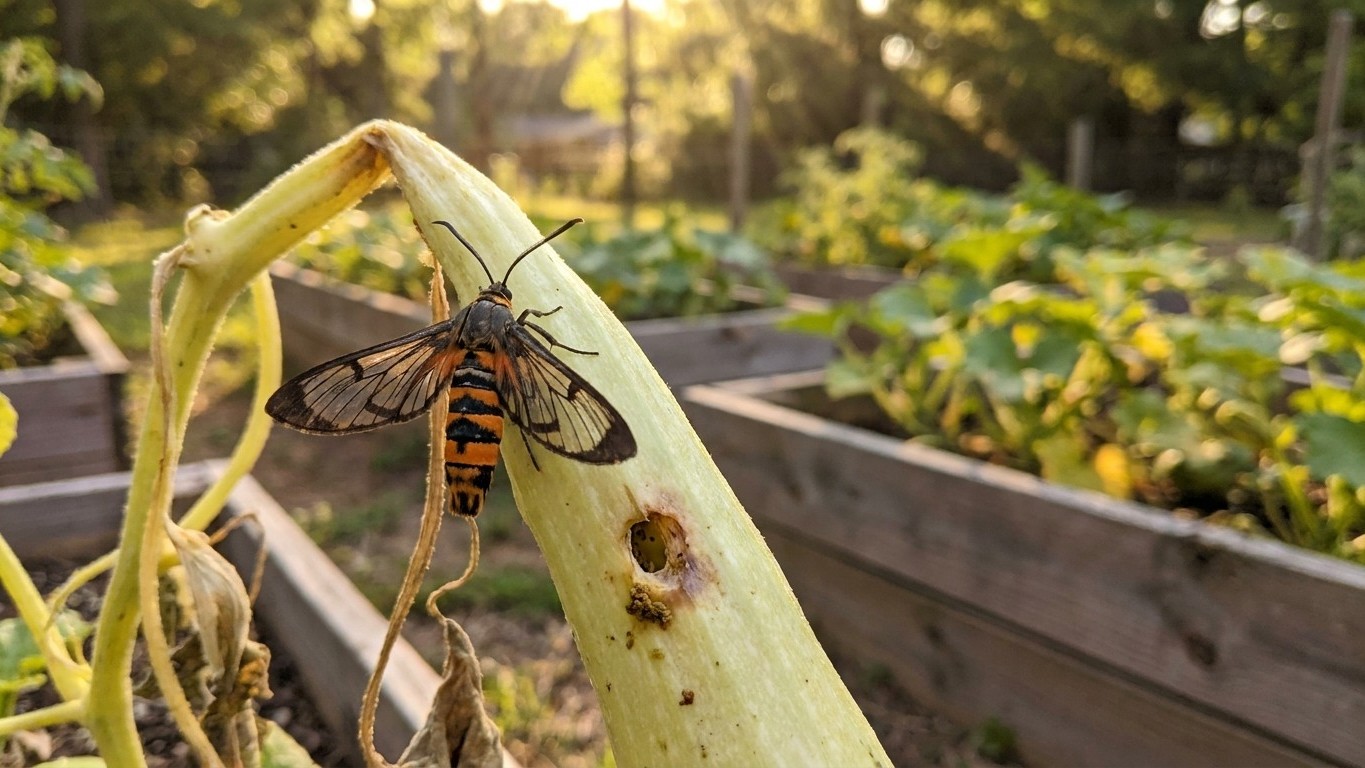

Squash vine borer moths start flying in South Carolina as early as mid-May in the Lowcountry and Midlands, with a second wave often hitting in August. Row covers removed too early, stems left unwrapped, and squash planted on the “normal” late-spring schedule all but guarantee an infestation. The fixes that actually work: timed planting, physical barriers on the stem base, and catching larvae before they tunnel deep enough to cut off the plant’s water supply.
Squash Vine Borer Timing Across South Carolina

South Carolina’s growing season stretches long enough that squash vine borer (Melittia cucurbitae) can complete two generations in a single year, something gardeners farther north rarely deal with. The first flight of adult moths typically begins in late May along the coast and Midlands, a little later in the Upstate where cooler spring soil delays pupation. That first wave lays eggs through June, and the larvae that hatch spend three to four weeks feeding inside the stem before dropping to the soil to pupate again.
A second generation of moths often emerges in August, right as many home gardeners are planting a fall crop of squash or zucchini to dodge the first wave’s damage. That timing overlap is the reason fall plantings get hit just as hard as spring ones if no protection is in place. Coastal counties like Charleston and Beaufort tend to see moth activity start earliest and run longest because soil temperatures warm up sooner and stay warm into October.
The moth itself looks nothing like the gray, dusty pests most gardeners picture. It’s roughly an inch long, with an orange abdomen ringed in black and forewings that are metallic olive-green to black. It flies during the day, which means it’s often mistaken for a wasp buzzing around the base of squash plants rather than identified as the actual threat.
Spotting the Damage Before the Vine Dies
By the time a squash plant wilts suddenly in full sun despite well-watered soil, the larva has usually already done the damage that matters. Squash vine borer larvae tunnel into the base of the stem, near the soil line, and feed inside for weeks while the plant tries to push water and nutrients through a stem that’s slowly being hollowed out.
The clearest early sign isn’t the wilting itself. It’s a small pile of sawdust-like frass, yellow-green and slightly moist, sitting right at the base of the stem where it meets the soil. That frass is larval waste pushed out through the entry hole, and it shows up days or weeks before the plant visibly struggles. Checking the base of every squash and zucchini plant twice a week during June and again in August catches infestations while a single larva can still be removed by hand.
Yellow crookneck squash, zucchini, and pumpkins are the varieties borers prefer most. Butternut squash and other Cucurbita moschata types have thicker, more solid stems that resist larval entry far better, which is why plenty of South Carolina gardeners who’ve lost zucchini three years running switch to butternut and stop losing plants altogether.
What Actually Stops Squash Vine Borer
Nothing kills an established larva inside a stem without cutting the vine open. That single fact drives every effective control strategy toward prevention and early detection rather than treatment after the fact.
Timing and Row Covers
Floating row covers keep adult moths from ever laying eggs on the stem, but only if they go on at planting and stay on until female flowers appear and need pollinator access. In South Carolina, that means covers should be in place by early May for spring plantings and removed only once blossoms show up, at which point hand-pollination or careful daily monitoring takes over. Leaving covers on too long starves the plant of pollinators; taking them off too early exposes seedlings to the first moth flight.
Staggering plantings helps too. Instead of putting in every squash seedling on the same weekend in April, spacing plantings two to three weeks apart through late spring means not every plant is at its most vulnerable stage when moths are actively laying eggs.
Physical Barriers on the Stem
Wrapping the lower six to eight inches of stem in aluminum foil or a strip of nylon stocking at transplant time blocks females from reaching the tissue where they lay eggs. It’s a low-cost trick that works because the moth needs direct access to that exact section of stem, and a physical wrap denies it. Mounding soil over the base of the stem periodically, called stem burial, also encourages the plant to root along the buried section, giving it a backup water source if the original stem base does get compromised.
Finding and Removing Larvae
If frass shows up despite prevention, a slit made lengthwise along the stem with a sharp knife, right where the frass trail leads, lets a gardener dig out the larva by hand. The cut needs to run with the stem’s fibers, not across them, to avoid severing the plant’s vascular tissue completely. After removing the larva, mounding moist soil over the wound encourages new root growth from that section and often saves the plant.
Some gardeners use a straightened wire or a fine needle to probe and skewer larvae inside the stem without cutting it open at all, working the wire in through the entry hole itself. It’s slower than the knife method but leaves less visible damage to the plant.
Biological and Soil-Based Controls
Bacillus thuringiensis (Bt), injected directly into the stem with a syringe near the base every one to two weeks during moth flight, can kill larvae as they hatch and begin tunneling, before they get deep enough to cause real damage. Beneficial nematodes applied to the soil around the base of plants attack larvae and pupae that have dropped to overwinter, cutting down the population that emerges the following season. Neither method works well once a larva has tunneled more than an inch or two into the stem, which is why timing the application to egg-laying and early hatching matters more than the product itself.
Regional Differences Worth Planning Around
Upstate counties around Greenville and Spartanburg see squash vine borer activity start about two to three weeks later than the coast, giving Upstate gardeners a slightly wider window for early-season row covers before the first moth flight arrives. That later start also means the second generation’s timing shifts later into September, sometimes overlapping with the first frost date and reducing how much damage it can do before cold weather ends the season.
The Midlands, including Columbia and the surrounding counties, sits in between: moth flights typically begin in late May to early June and run through the first hard frost, which averages mid-November in most years. That long window is why Midlands gardeners often report losing both a spring and fall squash planting in the same year if no preventive measures go in.
Coastal and Lowcountry gardens face the longest exposure window of any region in the state. Mild winters mean pupae overwintering in the soil survive at higher rates than in colder inland counties, and the extended warm season lets both generations complete fully before frost, sometimes even supporting a partial third generation in exceptionally warm years. Clemson Cooperative Extension’s Home & Garden Information Center notes that monitoring should begin as soon as vines start to run, rather than waiting for visible wilting, precisely because of how quickly larvae can establish once temperatures warm.
Gardeners who’ve fought this pest for a few seasons tend to land on the same conclusion: prevention beats treatment every time, because once the frass appears at the base of the stem, the plant is already running on borrowed time. Rotating squash to a different bed each year, since pupae overwinter just a few inches below where the previous crop grew, adds one more layer of protection that costs nothing but a little planning at the start of the season.