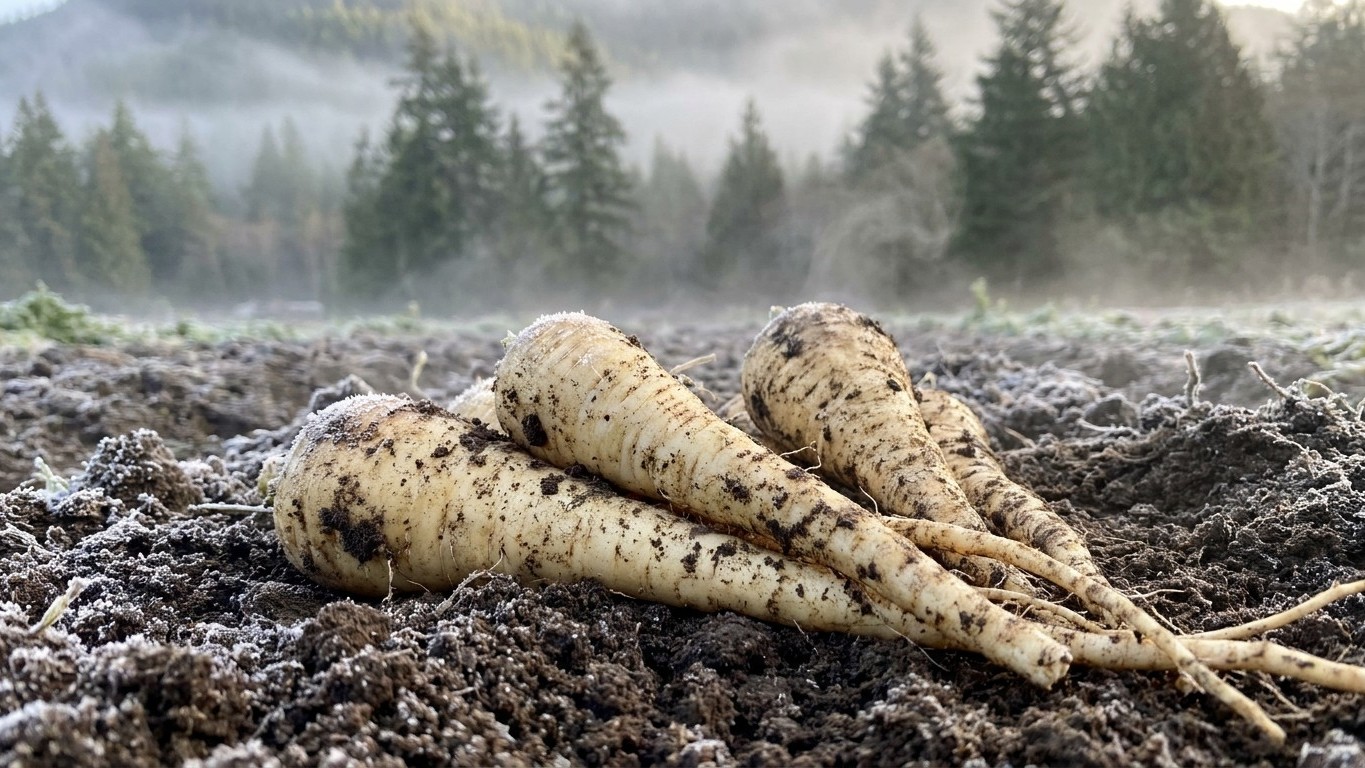

Four insects have documented feeding activity on garden vegetables in Michigan that could reach a parsnip row: cutworms, flea beetles, seedcorn maggot, and slugs. Each one is active at a different point in the roughly 100 to 120 days a parsnip spends in the ground, timed to the state’s frost-free window rather than a fixed month. The rest of the pests Michigan’s extension service documents for garden crops target other plants entirely.
Which pests attack parsnip in Michigan
MSU Extension Bulletin E3276, Diseases and insects in Michigan cucurbits, documents ten insects active in Michigan vegetable gardens: Asiatic garden beetle, cutworms, emerald ash borer, flea beetles, seedcorn maggot, slugs, spotted cucumber beetle, squash bug, squash vine borer, and striped cucumber beetle. That bulletin is built around cucurbit crops, squash, cucumbers, melons, so most of that list has no business anywhere near a root crop like parsnip.
Start with what to cross off. Squash bug, squash vine borer, striped cucumber beetle, and spotted cucumber beetle are all cucurbit specialists, their life cycles and egg-laying habits are built around vine crops, not the ferny foliage or fleshy taproot of a parsnip. Emerald ash borer bores into ash trees exclusively, it’s a forestry pest, not a vegetable garden one, and it has no documented connection to any root crop. Asiatic garden beetle grubs feed on turfgrass roots underground while the adults chew on a wide range of ornamental and garden leaves, but the documentation tying it to Michigan gardens comes from cucurbit-focused monitoring, not root vegetable beds.
That leaves four candidates with an actual path to parsnip: cutworms, flea beetles, seedcorn maggot, and slugs. None of the four specialize in one plant family, which is exactly why they show up broadly enough in vegetable gardens to matter for a crop that sits direct-seeded in the same spot for months.
Seedcorn maggot causes the most damage before a parsnip seedling even breaks the soil, because parsnip germination takes 14 to 21 days, a long stretch for a soil-dwelling larva to find and hollow out a seed before it ever sprouts. The other three act on foliage or stems once something is actually growing above ground.
When each one shows up, and what it does first
Michigan’s last spring frost lands around April 30 near Detroit and early to mid-May across most of the Lower Peninsula, per MSU Extension’s Frost-Free Dates. The first fall frost arrives between October 6 and October 21 in zone 6a, per MSU Extension’s Michigan Garden Calendar. Parsnip seed goes into the ground directly, not as a transplant, roughly two to three weeks before that last spring frost, following the University’s own timing guidance.
Seed then sits in cold soil for 14 to 21 days before germinating, and that window is when seedcorn maggot does its work. The fly is drawn to cool, damp soil rich in organic matter, and its larvae tunnel into the seed itself. The first sign is a gap in the row where nothing ever came up, or a seedling that emerges and then collapses because the seed underneath is already hollow.
Cutworms take over once seedlings are actually standing, in the weeks right after germination while stems are still thin and soft. The first sign is a seedling lying flat overnight, cut cleanly at the soil line with the top otherwise undamaged, no chewed leaves, just a severed stem.
Flea beetles arrive once the first true leaves expand, and their feeding tends to pick up during warmer, drier stretches later in the season. The first sign is a scatter of small round holes across a leaf, the classic shothole look, rather than one big chewed section.
Slugs stay active through any damp stretch of the growing season, early on and again as cooler, wetter weeks return heading toward the first fall frost, since parsnip foliage is still in the garden for the crop’s full season. The first sign is ragged, irregular holes in the leaves along with slime trails that show up clearest after rain or heavy dew.
Telling the damage apart from everything else
Not every gap in the row or hole in a leaf means an insect is involved. A parsnip bed can show similar symptoms from soil conditions, weather, or plain garden mechanics, and the fix is completely different depending on which one it actually is.
| Symptom | Possible cause | What distinguishes it |
|---|---|---|
| Seed never comes up, gaps in the row | Seedcorn maggot, or simply seed still inside its 14 to 21 day germination window | Dig gently at seed depth: a maggot-damaged seed is hollow or rotted with a small white larva nearby; an undamaged seed has just not reached day 14 yet |
| Seedling toppled, stem cut at the soil line | Cutworm | A curled grayish larva is usually in the top inch of soil right next to the cut; wind or hail damage instead snaps stems higher up or shreds leaves rather than clipping the base |
| Small round holes scattered across a leaf | Flea beetle | Holes are numerous, shallow, and evenly spread; a fungal or bacterial leaf spot instead shows discrete discolored lesions with a defined edge, not clean punched holes |
| Ragged holes and slime trails | Slugs | Slime is visible, especially in the morning; caterpillar feeding leaves dark droppings behind but no slime |
| Root forks or splits into two or more legs | Not an insect at all | Heavy or stony ground deflecting the taproot, and overwatering encouraging side roots, are two separate causes; a forked root with no holes, no frass, and no larvae anywhere on it points to soil or water, not a pest |
When the damage doesn’t match any row in that table cleanly, that’s a sign to get an actual identification rather than guess and treat for the wrong thing.
What actually works here, and what is a waste of time
A lightweight floating row cover placed over the row right at seeding, sealed along the edges, keeps seedcorn maggot flies from laying eggs near the germinating seed and blocks flea beetle adults from reaching the young foliage once it emerges. Since parsnip is grown for its root rather than a pollinated fruit, the cover can stay on longer than it could on a crop that needs bees to reach the flowers.
Waiting for even a week or two of warmer weather before seeding into cold, wet ground cuts seedcorn maggot pressure more reliably than any treatment applied after the damage shows up, because the fly targets exactly that cool, high-organic-matter soil. Working fresh manure or a heavy dose of undecomposed compost into the row right before seeding recreates those same conditions and invites the problem in.
Once seedlings are thinned to their final spacing, a stiff paper or cardboard collar pushed an inch into the soil around each one blocks the cutting motion cutworms rely on, worthwhile because there are only so many plants left to protect after thinning. Slugs respond more to moisture management than to anything applied after the fact: pulling mulch back a few inches from the stems and watering in the morning instead of the evening removes the damp, shaded cover they need during the day.
Broad, calendar-based spraying without confirming which of the four pests is actually present wastes both time and money, since none of them follow the same schedule and treating for one does nothing against another. Any decision about a specific product, timing, or rate belongs with the state’s extension service, which knows what’s actually labeled for use on a root vegetable in Michigan.
Where to check this for your own county
MSU Extension is the service documenting these pests for Michigan, exactly as named in Bulletin E3276, Diseases and insects in Michigan cucurbits. That bulletin was built around cucurbit crops, not parsnip specifically, so a gardener seeing damage that doesn’t match cutworms, flea beetles, seedcorn maggot, or slugs is looking at something outside what this source documents for this crop, not necessarily something exotic.
Pest pressure documented at the state level doesn’t describe what’s happening in one particular county, let alone one particular yard. A garden bordering a cornfield sees more seedcorn maggot pressure than one surrounded by lawn, and slug activity tracks with how damp and shaded a specific yard runs through the season.
MSU Extension maintains county offices across the state, and that local office is where a sample, a photo, or a description of the damage in the table above gets an actual identification, something a general list can narrow down but never confirm on its own. Photograph the damage, note how many days it’s been since seeding, and bring both to the county MSU Extension office before deciding which of the four documented pests is actually responsible.
Common questions
Does emerald ash borer affect parsnip or other root vegetables?
No. It feeds exclusively on ash trees and has no documented connection to garden vegetables.
What’s the earliest pest risk after seeding parsnip in Michigan?
Seedcorn maggot, active during the 14 to 21 day germination window before seedlings ever emerge.
Do slugs damage the parsnip root, or just the leaves?
The documented feeding is on foliage. Root feeding by slugs isn’t part of what’s documented for this crop here.
Should a gardener spray as a preventive measure before seeing any damage?
No. None of the four documented pests follow the same schedule, and confirming which one is present, through the county MSU Extension office, comes before any treatment decision.