
Winter squash goes into Pennsylvania ground once the soil has warmed past the last spring frost window of March 29 to April 6, and it needs to be off the vine well before the first fall frost, which lands between November 5 and November 16. That gives most of the state a workable stretch, but the real planting date depends on where in Pennsylvania you’re standing.
The short answer for Pennsylvania
Those frost dates aren’t predictions. They’re probability bands: NOAA’s 30-70% range for when a 32F freeze occurs at the reference station in Philadelphia, drawn from 1991-2020 climate normals. That means in any given year, there’s a real chance frost shows up outside that window, which is why gardeners add a buffer rather than planting to the exact date.
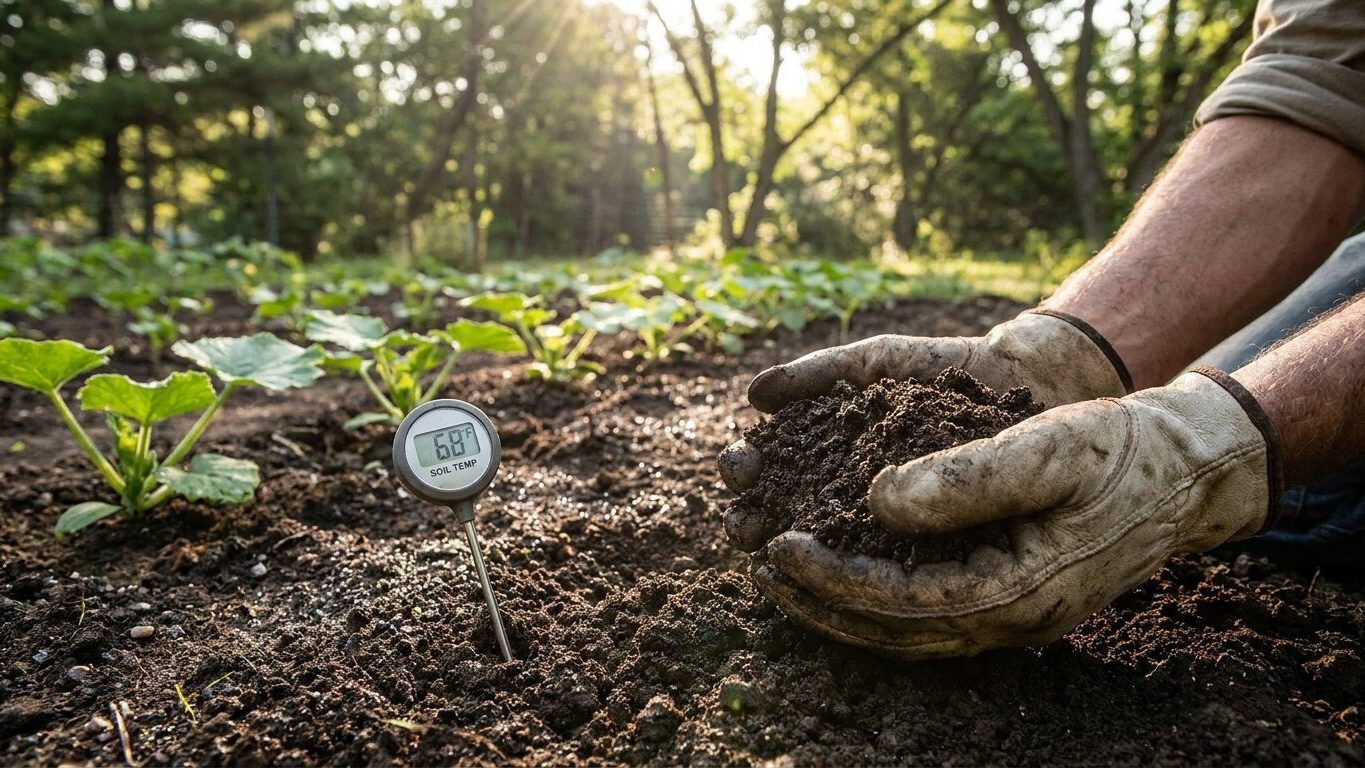
For winter squash, the working rule is to direct-seed outdoors once the soil has warmed past 60-65F, which typically trails the last frost by one to three weeks. Applied to Philadelphia’s window of March 29 to April 6, that puts safe direct-seeding somewhere from mid-April into May for the mildest parts of the state. Squash seed sitting in cold, wet soil doesn’t germinate faster for having been planted early. It just rots.
On the other end, count backward from the first fall frost. Winter squash varieties run anywhere from about 80 days (acorn types) to well over 100 days (many hubbards), plus a week or two of curing time on the vine before a hard freeze. Using the earliest fall frost date in the band, November 5, and the latest spring frost, April 6, the reference station’s frost-free stretch works out to roughly 213 days. That’s a wide margin for a 90 to 100-day crop, and it’s the reason winter squash is considered a forgiving crop across most of Pennsylvania: season length is rarely what limits it here.
| Milestone | Date window | What it means for squash |
|---|---|---|
| Last spring frost | March 29 – April 6 | Direct-seed 1-3 weeks after this, once soil is warm |
| First fall frost | November 5 – November 16 | Harvest and cure before this date |
| Frost-free season (conservative) | ~213 days | Comfortably covers 80-110 day varieties |
This is the state-level picture, built on the Philadelphia reference station. It’s a starting point, not the answer for every county, and the next section covers why that gap matters.
What will not work here
Planting too early is the most common failure, and it has nothing to do with the calendar date looking safe. Even inside the March 29 to April 6 window, soil temperature lags air temperature by days or weeks. A gardener who sows the moment the frost-free date passes is often putting seed into soil still in the 40s or low 50s. Squash seed sits there, absorbs moisture, and rots before it ever sprouts. The fix isn’t a different date on paper, it’s waiting for the soil itself to catch up.
Summer humidity is the other quiet failure point, and it’s tied directly to the rainfall pattern. The reference station logs about 12.7 inches of rain across June, July, and August, spread fairly evenly (4.04 inches in June, 4.38 in July, 4.29 in August) rather than concentrated in a few storms. That steady moisture, combined with warm nights, keeps foliage damp longer than in drier climates. Winter squash planted at tight spacing, or crowded against a fence or shed where airflow is poor, tends toward powdery mildew and downy mildew by midsummer. The plants don’t die outright, but yields drop and vines collapse early, sometimes before the fruit has finished sizing.
Heat load is a smaller factor here than in the Deep South or the Southwest, but it’s not zero. The reference station averages 24.0 days a year at or above 90F. That’s enough heat to stall pollination during the hottest stretch of July, when blossoms can drop before fruit sets, and enough to increase water demand faster than the summer rainfall pattern supplies it on its own. A garden on sandy soil, where that steady rain drains through within a day, can still need supplemental watering during a hot dry spell even though the seasonal total looks adequate on paper.
What genuinely fails in Pennsylvania is the combination of poor spacing and inconsistent watering during heat spikes, not the season length itself. A gardener chasing a 120-day storage pumpkin variety in the coldest corners of the state, or at higher elevation, is taking on real risk given how much later frost arrives there. Everywhere else, the crop that struggles is the one crowded into a damp, still corner of the yard and left to fend for itself through late July’s hottest week.
What changes across Pennsylvania
Pennsylvania spans USDA hardiness zones 5a through 7b, a range built on one measurement: average annual extreme minimum winter temperature. That’s a wide spread for one state, and it means there is no single planting date that fits both ends. Zone 7b, the milder end, sits in the Philadelphia corner the reference station represents. Zone 5a shows up in the northern tier and up in the Alleghenies, where winters run considerably colder.
That zone spread tracks closely with the frost-date caution attached to this page’s numbers: the northern tier and the Alleghenies run two to four weeks later in spring than Philadelphia, and by the same logic, likely earlier into fall frost as well. A gardener in those regions working from Philadelphia’s March 29-April 6 window would be planting into soil that hasn’t caught up yet, and risking the same seed rot described above. The practical shift is straightforward: push the whole calendar later by two to four weeks, both the direct-seeding date in spring and the expected end of the growing window in fall.
Elevation compounds this inside a single county, not just across the state. A garden at the base of a valley in the Alleghenies can run noticeably colder at night than one on a nearby ridge, simply from cold air pooling as it drains downhill. That’s a microclimate effect layered on top of the zone difference, and it’s part of why a state-level hardiness map can only describe a range, never a single reader’s plot.
None of this changes the biology, only the timing. A gardener in the milder southeast is not growing a different crop than one in the northern tier or the mountains, just working a calendar shifted by a few weeks. The question of exactly how far to shift it belongs to the next section.
Where to check this for your own county
Pennsylvania State University’s Cooperative Extension is the authority for county-level planting guidance, and it’s reachable at extension.psu.edu. This page has worked from a single reference station in Philadelphia. That’s useful for describing the state’s general pattern, but it is not a substitute for the county-specific calendars Penn State Extension publishes, which are built from local frost records rather than one station’s data extrapolated across seven hardiness zones.
Two things are worth looking for once there. First, the local planting calendar for the specific county, which will reflect the actual frost dates for that location rather than the statewide 5a-7b range described here. A county in the northern tier or up in elevation will show a materially later window than the one calculated in this article. Second, look for variety trial results specific to Pennsylvania growing conditions. Extension offices track which winter squash varieties have performed well against the state’s particular disease pressure, especially the powdery and downy mildew risk tied to the summer rainfall pattern described above.
A county recommendation will always outrank a state one, for the simple reason that it’s built on data closer to the actual garden. This page describes what’s true across Pennsylvania broadly, using one reference station’s numbers as an anchor. Penn State Extension’s county material narrows that down to the frost dates, soil conditions, and disease pressure specific to one place. That’s the resource to check before finalizing a planting date, not this page.
Checking this against your own garden
Every date in this article is a regional average pulled from a 1991-2020 dataset. None of it accounts for a particular yard’s sun exposure, soil type, or the shelter (or lack of it) from nearby structures and trees. The garden itself settles the question that a climate normal can only estimate.
Soil warmth by feel is the first and most direct check. Cold, wet soil that clumps and feels chilly to bare skin is not ready for squash seed, no matter what the calendar says. Soil that’s dried out enough to crumble and feels comfortably warm to the touch, similar to a spring afternoon rather than a lingering winter chill, is the signal to plant. This test alone catches the seed-rot failure described earlier, because it responds to actual local conditions rather than a distant weather station’s average.
The first flush of male flowers is the next marker. Winter squash produces male blossoms before female ones, often by a week or two, and a healthy first flush signals the plant has settled into active growth. If male flowers are slow to appear or sparse, it’s often a sign the plant is still recovering from a cold shock at planting, or from a spell of the heat stress described earlier in the 90F-plus days.
First true leaves, the leaves that appear after the initial seed leaves and actually resemble squash foliage, mark the point where the plant has moved from surviving on stored seed energy to running on its own root system. Slow or pale true leaves usually point to soil that’s still too cool or too wet, which loops back to the same soil-feel check that started this list, and confirms whether the local microclimate is running ahead of or behind the dates calculated from Philadelphia’s climate record.