
South Carolina gardeners get two windows for winter squash: a spring sowing after the worst frost risk fades, and a summer sowing timed backward from the first fall frost. The frost dates driving both come from a single NOAA station near Charleston, and they describe a probability, not a guarantee. Coastal and Upstate gardens shift those dates by weeks in either direction.
The short answer for South Carolina
Winter squash is a warm-season crop that resents cold soil, so the spring planting date follows the state’s last spring frost window of February 28 to March 17. That range is NOAA’s 30 to 70 percent probability band for a 32F freeze at station USW00013880, the reporting station used for South Carolina’s official climate normals. It does not mean frost stops on March 17. It means the odds of a freeze after that date drop to roughly three in ten, and keep falling through April. Most gardeners direct-seed winter squash two to three weeks after that window closes, once nighttime soil temperatures sit reliably above 60F, which in practice lands sowing dates in the last half of March through mid-April across most of the state.
The second window works backward from the other end of the season. The state’s first fall frost arrives between November 20 and December 5, again a 30 to 70 percent probability band from the same station. Winter squash needs anywhere from 80 days for the fastest acorn types to 100 or 110 days for a full-size Hubbard or a banana squash to reach a cured, storable fruit. Counting back from November 20, the earlier and tighter edge of that fall frost band, a 100-day squash needs to be in the ground by early August at the latest, with margin lost if the summer sowing gets delayed by heat or a late spring harvest still occupying the bed.
Both windows come from one caution worth repeating: the station behind these dates sits near the coast. Peninsular Charleston itself runs milder than its own airport station, sometimes by a week or more on both ends. Upstate South Carolina, at higher elevation and farther from the moderating Atlantic, runs several weeks tighter at both ends, a shorter frost-free season squeezed from both directions. A planting calendar built on one station cannot resolve that gap; it can only flag it.
| Planting window | Anchor date | What it targets |
|---|---|---|
| Spring sowing | Mid-to-late March through mid-April | Harvest before summer heat peaks; earliest fruit set |
| Summer sowing | By early August at the latest | Storage squash maturing before first fall frost (Nov 20-Dec 5) |
What will not work here
The failure most South Carolina gardeners run into isn’t frost. It’s the calendar math on the back end of the season. A 110-day Hubbard or a slow-maturing banana squash sown in mid-August, after a spring crop finally clears the bed, is racing a first fall frost that can land as early as November 20. That leaves roughly 95 days on a good year and far fewer on a bad one, not enough for the fruit to size up and cure a hard rind before cold weather forces an early harvest. The fix isn’t a faster variety alone; it’s sowing the summer crop earlier, before the spring garden is even finished, so the clock starts in July rather than August.
The other trap is treating the state’s summer rainfall as a substitute for a hose. June, July and August together bring about 19.8 inches of rain, roughly 6.2 to 7 inches a month, which sounds like plenty. But that rain arrives mostly as short, heavy thunderstorms that run off rather than soak in, and it lands during a stretch that averages 55.1 days a year at or above 90F. That heat load drives evaporation fast enough that a squash bed watered only when it rains, or watered on a fixed weekly schedule, dries out between storms just when the plant needs steady moisture to set fruit. Squash vines wilting by mid-afternoon in July are usually a watering-frequency problem, not a disease.
Humidity compounds the third failure: powdery mildew and vine borer pressure build fast in a state with this much summer rain and heat together, and tight spacing makes both worse by trapping moisture on the leaves and hiding borer entry points at the base of the stem. Planting winter squash at the seed packet’s minimum spacing, a spacing often written for a drier climate, invites a mildew problem that a few extra feet of airflow would have prevented. Wider spacing than the package suggests is a reasonable adjustment for this specific humidity load, not an overcautious one.
What changes across South Carolina
South Carolina spans USDA Hardiness Zones 7a through 9a, a range built entirely on average annual extreme minimum winter temperature, not on frost timing or summer heat. That’s a wide spread for one state, and it means there is no single frost date or planting date that applies evenly from the coast to the mountains. A gardener working from a zone 9a coastal reference and one working from a zone 7a Upstate reference are effectively gardening in different seasons, even though both are technically “South Carolina.”
The practical shift follows the frost dates already cited, stretched further inland and uphill. Where the reference station’s last frost window runs February 28 to March 17, Upstate gardens sit several weeks tighter on that same window, meaning both a later safe spring sowing date and an earlier fall frost cutoff. That squeezes the fall planting deadline for slow winter squash even further than the state-level math above suggests. A 100-day variety that comfortably clears the coastal frost window can run out of season entirely in the Upstate if sown on the same August date.
None of this can be resolved from a state-level page, and it shouldn’t be. The honest answer is that a 7a-9a range means the spread between the earliest-safe and latest-safe planting dates in South Carolina is measured in weeks, not days, and that a reader’s own location inside that range matters more than the state average. The next section points to where to find that local number.
Where to check this for your own county
Clemson Cooperative Extension is South Carolina’s land-grant extension service, and its Home and Garden Information Center is the right next stop for a county-level planting calendar, not this page. From there, the Home and Garden Information Center publishes vegetable planting guidance broken out with more precision than a single statewide frost-date range can offer.
Two things are worth looking for once there. First, a county or regional vegetable planting calendar, since Clemson’s agents work with local extension offices that track actual frost patterns and soil warming trends for their specific counties, information no state-level source can replicate. Second, any variety trial results or recommendations specific to South Carolina growing conditions, since Clemson’s horticulture specialists test squash varieties for performance against the state’s particular combination of humidity, heat load and disease pressure described above, rather than relying on seed catalog claims written for a national audience.
A county recommendation beats a state one every time, for a simple reason: this page had to average a frost date across a state that runs from zone 7a to zone 9a, while a county extension office only has to describe one county. That’s the tradeoff of a page like this one. It’s useful for understanding the mechanism, the frost probabilities, the heat load, the rainfall pattern, and why they matter. It’s the wrong source for a planting date precise enough to bet a season’s harvest on.
Checking this against your own garden
Every date above is a regional average built from decades of station data. A reader’s own garden is one specific microclimate, and it will tell them more than any calendar once they know what to watch.
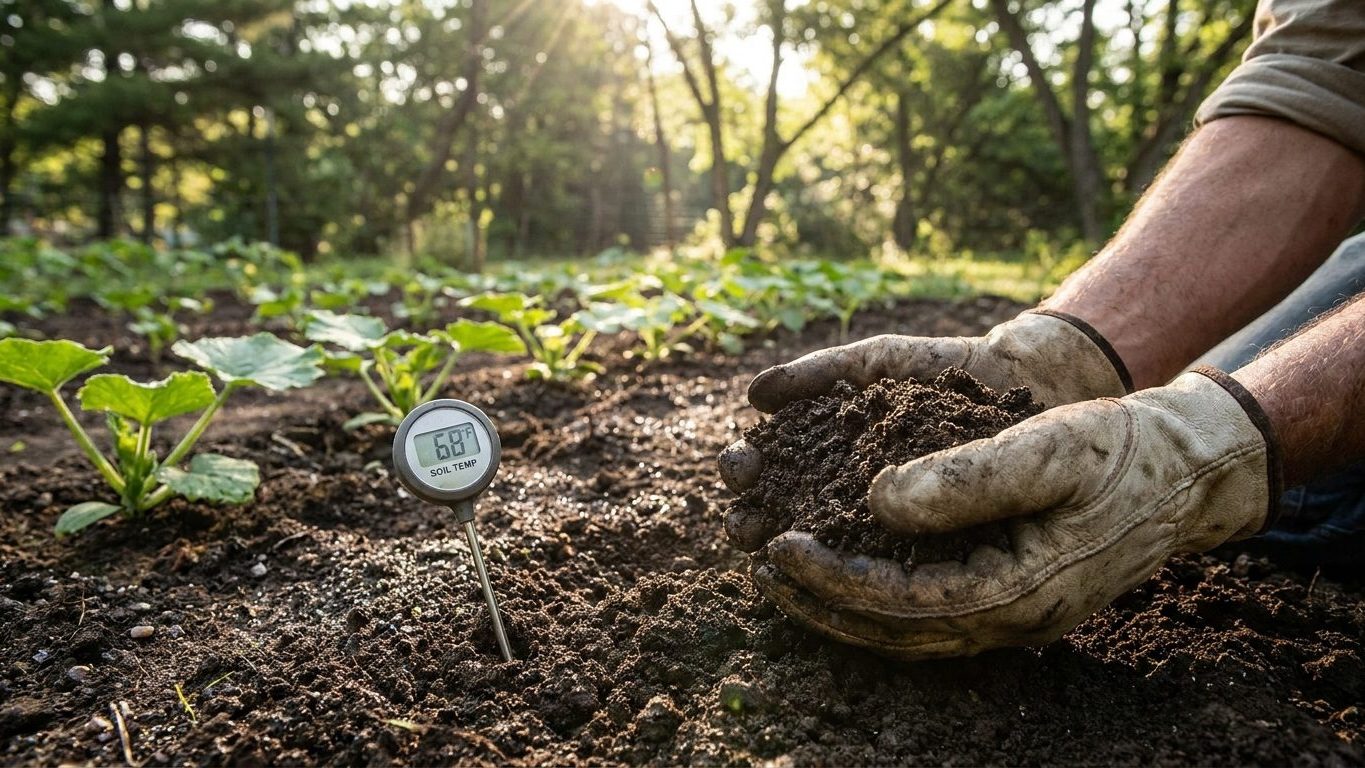
Soil warmth by feel is the first check. Winter squash seed sits in cold soil and simply rots rather than germinating, so a hand pushed a few inches into the planting bed should feel warm, not cool, before seed goes in. A south-facing bed against a wall or fence warms weeks ahead of an open, shaded spot, even in the same yard.
The first flush of male flowers is the second signal, and it usually shows up before any female flowers or fruit. Male flowers open first as a matter of course for squash, so their appearance alone doesn’t mean fruit is coming yet, but a long gap before female flowers follow can flag a plant still under heat or moisture stress from the failures described above.
The first true leaves, the second set that emerges after the rounded seed leaves, are the third marker. Vigorous, dark-green true leaves within one to two weeks of sowing suggest a plant that has settled into warm enough soil and even moisture. Slow, pale, or stalled true-leaf growth is worth investigating before assuming the calendar was wrong.