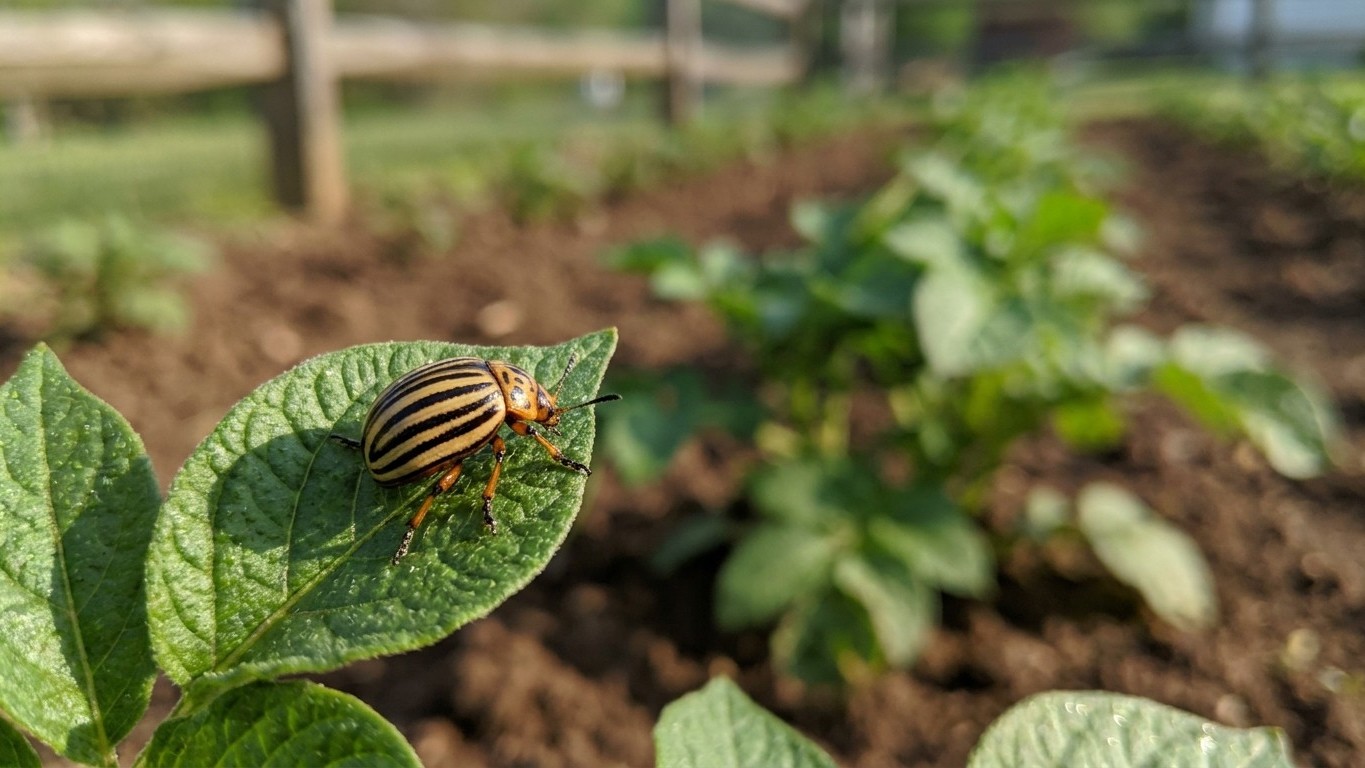

WVU Extension documents a dozen garden insects and slugs for West Virginia, but only about half of them actually eat potato. The Colorado potato beetle, flea beetles, aphids and whiteflies, slugs and the tobacco hornworm are the ones that matter. They show up in a predictable order, starting the week shoots break the soil and running through late summer.
Which pests attack potato in West Virginia

WVU Extension’s list for the state reads: aphids and whiteflies, asparagus beetles, cabbage worms, Colorado potato beetle, corn earworm, cucumber beetles, flea beetles, harlequin bug, Japanese beetle, slugs and tobacco hornworm. It is a garden-wide list, not a potato list. Most of it belongs to other crops, and a potato patch is not the place to hunt for them.
Start with the ones to set aside. Asparagus beetles feed on asparagus. Cabbage worms and the harlequin bug go after cabbage-family crops. The corn earworm is named for its host, corn. Cucumber beetles follow squash, melons and cucumbers. A potato plant near any of these crops may see a stray visitor, but the damage you are chasing is coming from somewhere else. The Japanese beetle is a different case. It feeds on a wide range of plants and can chew potato leaves, but potato is not its target, so treat it as a bystander.
That leaves five that belong on a potato page:
- Colorado potato beetle, the one named for the crop
- Flea beetles, which hit young plants
- Aphids and whiteflies, which feed on sap
- Slugs, which work at night in damp weather
- Tobacco hornworm, a caterpillar that feeds on nightshade family plants, potato included
The Colorado potato beetle is the one to learn by sight. Of everything on the list, it is the only insect whose name points straight at your crop. The rest are opportunists that also happen to like potato.
The list is short, and it should be. WVU Extension documents these species for the state, and this page names nothing beyond them. Wireworms, grubs and other soil pests are common talk in garden circles, but they are not in the material used here, so they get no verdict. If you find something that fits none of the five, that is a question for your county office, not a reason to guess.
When each one shows up, and what it does first
Pests follow the plant, not the calendar. In Charleston, the last spring 32F freeze falls between April 9 and April 23 (the 30-70% probability band in NOAA NCEI Climate Normals). But Charleston sits in a river valley, and a hillside garden a few miles away runs on a different clock. So the sequence below is counted from planting and emergence. Our When to Plant Potatoes in West Virginia: Counting Back From Your Last Frost page shows how to anchor your own planting date.
Slugs and flea beetles come first, while plants are small and the weather is cool and damp. Slugs leave ragged holes in leaves and a silvery slime trail across the soil or mulch. You rarely see the animal, because it feeds after dark. Flea beetles leave a scatter of tiny round holes, almost like buckshot, and the beetles hop when you brush the foliage. On a seedling the holes look alarming. On an established plant they usually matter less.
The Colorado potato beetle arrives about when shoots do. Adults spend the winter in the soil and walk or fly to potato as it emerges. The first sign is chewed leaf edges. Then come clusters of small orange-yellow eggs on the undersides of leaves, and after that the soft, humped larvae that do the heaviest stripping. Check leaf undersides as soon as the first shoots are up, because the egg cluster is the easiest stage to deal with and the easiest to miss.
Aphids and whiteflies build up as the canopy fills in and the weather warms. You see them on the undersides of leaves: curling, a yellow cast, and a sticky residue on foliage below. Japanese beetles come in midsummer and chew leaves into lace. The tobacco hornworm tends to show up later, when plants are large. It is a big green caterpillar, and the giveaway is that whole sections of foliage disappear in a day or two, with chunky dark droppings on the leaves beneath.
These are general patterns of how the insects live, not dates published for a specific county. WVU Extension can tell you what has been active near you lately.
Telling the damage apart from everything else
Not every hole is an insect, and not every yellow leaf is an aphid. A wrong diagnosis costs a season, because the fix for a nutrient shortage is not the fix for a beetle. The table sorts the most common look-alikes. It does not tell you what is in your garden. It tells you what to check.
| What you see | Could be | What settles it |
|---|---|---|
| Small round holes, plant otherwise healthy | Flea beetles, hail or wind damage | Tiny beetles that jump when disturbed point to insects. Holes with no beetles and torn edges point to weather. |
| Ragged edges, whole leaves gone | Slugs, Colorado potato beetle | Slime trails and night damage suggest slugs. Egg clusters or humped larvae on leaf undersides suggest the beetle. |
| Yellowing lower leaves, plants wilting by afternoon | Aphids or whiteflies, water stress, nutrient shortage | Insects and sticky residue on leaf undersides, or a dry soil profile a hand’s depth down. A soil test settles the nutrient question. |
| Brown spots spreading, leaves dying from the bottom up | Fungal leaf disease | No insects present and spread that follows wet weather. Have the county office identify it. |
| Stems stripped overnight, large dark droppings | Tobacco hornworm, deer or rabbit browsing | Droppings on the leaves and a caterpillar on the plant, versus clean-torn stems and animal tracks. |
| Holes or gouges in tubers | Slugs, fork or hoe damage, or something not documented here | Slime and shallow scoops suggest slugs. Straight, clean cuts suggest a tool. Tunnels are a question for your county office. |
The trap is single-cause thinking. A plant can have flea beetle holes, dry soil and a nutrient problem at the same time, and only one of them will get the blame. Look at the whole plant, top and bottom, and at the neighbors. If damage follows the row, think water or soil. If it follows the plants, think insects.
When the table doesn’t settle it, take a sample. Bring a damaged leaf, a live insect in a sealed jar or bag, and a photo of the whole plant to your county WVU Extension office. That beats any photo match online.
What actually works here, and what is a waste of time
On a short season, timing beats treatment. The Colorado potato beetle overwinters near last year’s potato ground, so plant in a spot that has not held potatoes recently and cover the row when shoots break the soil. Floating row cover blocks beetles and flea beetles from reaching the plants. It has to be sealed at the edges and it only works if nothing is already under it, which is why the rotation matters. Check with your county office on when to lift it.
Hand-picking is dull and effective in a home garden. Turn leaves over every few days, crush egg clusters and drop larvae and hornworms into a bucket of soapy water. A hornworm is large enough to spot. The beetle eggs take practice. For slugs, cut down what shelters them: keep mulch and debris off wet soil, water in the morning so the surface dries by night, and set boards down as traps to collect them by hand.
Certified seed belongs in this list too, and it is not a small detail. Uncertified seed potatoes can carry virus, and no spray or row cover fixes that later. Our guide to Potato Varieties That Suit West Virginia covers what to buy, and the main Growing Potatoes in West Virginia page covers the rest of the season.
What wastes your time is spraying because you saw one beetle, or spraying on a schedule with no diagnosis. These pests are different animals with different habits, and no single remedy covers them. Home concoctions get repeated without evidence behind them. Waiting until leaves are stripped to act means you are treating the last stage, not the first. This site doesn’t recommend pesticides. WVU Extension knows what is registered for use in West Virginia, so ask them before buying anything.
Where to check this for your own county
WVU Extension has an office in your county, and that is the right first call. Its staff know which insects have been active locally, what the season has been doing and what is legal to use in the state. A general list can’t tell you any of that.
The gap between a state list and a single garden is wide. The list above is what WVU Extension documents for West Virginia as a whole, not a survey of your backyard. A pest on the list may be common in one county and barely seen in the next. The frost figure is the same kind of number: April 9 to April 23 belongs to Charleston, in a river valley. Higher elevations across the state freeze noticeably earlier in fall, and a ridge-top garden has a shorter window than the valley floor.
Before you go, gather what makes a diagnosis easy. Bring a photo of the whole plant and a close-up of the damage. Include the underside of a leaf, and a live specimen sealed in a jar or bag if you have one. Note when it started and what the weather had been doing. If tubers are damaged, bring one.
Next step: before planting, call or visit your county WVU Extension office and ask which of these five pests have been active near you lately, then plan your row cover and rotation around the answer.
Common questions
Which pest is most likely to strip my potato plants?
Among the pests WVU Extension documents for West Virginia, the Colorado potato beetle is the one named for the crop. Its larvae do most of the stripping, so leaf undersides are worth checking early.
Do I need to worry about corn earworm or cabbage worms on potatoes?
Not as a rule. They are on the state list because they attack corn and cabbage-family crops. They are unlikely to be what is eating your potato plants.
Does the last frost date tell me when pests will arrive?
No. In Charleston the last spring freeze falls between April 9 and April 23, but that only anchors your planting. Pests follow plant stage and weather, and your elevation can shift the whole schedule.
Is there something I can spray?
This site does not name products. What is registered for use in West Virginia is a question for your county WVU Extension office, which can also tell you whether spraying is needed at all.