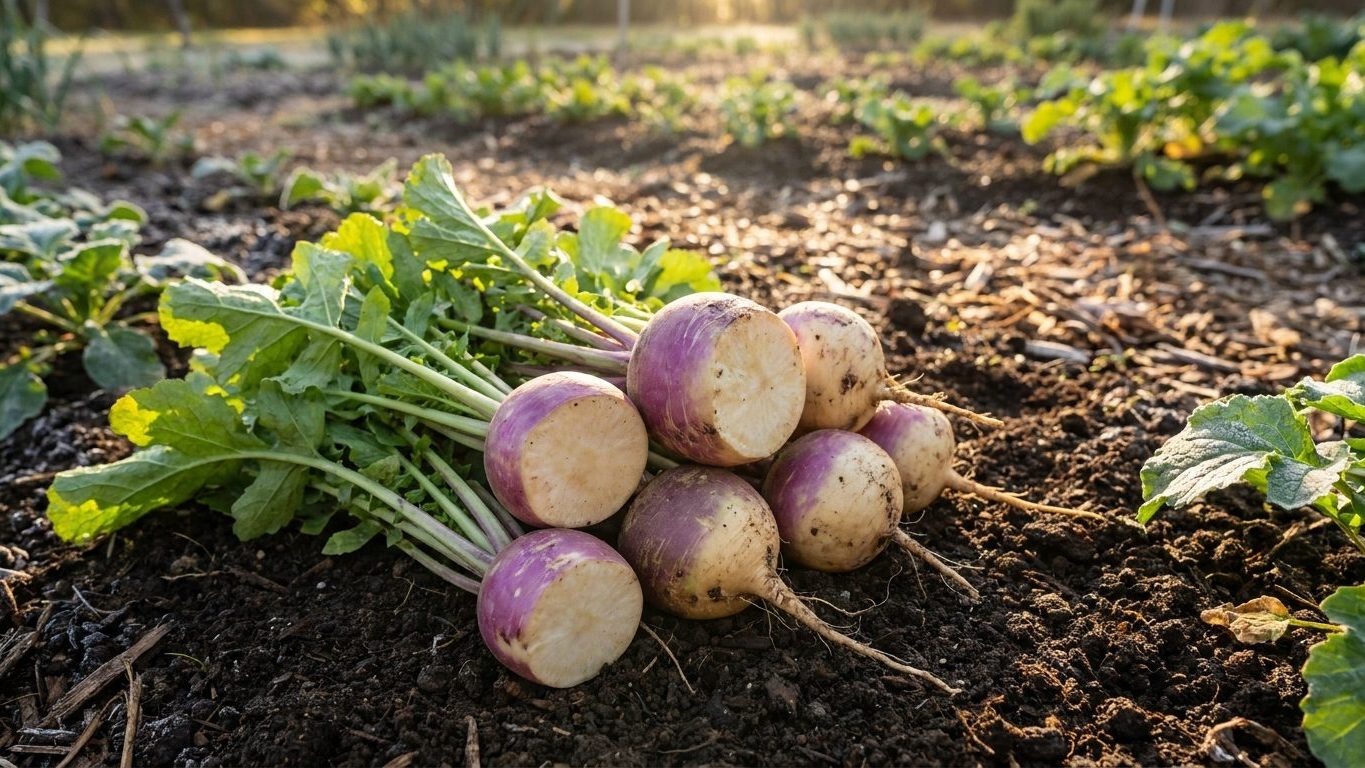

In Arizona’s low desert, turnips and rutabaga are strictly a cool-season crop: sow them in fall and harvest through winter, because summer heat stops root development outright for months at a stretch. In the high country around Flagstaff, real frost sets a different, shorter window. Either way, the calendar here has almost nothing to do with the spring frost dates that guide gardeners elsewhere.
When the soil is warm enough in Arizona
Ask the frost question in most states and you get a clean spring date. Ask it in Phoenix and the answer is close to nothing. NOAA’s 1991-2020 Climate Normals, built from station USW00023183, list the frost-free season at a full 365 days. Over 30 years of record, the temperature dipped to 32F in only 6 springs, and when it did, the cold snap landed somewhere between late December and mid-January, not in the weeks gardeners elsewhere call spring. There is, in practical terms, no reliable frost to wait out in the low desert.
The real trigger is heat, not frost
That number changes how you should think about planting turnips and rutabaga here. Elsewhere, the frost date is a proxy for something else: soil temperature. Gardeners use it because soil usually crosses a moderate, root-friendly range around the same time frost risk ends. In Arizona’s low desert, that proxy breaks down completely. Frost isn’t the limiting event; heat is. Soil here spends months baked well past what a brassica root tolerates, and no frost date will ever tell you when that heat has finally broken.
So the real planting question in the low desert isn’t when the soil is warm enough, it’s when it has finally cooled enough. That happens in fall, once daytime highs settle down from summer extremes, and it’s the point local growers watch rather than any date on a national frost chart. Gardeners in Flagstaff and the high country are working an entirely different climate: hard freezes are routine there, and the spring-warming calendar that applies across most of the country applies to them too, just later and shorter than in milder states.
One family, one set of problems
Whichever zone you’re in, remember what these roots are. Turnips and rutabaga are brassicas, in the same family as cabbage, kale and mustard. Any bed that grew one of those crops in the past two or three years carries the same pests and diseases, and planting turnips into it isn’t rotation, it’s just a delay. Check the rotation guide on this site before deciding where the fall bed goes. For the actual planting window and soil-temperature targets that make sense for your part of the state, the University of Arizona Cooperative Extension is the source to use, not a national chart built around a frost calendar that doesn’t apply here.
How long the season lasts here
Subtracting a last frost date from a first fall frost date is the standard way to size up a growing season, but that arithmetic needs two actual dates, and Phoenix doesn’t really have them. NOAA’s data for station USW00023183 records no reliable spring frost and no reliable fall frost in most years, with the frost-free season listed at 365 days. There’s no gap to measure, because there’s essentially no frost bracketing one.
What a frost-free window actually allows
That doesn’t mean the growing window is unlimited, it means frost stopped being the boundary. The cool season for turnips and rutabaga in the low desert runs from roughly early fall, once the punishing summer heat has broken, through winter and into early spring, before the next heat wave shuts root growth down again. Within that window, gardeners here often get more room than a frost-bound calendar would suggest: a fall sowing can be followed by a second one a few weeks later, since there’s no hard freeze forcing everything to finish at once. Whether that second sowing is worth the effort depends on how the first one is doing, and a long, mild cool season gives you the slack to succession-sow every few weeks rather than pulling everything at once. The succession sowing guide on this site walks through spacing those plantings so they don’t all mature in the same short stretch.
Why transplanting matters less here
Where the calculus changes is transplanting. In a genuinely short season, gardeners sometimes start turnips indoors to gain a few weeks before a hard freeze. In the low desert’s long, frost-free cool season, that head start matters less. It’s usually simpler to direct-sow once the heat has broken and check roots by hand rather than by the calendar: a root that’s sized up and firm is ready, while a soft patch or a weeping spot on the crown means it’s past its point and shouldn’t go into storage regardless of how the calendar reads. High-country gardeners, by contrast, work a shorter, more conventional window bounded by real frost on both ends, closer to what the rest of the country deals with.
Heat and water in Arizona
Arizona’s growing conditions get discussed through two very different sets of numbers, and for a fall-into-winter crop like turnips and rutabaga, the ones that actually govern the outcome are the cold ones, not the heat statistics that usually define the state.
Why the coldest month matters more than the hottest
The low desert’s summer heat is real, but it isn’t what decides whether turnips and rutabaga do well here. It decides only when you can’t grow them at all, which is why the entire crop calendar shifts to fall. Past that point, the figures that matter are the coldest month’s temperature and how cold winter nights actually get. NOAA’s 1991-2020 Climate Normals put the mean daily minimum of Phoenix’s coldest month at 45.3F. That’s mild by any standard, and it answers the storage question directly: roots left in a mulched bed through a Phoenix winter aren’t fighting anything close to a hard freeze, so the choice between lifting the crop and leaving it in the ground under mulch is mostly one of convenience, not survival, in the low desert.
It also answers a question gardeners in colder states rarely think to ask: how much frost sweetening will this crop actually get? Turnips and rutabaga develop some of their sweetness after a real cold snap, and in a climate where 32F shows up in roughly one spring out of five, and often not at all in a given winter, that sweetening effect is minor at best around Phoenix. Gardeners chasing the flavor boost a hard frost gives these roots elsewhere won’t get much of it here.
One state, several climates
The USDA Plant Hardiness Zone Map lists Arizona spanning zones 4b to 10b, built on the average annual extreme minimum temperature, which says more about how different the state’s regions are than about any single garden. Phoenix sits at the warm end of that range; the high country around Flagstaff sits at the cold end, with real hard freezes that change storage, frost sweetening, and the whole planting calendar. A recommendation built around Phoenix’s mild coldest month doesn’t transfer to the high country, and the reverse is just as true. Rainfall in the low desert is low enough, and irrigation-dependent gardening common enough, that consistent watering, not disease pressure from humidity, is the bigger day-to-day concern for root quality there. Roots that dry out and rewet unevenly tend toward cracking and pithiness rather than rot.
Which turnips and rutabaga suit Arizona
None of this points to a variety name, and that’s deliberate. The types trialled and recommended for Arizona conditions are documented by the University of Arizona Cooperative Extension, and that’s where the useful recommendation lives, not on a general page that has no way to know what performed well in Tucson versus Prescott versus Yuma last season.
Choosing by type, not by name
What the state’s facts do point to is a type, not a specific cultivar. Because the low desert’s growing window opens only after summer heat breaks and closes again once the next heat wave arrives, the earliest-maturing types make the most sense there: they get a full root before the window closes, rather than racing a heat wave that’s already building. In the high country, where the season is bounded by real frost on both ends rather than heat, gardeners have more room to grow types that take longer to size up. Where a fall sowing goes in before the low desert’s heat has fully broken, giving the crop airflow and some shade at the root zone matters more than it would in a milder climate; roots planted into hot, still soil size up unevenly and are more prone to cracking and pithiness, regardless of variety.
Dry air changes the priority list
Because Arizona’s air is dry rather than humid, the disease pressure that shapes variety choice in wetter states, downy mildew among them, is a smaller factor here than consistent soil moisture. That doesn’t make disease resistance irrelevant, only that it isn’t the first criterion the way it would be in a humid southeastern state. Consistent, even irrigation does more for root quality here than resistance ratings do.
And whatever type you choose, remember it’s a brassica, sharing its pest and disease pressure with cabbage, kale and mustard. A rotation plan that moves turnips into last year’s cabbage bed hasn’t rotated anything; check the rotation guide on this site before deciding where the fall planting goes. For the names that actually matter, early types suited to the low desert’s short cool window versus longer-season types for the high country, the University of Arizona Cooperative Extension (extension.arizona.edu) publishes the trial results specific to your part of the state, and that’s the recommendation worth following.