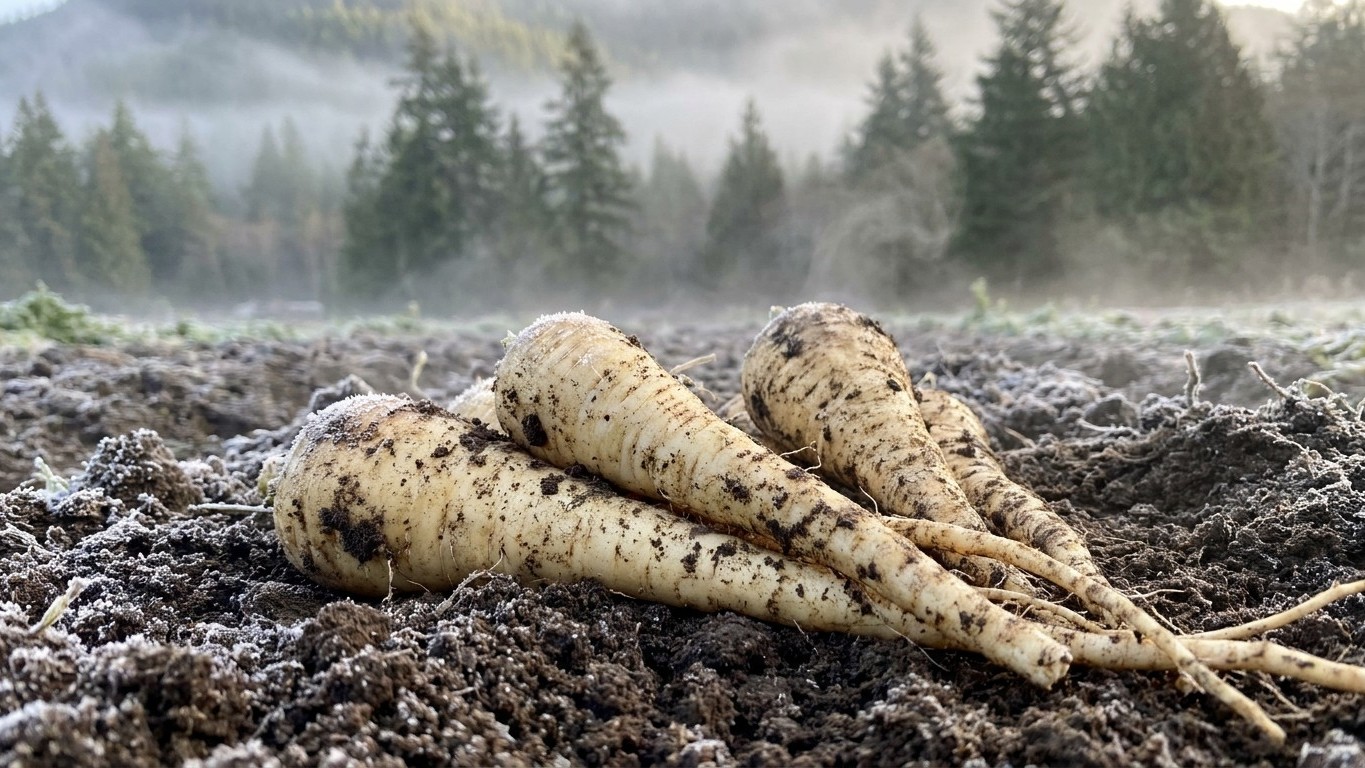

Lift parsnips in Hawaii when the roots reach full size, 100 to 120 days after seeding. There is no frost to wait for, because lowland Hawaii has none. That changes the flavor more than the timing: the roots come out mild and starchy, not sugar-sweet. Once lifted, a parsnip can keep 4 to 6 months, but only in cold, humid storage that a Hawaii kitchen cannot supply, and only away from the fruit bowl.
The short answer
Does Hawaii deliver several frosty weeks? No. NOAA NCEI’s most recent 30-year Climate Normals for the Honolulu reference station put the mean daily minimum of the coldest month at 66.8°F. The same station logs zero days per year at or below 32°F, and the freeze percentiles cannot even be computed, because the freezes never happen. Frost shows up only on the high volcanic summits (Mauna Kea, Mauna Loa and Haleakala), never where people garden. A parsnip grown here will grow. It will not sweeten in any meaningful way.
The sweetening is the crop’s own mechanism. According to Utah State University Extension, parsnips taste best after several weeks of cool, frosty weather, which converts stored starch to sugar. A coldest-month night that still bottoms out near 67°F does not start that conversion. A hardiness zone number is a different measurement, since it describes the coldest winter a plant can survive. A comfortable zone is not several frosty weeks, and a root can live happily in one without ever tasting frost. Higher, cooler gardens on the islands help the plant’s comfort, but cooler is not frosty. The longer discussion is in Will Parsnips Sweeten in Hawaii?, and the general growing picture sits in Growing Parsnips in Hawaii.
What sets the lifting date instead
With no frost calendar to lean on, the date comes from the seed packet’s clock and from your conditions. Parsnips are sown in place, so the 100 to 120 days run from seeding, not from transplanting. Germination alone takes 14 to 21 days, which means a bed can look bare for up to three weeks and still be perfectly fine. Digging into it to check, or re-sowing over it, is the most common mistake. Beyond that, rainfall, elevation and windward versus leeward exposure govern how a bed behaves, and they matter far more than any date on a wall calendar.
How long they keep once lifted
Here is the fact most guides skip. A parsnip is not chilling sensitive, so cold does not hurt it. Ethylene does. USDA Agricultural Handbook 66 reports that parsnips produce very little ethylene themselves, under 0.1 µL per kg per hour at 68°F, but that exposure to low levels of the gas in cold storage causes bitterness, likely through an accumulation of xanthotoxin. Parked next to apples or any ripening fruit, a parsnip turns bitter even at the right temperature. In a Hawaii kitchen, where mangoes, papayas and bananas ripen on the counter all year, that matters.
The same handbook gives the storage figure: 4 to 6 months at 32 to 34°F with 98% relative humidity. That is a long keeper by any standard. It also assumes those conditions are held steady, which almost no house does. Expect less at home, and keep the roots in their own drawer or bag. Top them after harvest, but do not trim into the crown.
Does the season fit?
The standard rule is simple: 100 to 120 days from a sowing made 2 to 3 weeks before the last frost. Run the arithmetic for Hawaii and the rule falls apart at the first step, because there is no last frost to count from. Here is how the numbers work out in words.
- Find the anchor. The usual advice anchors sowing to the last spring frost. In inhabited Hawaii there is no such date, since the station data show no freezes at all. Pick the sowing window by soil moisture and daytime heat in your own spot instead.
- Allow for germination. Seed in place and expect 14 to 21 days before anything shows. That time is already inside the 100 to 120 days, so it does not get added on top.
- Add the growing time. 100 days is a little over 14 weeks, and 120 days is just over 17. Call it a bit more than three months at the short end and about four at the long end.
- Look for the deadline. In a cold state, the first fall frost ends the argument. Here there is no first fall frost either, so nothing cuts the season off from the cold side.
- Judge the fit. On the calendar, the season fits comfortably, because four months of growing never runs into a wall. The limits are rain, elevation and exposure, which belong to your garden and not to the date.
What the arithmetic leaves out
Fitting the calendar is not the same as delivering the payoff. The count tells you when the root is big enough, and it says nothing about taste. In a cold-winter state the last stretch of the season is where parsnips earn their reputation, because the weeks after the first frost are what turn starch to sugar. Hawaii skips that stretch. A root lifted at 100 days and one lifted at 120 will both be mild, and neither will be the candy-sweet parsnip from a northern garden. Leaving roots in warm, wet soil past that point does not buy sweetness. It tends to buy splitting, rot and visitors; see What Eats Parsnip in Hawaii, and When for who shows up.
So lift on evidence: count from seeding, check that the shoulders at the soil line have broadened, and pull one test root before you commit the row.
What goes wrong here
Most failures here trace back to soil, water or expectations, not to cold. The state soil is only a starting point, and a garden can differ from its neighbor’s across the fence, so treat these as things to check in your own bed.
- Forked roots from heavy or stony ground. A taproot that hits a clod or rock splits and wanders. Utah State calls for deep sandy soil and says heavy soil must be double dug. Loosen the bed to a full spade depth or more, pick out stones, and consider a raised bed if the native ground is dense clay.
- Forked roots from overwatering. This is a separate cause with a separate fix. Constantly soggy soil, common on wet windward sides, encourages branching and rot. Water evenly, avoid puddling, and improve drainage before sowing, or sow where the bed sheds rain.
- Bare soil mistaken for failure. Seed takes 14 to 21 days to come up. Keep the surface moist, mark the row, and resist re-sowing until three weeks have passed.
- Waiting on frost that never comes. Leaving roots in the ground for a cold snap that will not arrive just extends their exposure to warm soil and pests. Lift at full size, 100 to 120 days from seeding, and accept a mild root. Roast or glaze it, since cooking brings out what sweetness it has.
- Bitterness in storage. Roots kept beside ripening fruit pick up ethylene and turn bitter. Store them separately, topped but with the crown left uncut, and use the coldest, most humid spot you have.
The failure you cannot fix is the mild winter itself. No watering schedule or soil amendment substitutes for weeks of frost, so the honest approach is to grow parsnips here for what they are, a fine, earthy root vegetable, rather than for the sweetness they reach elsewhere.
Common questions
Can I leave parsnips in the ground in Hawaii until I need them?
Nothing frost-related forces you to dig them, but nothing is gained by waiting either. Without frost the roots do not sweeten, and warm, wet soil invites rot and pests. Lift at full size and store them properly.
Will a high-elevation garden sweeten parsnips?
Frost occurs only on the summits of Mauna Kea, Mauna Loa and Haleakala, not where people garden. A cooler upland bed is gentler on the crop, but the sweetening depends on several frosty weeks, and cool is not the same as frosty.
How should I store lifted parsnips at home?
Keep them cold and humid, top them, and leave the crown intact. The 4 to 6 month figure from USDA Handbook 66 assumes 32 to 34°F at 98% humidity held steady, so a home setup will keep them for less. Above all, keep them away from apples, mangoes, bananas and other ripening fruit, because ethylene makes them bitter.
How do I know when to lift with no frost date to go by?
Count 100 to 120 days from seeding, and check the root size. Remember that germination takes 14 to 21 days and is included in that count. If you are unsure, lift one root as a test; the rest will stay fine for a few more days.