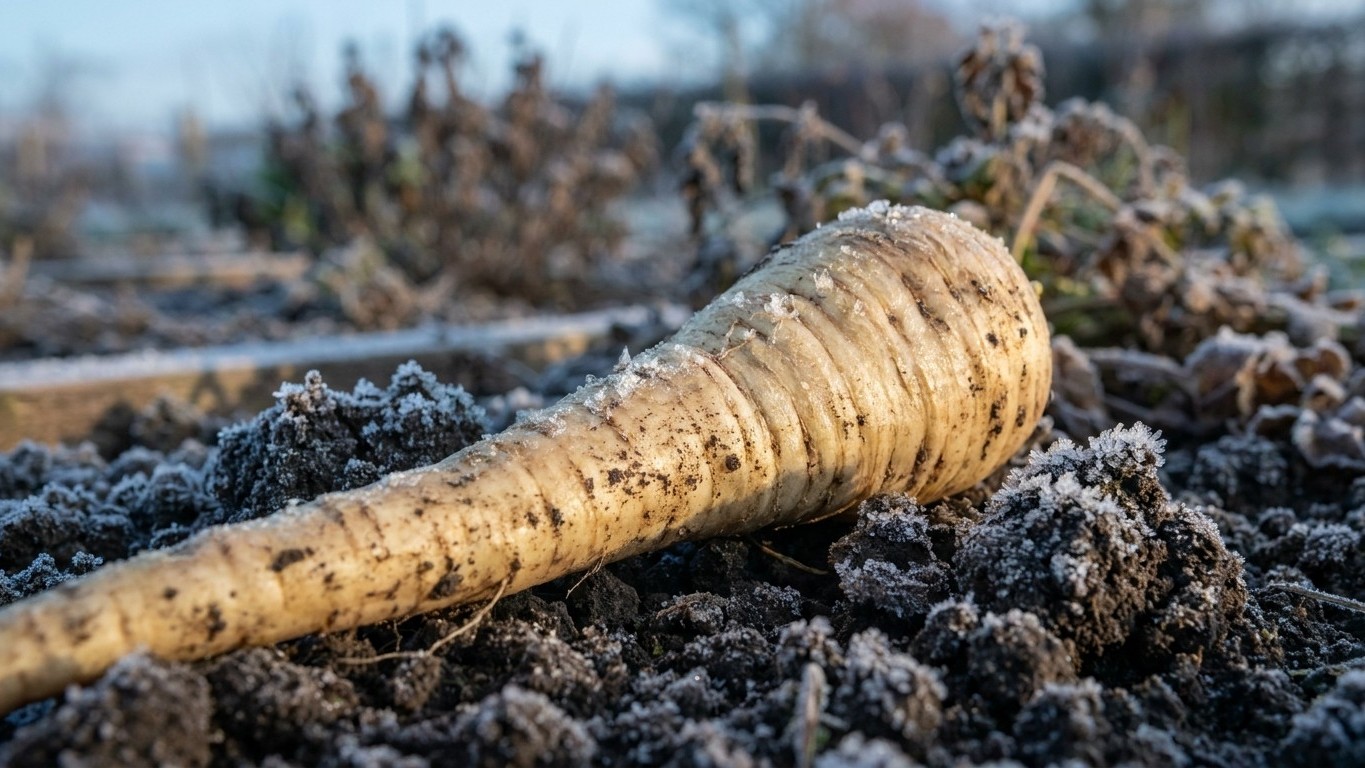

In Tennessee, parsnip faces three insects documented for the state by University of Tennessee Extension: root maggots, which tunnel into the taproot itself; flea beetles and cutworms, which hit seedlings within days of germination; and aphids, which colonize foliage once the canopy fills in. Root maggot and seedling pressure concentrates around the spring sowing window. Aphids build later, through the growing season. None of the three stop parsnip from developing the sweetness that only comes after several weeks of hard frost.
Which pests attack parsnip in Tennessee

University of Tennessee Extension documents fourteen insect pests for home vegetable gardens in this state:
- Aphids
- Cabbage looper
- Colorado potato beetle
- Corn earworm
- Flea beetles and cutworms
- Harlequin bug
- Imported cabbageworm
- Mexican bean beetle
- Onion (pests)
- Root maggots
- Spotted and striped cucumber beetles
- Squash bug
- Squash vine borer
- Tobacco and tomato hornworms
That list covers the whole vegetable garden, not one crop, and most of it has nothing to do with parsnip. Cabbage looper, harlequin bug, and imported cabbageworm are cole crop feeders, they work on cabbage, broccoli, and their relatives, not on a root planted in the carrot family. Colorado potato beetle and the tobacco and tomato hornworms belong to the nightshade family, potatoes, tomatoes, eggplant, and skip parsnip entirely. Corn earworm targets corn ears and tomato fruit, structures parsnip doesn’t produce. Mexican bean beetle needs bean foliage. Spotted and striped cucumber beetles, squash bug, and squash vine borer are cucurbit specialists, tied to squash, cucumber, and melon vines. The onion pests need an onion crop to feed on.
That leaves three: aphids, flea beetles and cutworms, and root maggots. A pest whose host list doesn’t include the carrot family has no business on a parsnip damage report, no matter how common it is elsewhere in a Tennessee garden. Root maggots are the one worth watching most closely, because they attack the harvestable part of the plant directly rather than the leaves. Flea beetles and cutworms threaten the crop only at its most fragile stage, right after the seed comes up. Aphids are the slowest-building threat and rarely cost a gardener the harvest on their own, though a heavy colony can weaken a plant enough to affect root size.
University of Tennessee Extension documents just these three for parsnip specifically among its fourteen garden pests. That’s a short list, and it should stay that way. Padding it with a pest that belongs to another crop family doesn’t make the page more useful, it makes the diagnosis wrong.
When each one shows up, and what it does first
Parsnip is sown directly in the ground, not transplanted, and the timing runs off the state’s frost calendar rather than a calendar month. NOAA climate normals put the last spring freeze for this station between March 31 and April 12, and the first fall freeze between October 28 and November 8, with East Tennessee and the Cumberland Plateau running cooler and later than that on both ends. Seed goes in the ground roughly two to three weeks ahead of the last frost date, so the seedling stage lands right in that unsettled early spring stretch.
Germination takes 14 to 21 days, according to Utah State University Extension, the only source this page relies on for parsnip’s own growth habits. That’s a long, exposed window with nothing visible above ground, which is exactly when cutworms do their damage. A cutworm works at night, severing a seedling at the soil line before it’s ever been seen. The first sign a gardener actually notices is a gap in the row where a seedling stood the day before, not a chewed leaf.
Flea beetles arrive close behind, as soon as the first true leaves unfold. Their damage looks like a scatter of tiny round holes across the leaf surface, sometimes called shot-holing, and it shows up fast on a young plant with very little leaf tissue to spare. A seedling that’s already stressed by cool, wet soil takes longer to outgrow that damage than one growing quickly in warm conditions.
Root maggots operate underground and later in the plant’s life, once roots have started to bulk up. The adult fly lays eggs at the base of the plant during cool, moist weeks, and the larvae tunnel into the developing root. Nothing shows above ground until the plant wilts on a warm day for no clear reason, or until the root comes up scarred at harvest, sometimes months after the eggs were laid.
Aphids show up last, once the canopy has filled in and offers shelter on the undersides of leaves. Parsnips need 100 to 120 days from seeding to size up, and aphid colonies tend to build steadily through the middle of that stretch, curling new leaf growth and leaving a sticky residue rather than doing sudden, visible damage.
Telling the damage apart from everything else
A missing seedling isn’t automatically a cutworm. Damping-off disease collapses seedlings too, but the stem usually shows a pinched, water-soaked rot right at the soil line rather than a clean, chewed severing. A cutworm leaves a cut mark; a fungal problem leaves mush.
Shot-holed leaves aren’t always flea beetles either. A nutrient shortfall, particularly on the sandy soil parsnip actually prefers, shows up as yellowing or pale streaking between the leaf veins, with the leaf tissue intact. Flea beetle damage is physical, actual holes with slightly browned edges, not discoloration.
A wilting plant on a hot afternoon can mean root maggot tunneling, but it can also mean simple drought stress on shallow or sandy ground that dries out fast. The difference shows up at the root: maggot tunnels come with visible brown scarring and sometimes a fine sawdust-like frass, while drought stress leaves the root shape normal, just smaller than expected.
Forked or split roots cause the most confusion, because they look like pest damage but usually aren’t. A forked root here has two separate possible causes, and they shouldn’t be merged into one explanation: heavy or stony ground that physically deflects the taproot, and overwatering that encourages a mass of secondary rootlets instead of one clean root. Neither one involves an insect at all. Utah State University Extension notes that parsnip wants deep, sandy soil, and that heavy ground needs to be double dug before sowing, which is a soil-prep issue, not a pest issue.
| Symptom | Likely cause | What tells it apart |
|---|---|---|
| Seedling gone, clean cut at soil line | Cutworm | Stem severed, not rotted or mushy |
| Small round holes in young leaves | Flea beetle | Actual holes, not discoloration |
| Wilting mid-day, brown root scarring | Root maggot | Tunnels and frass inside the root |
| Curled new leaves, sticky residue | Aphids | Visible clusters on leaf undersides |
| Forked, split root | Soil or watering, not a pest | Check soil texture and watering schedule first |
When the cause isn’t obvious from the plant itself, a county Extension agent can look at an actual sample. Guessing from a photo online isn’t a substitute for that.
What actually works here, and what is a waste of time
Timing matters more than any single treatment on a season this short. Sowing seed 2 to 3 weeks before the last frost date, then covering the row until the seedlings have several true leaves, protects the plant through its two most vulnerable weeks in one move. A lightweight physical barrier laid down before emergence keeps cutworm moths and flea beetles from ever reaching the row, and it costs nothing to remove once the plants have toughened up.
Deep, loose, sandy soil, or heavy soil that’s been double dug ahead of sowing, does double duty. It gives the root room to grow straight instead of forking, and it also makes the ground less hospitable to root maggot larvae than compacted, waterlogged soil. Rotating parsnip away from the spot where carrots, celery, or parsnip grew the year before reduces the odds that root maggot flies find the row again quickly.
What doesn’t work is waiting until damage is visible to act. A row cover put on after flea beetles have already found the seedlings is protecting nothing. Thinning a stand after cutworms have already taken several seedlings doesn’t bring them back, it just tells the gardener the barrier went on too late. And treating a forked root as a pest problem, when the actual cause is heavy soil or overwatering, means the same mistake gets repeated next season because the real cause was never addressed.
Beyond timing and soil prep, decisions about any additional treatment belong with a county Extension office, which knows what’s actually labeled for use in Tennessee gardens. This page doesn’t recommend products, and no product name should substitute for that call.
Where to check this for your own county
University of Tennessee Extension maintains the pest documentation this page draws from, and every county in the state has its own Extension office staffed by agents who track local conditions directly. What’s documented at the state level describes what’s known to occur in Tennessee gardens generally, it doesn’t confirm what’s actually present in one particular garden. Pest pressure shifts across the state’s geography, and the same frost data that shapes planting dates here also runs cooler and later across East Tennessee and the Cumberland Plateau than it does around Nashville.
A gardener seeing damage that doesn’t match anything described above, or wanting confirmation before treating a crop, should bring a sample, a photo, or a description to the local county Extension office rather than relying on a state-level list alone. That’s the office equipped to say what’s active in that specific area this season, not a general guide covering the whole state.
Common questions
Do rabbits or deer eat parsnip foliage in Tennessee?
University of Tennessee Extension’s pest list for this crop covers insects, not browsing wildlife. A county Extension office is the right place to ask about deer or rabbit pressure specific to a property.
Does a mild winter mean root maggots survive better?
The facts here don’t cover root maggot overwintering survival rates. What’s documented is that the pest attacks parsnip roots during the growing season; winter survival isn’t part of this page’s sourced data.
Can parsnip be harvested before the first fall frost?
It can be dug earlier, but Utah State University Extension notes the crop tastes best after several weeks of cool, frosty weather, which converts stored starch to sugar. Harvesting before that exposure trades flavor for an earlier date on the calendar.
Is a forked root safe to eat?
A forked root from heavy soil or overwatering is a shape problem, not a pest or disease problem, and doesn’t indicate the root is unsafe. It’s simply harder to peel and prep than a straight one.