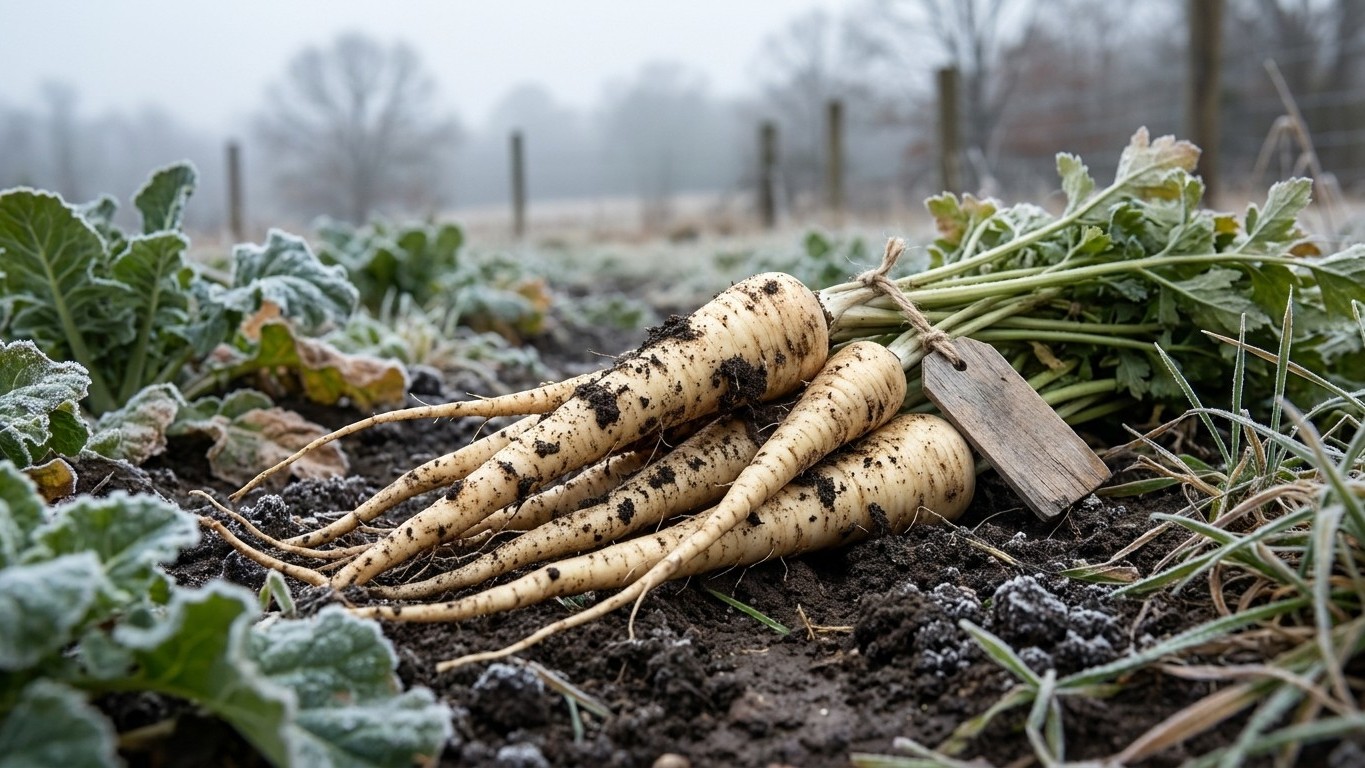

Middle Tennessee gets the frost exposure a parsnip needs. The coldest month there averages a nightly low of 30.1°F, cold enough, often enough, to turn stored starch into sugar. Grown and timed right, a Tennessee parsnip won’t just grow. It will sweeten. But the timing has to be right, and that’s where the arithmetic and the soil both matter.
The short answer
Here’s the question that actually decides this, not “what zone am I in” but “does this place deliver several frosty weeks in a row.” Hardiness zones measure whether a perennial root survives winter underground. That’s a different question entirely from whether a parsnip’s flesh converts starch to sugar above the freeze line. The number that answers the sweetening question is the mean minimum temperature of the coldest month, and for Middle Tennessee, using the Nashville reference station, that figure is 30.1°F, based on NOAA NCEI 1991-2020 Climate Normals.
A mean minimum of 30.1°F means that on a typical night in the coldest month, the temperature isn’t dipping to freezing occasionally. It’s sitting at or just below it as the norm across the month. That’s not one cold snap. That’s a stretch of repeated frost exposure, week after week, which is exactly the condition Utah State University Extension points to when it describes parsnips tasting best after several weeks of cool, frosty weather that converts stored starch to sugar.
So the plain answer for Middle Tennessee: yes, a parsnip left in the ground through the cold season here will sweeten, not merely mature. The root reaches size by late summer, then sits through a winter cold enough, on average, to do the conversion work extension guidance describes.
One caution worth repeating, because it trips people up: don’t reach for the USDA hardiness zone number to answer this. A “comfortable” zone rating says nothing about how many frosty weeks a given county actually gets. Two towns in the same zone can have very different coldest-month averages. The 30.1°F figure is a direct measurement of winter cold at a specific station, and that’s the number that tracks with sweetening, not a zone label.
It’s also worth noting that this figure comes from a Nashville-area station. East Tennessee and the Cumberland Plateau run cooler and later in the season than Middle Tennessee does. That generally means those regions see at least as much frost exposure, likely more, so the sweetening outcome shouldn’t be worse there. It just means a gardener in the eastern part of the state is working with a slightly different calendar, which the next section walks through.
Does the season fit?
Parsnips are sown directly in place, never transplanted, and the 100 to 120 days extension guidance calls for run from the day the seed goes into the ground, not from any later stage. Here’s how that stretch lines up against Middle Tennessee’s frost calendar.
- Germination is slow, and that’s normal. Parsnip seed takes 14 to 21 days to come up. A gardener who doesn’t know this often assumes the seed failed and re-sows into bare soil, doubling the planting and confusing the timeline. Mark the row, keep the soil evenly moist, and wait the full three weeks before judging anything.
- The sowing window is set by the last spring frost. Middle Tennessee’s last spring frost falls between March 31 and April 12. Sowing 2 to 3 weeks ahead of that puts seed in the ground roughly in the second week of March through the very start of April.
- The 100 to 120 day clock starts there. Counting forward from a mid-March to early-April sowing, roots reach maturity somewhere around late June through early August, well inside summer, with the growing season still wide open around them.
- The first fall frost doesn’t arrive until much later. Middle Tennessee’s first fall frost falls between October 28 and November 8. That leaves a gap of roughly three months between the root reaching maturity and the first frost showing up.
- That gap is not wasted time, it’s the point. Parsnip roots hold perfectly well in the ground once mature. The extra months between maturity and first frost simply mean there’s no pressure to harvest early. The root sits, size already made, waiting for the cold to do the sweetening.
- Harvest follows the frost, not the calendar. Once the first frost passes in late October or early November, the several frosty weeks that follow are what convert the starch. Digging happens after that stretch, not the moment the thermometer first touches freezing.
Laid out this way, the season doesn’t just fit in Middle Tennessee, it fits with slack to spare. The 100 to 120 day requirement is met with months left over before the frost season even begins, which removes the usual worry about a short growing region running out of daylight before the root matures.
What goes wrong here
- Forked roots from heavy or stony ground. Middle Tennessee’s clay-heavy soils resist a taproot’s straight downward push, and a root that meets resistance splits instead of growing single. Utah State University Extension recommends double digging heavy soil, loosening it well beyond the top few inches, or growing in a raised bed filled with looser material so the root has a clear path down.
- Forked roots from overwatering. This is a separate cause from soil texture, not the same problem wearing a different name. Too much water, especially once the taproot is established, encourages the root to branch rather than deepen. Water steadily and moderately, and let the soil dry slightly between waterings once seedlings are up.
- The season runs out because sowing was delayed. Push sowing past the window that starts 2 to 3 weeks before the last spring frost and the 100 to 120 day maturity clock can run right up against, or past, the first fall frost with an undersized root still in the ground. The fix is simple: sow inside that window, not after it, even if the soil still feels a little cool.
- Digging too soon, before the frost has done its work. A root pulled right at the first frost, or before it, hasn’t had the several weeks of cold the conversion needs. It will be a fine parsnip and a bland one. Leave it in the ground through multiple frost events before harvesting.
- Re-sowing over seed that simply hasn’t come up yet. Because germination takes 14 to 21 days, impatience reads as failure. Re-sowing on top of viable seed wastes seed and muddles the row. Wait out the full germination window before deciding anything failed.
Common questions
Does Tennessee’s hardiness zone tell me whether my parsnips will sweeten?
No. A hardiness zone measures whether a perennial plant’s roots survive winter cold underground, which is a different question. Sweetening depends on frost exposure during the growing season, tracked by the coldest month’s mean minimum temperature, 30.1°F for the Nashville reference station.
When should I sow parsnip seed in Tennessee?
Sow 2 to 3 weeks before the last spring frost. In Middle Tennessee, where the last spring frost falls between March 31 and April 12, that puts seeding roughly in mid-March through the start of April. Expect 14 to 21 days before seedlings appear.
Why are my parsnip roots forked instead of straight?
Two separate causes produce this, and they call for different fixes. Heavy or stony soil blocks the taproot and needs double digging or a raised bed with loosened soil. Overwatering, especially once the root is established, is the other cause, and it calls for steadier, more moderate watering rather than deep soil work.
How long until harvest, and does that change across the state?
Count 100 to 120 days from the seeding date to reach root maturity, then wait through several frosty weeks after the first fall frost before digging. Middle Tennessee’s first fall frost falls between October 28 and November 8. East Tennessee and the Cumberland Plateau run cooler and later than Middle Tennessee, so gardeners there should expect their own frost window to shift later on the calendar.