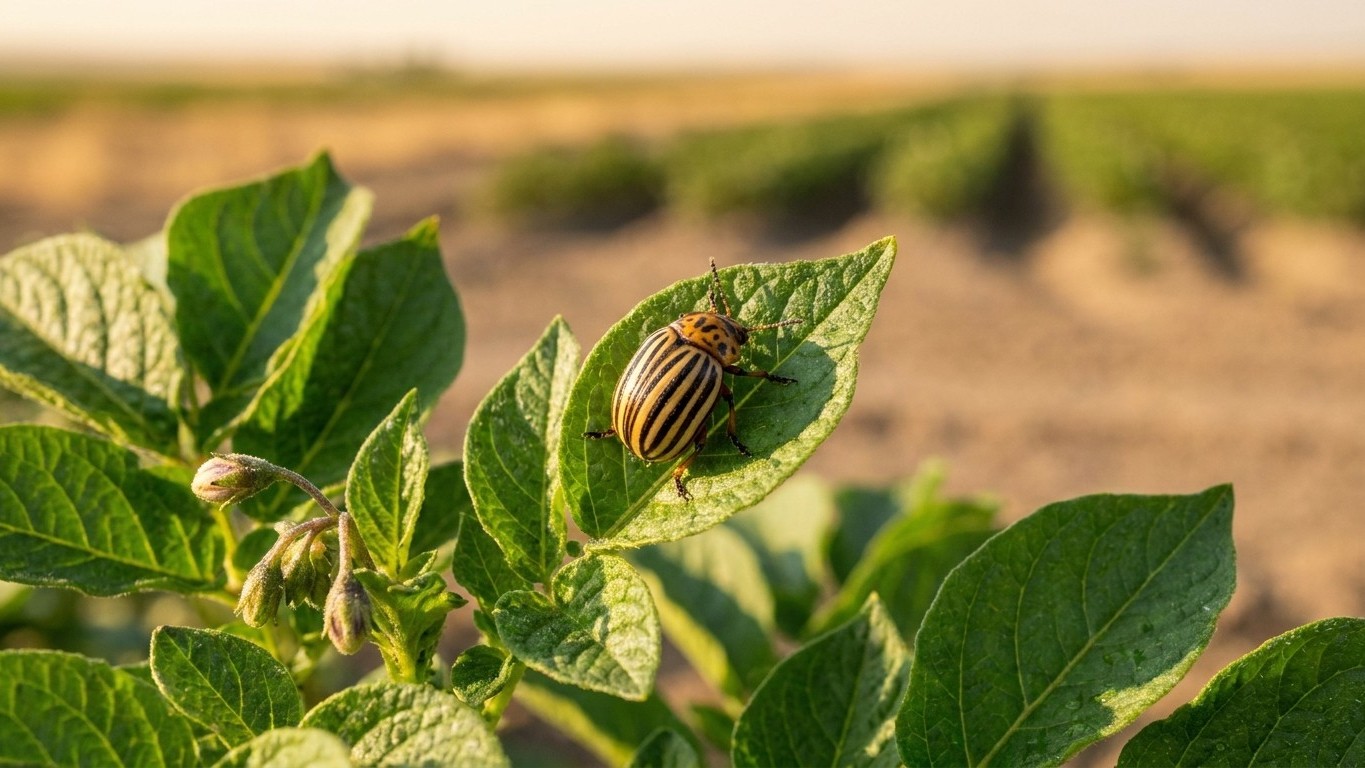

The short list that actually feeds on potato in Ontario gardens runs to about a dozen species, not the two dozen a broader vegetable-pest sheet might suggest. Colorado potato beetle tops it, but timing matters as much as identity: most of these insects move on a clock set by the region’s mean last-frost date, not the calendar month you remember from last year.
Which pests attack potato in Ontario

The documentation behind this page comes from three cooperative extension sources covering the states bordering Ontario: the Cornell University CALS Insect Diagnostic Laboratory in New York, the Michigan State University Extension bulletin (E3276, Diseases and insects in Michigan cucurbits), and Ohio State University Extension (Ohioline). Together they list, across garden crops generally, Aphids, Apple maggot (Rhagoletis pomonella), Asiatic garden beetle, Asparagus beetles, Cabbage maggot, Colorado potato beetle, Cutworms, Emerald ash borer (Agrilus planipennis), European earwig, Flea beetles, Fourlined plant bug, Imported cabbageworm, Japanese beetle, Onion maggot, Seedcorn maggot (Delia platura), Slugs, Spotted cucumber beetle, Spotted wing drosophila (Drosophila suzukii), Squash bug, Squash vine borer, Striped cucumber beetle, Swede midge, Three-lined potato beetle, Twospotted spider mite, and Viburnum leaf beetle.
Most of that list has no business near a potato row. Apple maggot, Emerald ash borer, and Viburnum leaf beetle are tree and shrub feeders, not row-crop pests. Asparagus beetles, Cabbage maggot, Imported cabbageworm, Onion maggot, and Swede midge are locked onto their own plant families (asparagus, brassicas, onions) and don’t cross over to a nightshade. Squash bug, Squash vine borer, Striped cucumber beetle, and Spotted cucumber beetle belong to cucurbit vines, and the MSU bulletin this list draws from is itself cucurbit-focused, which is why those names show up at all. Fourlined plant bug works mint-family and ornamental hosts, and Spotted wing drosophila targets soft fruit, not tubers.
What actually bites into potato
Strip the list down and what remains reads: Colorado potato beetle, Flea beetles, Aphids, Cutworms, Three-lined potato beetle, European earwig, Seedcorn maggot, Twospotted spider mite, and Slugs. That’s the working list for the rest of this page, and it’s shorter than most garden-pest charts imply, which is itself useful: a lot of leaf damage blamed on “bugs” in an Ontario potato patch turns out to be one of a handful of repeat offenders, not a mystery insect.
When each one shows up, and what it does first
Ontario’s growing season anchors to a mean last-spring-frost date of April 30, drawn from Environment and Climate Change Canada’s 1981-2010 Climate Normals for the Toronto Lester B. Pearson station. That figure is a midpoint, not a safe date: in one year out of two, frost lands after it, and gardens north or east of the Pearson station often trail it by more.
Cutworms and Seedcorn maggot arrive earliest, working underground before a shoot even breaks the surface. Cutworms sever young stems at soil level, so the first sign is a seedling that’s simply gone or toppled with a clean-cut base. Seedcorn maggot larvae tunnel into planted seed pieces in cool, wet soil, and the first sign there is a row with gaps where nothing came up at all, not damage on a growing plant.
Once shoots are up, Colorado potato beetle and Flea beetles move in fast. Adult Colorado potato beetles appear on the earliest foliage and their orange egg clusters show up on leaf undersides within days; flea beetles leave a scatter of small round shot-holes across the same young leaves, often before the beetles themselves are easy to spot.
Aphids build more slowly, colonizing the undersides of leaves through the middle of the season and curling growth as their numbers climb. Three-lined potato beetle larvae, recognizable by the dark fecal shield they carry on their backs, show up on foliage a bit later than the Colorado potato beetle’s first wave. Twospotted spider mite tends to flare during the hottest, driest stretch of summer, stippling leaves pale before webbing appears. European earwig and Slugs are opportunists tied to moisture rather than a fixed date, chewing irregular holes in foliage and, with slugs, sometimes into tubers themselves, whenever a wet week gives them cover.
Telling the damage apart from everything else
Not every ragged leaf or stunted plant in a potato bed is an insect’s work. Nutrient shortages, drought stress, mechanical injury from a hoe or cultivator, and fungal or bacterial disease all mimic pest damage closely enough to fool a quick glance. The one habit that prevents most misdiagnosis is checking leaf undersides and the base of the stem before assuming an insect, since that’s where eggs, larvae, or feeding scars actually sit.
| Symptom | Looks like | What it can actually be | What tells them apart |
|---|---|---|---|
| Yellowing between leaf veins | Aphid or mite feeding | Nutrient deficiency or waterlogged soil | No insects or webbing present on close inspection of undersides |
| Wilting despite moist soil | Cutworm or maggot root damage | Bacterial or fungal disease affecting the stem | Cutworm damage shows a clean severed stem; disease shows discoloration inside the stem |
| Small round holes in leaves | Flea beetle feeding | Hail bruising or mechanical tool damage | Flea beetle holes cluster on new growth and appear with tiny black beetles nearby |
| Pale, stippled leaves | Twospotted spider mite | Drought stress or heat scorch | Fine webbing on leaf undersides confirms mites; scorch is uniform, not speckled |
| Gaps where seedlings should be | Seedcorn maggot in seed piece | Seed piece rot from planting into cold, wet soil | Digging up the seed piece shows larval tunnels versus soft, decayed tissue with no insects |
None of that replaces a direct look. If the cause still isn’t obvious after checking undersides and digging up one affected plant, that’s exactly the case for sending a sample or a clear photo to a local extension office rather than guessing from a symptom list.
What actually works here, and what is a waste of time
On a season this short, timing beats product every time. Row covers set over the bed before shoots emerge, and pulled the moment flowering begins so pollinators can reach the plant, block the earliest wave of Colorado potato beetle and flea beetles without any spray at all. Hand-picking adult beetles and crushing the orange egg clusters on leaf undersides works well too, precisely because the insect is large, slow, and visible.
Planting only certified seed potatoes matters more than any pest control step on this list. Uncertified seed can carry viruses that no amount of insect management fixes afterward, and the plant carries that weakness all season regardless of what’s chewing on it.
Crop rotation away from last year’s potato ground, and away from any bed that held tomatoes or peppers, cuts down on overwintering Colorado potato beetle populations, since adults emerge from soil near where they fed the previous year. Hilling soil up around the base of the stems also blocks some early-season access and helps bury pupating insects.
What tends not to work: planting into cold, wet soil to “get ahead” of the season, which invites Seedcorn maggot and seed rot rather than beating either one. Broad, unfocused spraying without confirming which insect is actually present wastes a treatment window and can knock back the same insects that eat aphids and mites. Any specific product, timing, and rate should come from a local extension office, since registered options differ by product and by the exact pest confirmed.
Where to check this for your own county
The pest list on this page comes from cooperative extension programs across the border, in New York, Michigan, and Ohio, because those are the sources documenting these species in detail. None of them survey Ontario soil directly, and a province-wide list never describes what’s actually present in one county’s gardens in a given year.
Pest pressure inside Ontario itself varies by county and even by township. A garden near Lake Erie warms and thaws well ahead of one further north or at higher elevation, and that gap shifts every date in this article, including the frost mean itself, which is drawn from a single station at Toronto Pearson.
The next useful step isn’t reading another list. It’s taking a clear photo of the actual damage, the insect if visible, and the leaf undersides, and bringing that to the nearest county agricultural office or extension contact. They can confirm the species against current local activity, something no province-wide page, this one included, can do from a distance.
Common questions
Does Colorado potato beetle overwinter in Ontario gardens?
Adults overwinter in soil, often near where they fed the previous season, which is why rotating potato ground away from last year’s bed reduces the first wave the following spring.
Can flea beetle damage on potato be prevented without spraying?
Row covers set before shoots emerge and removed at flowering block flea beetles from reaching young foliage during the window when damage does the most harm to a small plant.
Is Ontario’s last-frost date the same across the whole province?
No. The April 30 figure comes from the Toronto Pearson station specifically, and it’s a mean, not a guarantee; northern and upland districts run behind it, sometimes by weeks.
Should uncertified seed potatoes be planted if they look healthy?
No. Uncertified seed can carry viruses invisible at planting time, and that weakness carries through the whole season regardless of how well insects are managed afterward.