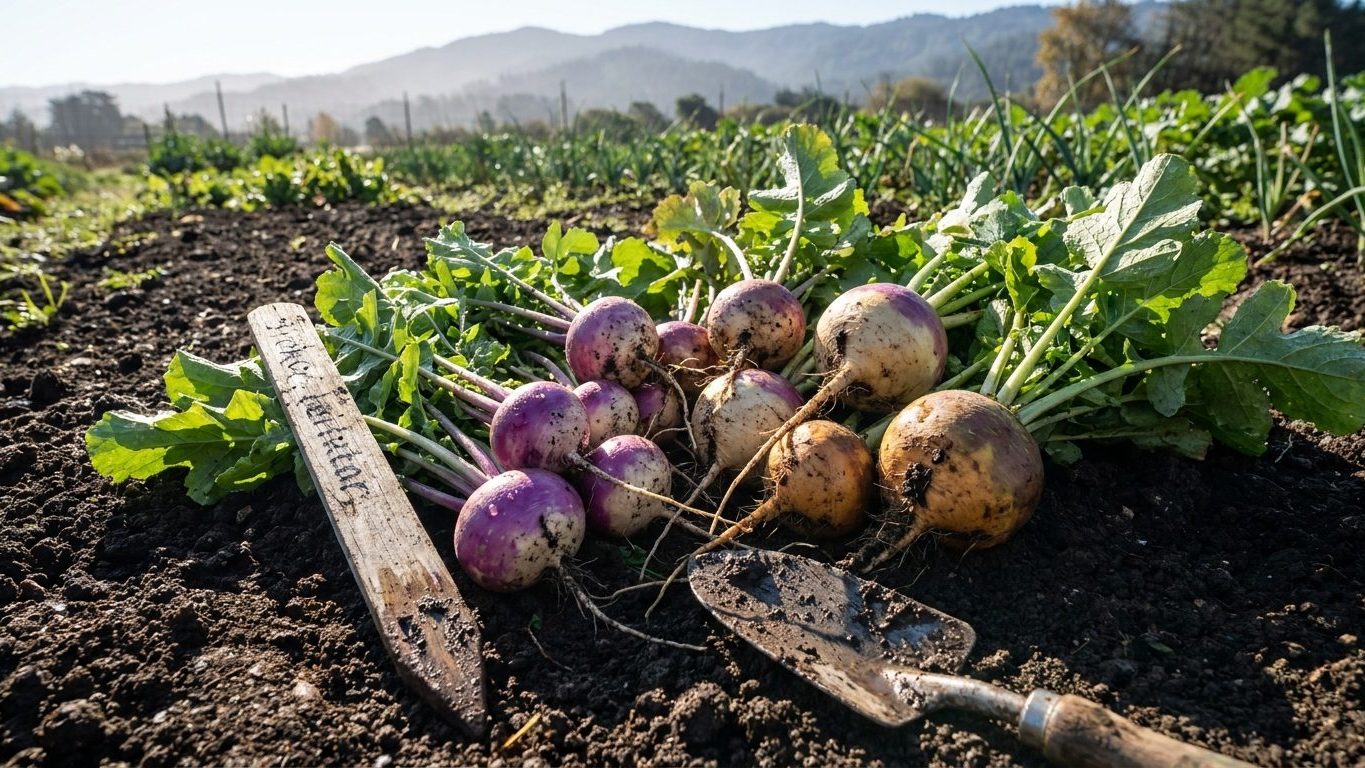

Turnips built for speed beat turnips built for size almost everywhere in Maine, and rutabaga only earns its space in a garden that starts it early enough to finish before the ground goes cold. That single distinction, fast root versus long-season root, is the real decision behind “best variety” here, more than any specific name on a seed packet.
The short answer for Maine
Split the decision by type before you split it by variety. Turnips fall into two working categories: quick salad types that size up in five to six weeks, and slower all-purpose types that take closer to two months but store better. Rutabaga is its own animal entirely, needing something closer to three months from seed to a storable root. In a state where the growing season is squeezed from both ends, that gap matters more than it would in Georgia or Virginia.
At the reference station in Portland, the last spring frost falls somewhere between April 22 and May 1, and the first fall frost arrives between October 9 and October 21. That gives the mildest part of the state a frost-free window of roughly five months. Interior and northern Maine run substantially later in spring and earlier in fall than that Portland window, which means the same varieties have noticeably less time to work with once you leave the coast.
For turnips, that argues for leaning on the fast types for a spring crop, then repeating with a fast type again in mid to late summer for a fall harvest, rather than betting the season on one slow-growing planting. For rutabaga, it argues for treating the whole plant as a single fall crop: sow it in early summer so the root has its full ninety-plus days before the ground freezes, and let the cool fall weather sweeten it rather than trying to rush a spring rutabaga to harvest before summer heat toughens it. Aim to have rutabaga in the ground by early July if you want a root worth storing before the first hard freeze.
Storage turnip types can go in on the same rough schedule as rutabaga, planted in mid to late summer for a fall pull, while the fastest salad turnips are flexible enough to slot into whatever six-week gap you have between other crops, spring or fall.
What will not work here

The clearest failure mode in Maine is sowing a long-season rutabaga type too late and expecting the fall frost date to wait for it. A root that needs close to a hundred days, started in mid-August, simply runs out of daylight and warmth before the first fall frost shows up in early October in the cooler parts of the state. The root that results is undersized, and there is no fixing that after the fact. This is a scheduling failure, not a variety failure, but it looks identical from the garden bed.
The second failure runs the opposite direction: sowing too early in spring and trusting a warm week that isn’t backed by the calendar. Maine’s last frost date is a probability, not a guarantee, and it stretches as late as May 1 in the reference window. A turnip seedling that germinates during a warm stretch in early April, then sits through a hard cold snap before that window closes, is a strong candidate to bolt, sending up a flower stalk instead of bulking a root. Treat April 22 to May 1 as the earliest safe outdoor sowing stretch for direct-seeded turnips in an average Maine garden, and expect the interior and north to need more patience than that.
Winter storage in the ground is a third trap. Some gardeners leave rutabaga or storage turnips under mulch through early winter, which works in milder regions but is riskier in Maine, where the coldest month averages a daily minimum of 15.6°F. That’s not a record cold snap, it’s the typical low for the season, and it’s cold enough to threaten roots that aren’t deeply mulched or that sit in poorly drained soil where ice can form around the crown. Roots left unprotected past the first hard freezes of November are gambling against a climate that runs consistently cold, not occasionally cold.
Finally, close spacing meant for a longer, gentler season tends to backfire here. Crowded turnip rows slow down air movement around the leaves right when the plant needs every available week of sun to bulk a root before frost, and thinning late instead of early just wastes growing time the state doesn’t have to spare.
What changes across Maine
Maine spans USDA hardiness zones 3b to 6a, which is a wide enough range that there is no single answer to “when do I plant” for the whole state. Zone 3b sits at the cold, short-season end, typically found in the far north and at higher inland elevations. Zone 6a, closer to the Portland reference station used for the frost dates above, sits at the mild end near the coast. That’s a spread of three full USDA zones inside one state, which is unusual and worth taking seriously rather than averaging away.
A gardener working in the milder coastal zones can generally follow the Portland frost window fairly closely and has enough season length to grow either fast turnips or a full rutabaga crop without much risk. A gardener farther north or at altitude, closer to zone 3b, should assume both a later last spring frost and an earlier first fall frost than the Portland dates given here, which compresses the usable season from both directions at once.
The practical shift for colder zones is to lean harder into the fastest turnip types for both spring and fall crops, and to treat rutabaga as an optional crop rather than a default one unless the plan includes starting it under cover a few weeks before it would normally go in the ground outdoors. Anyone gardening away from the coast, especially inland or upland, should shift their whole calendar later in spring and earlier in fall relative to what’s written here, since this page is built from a single coastal reference point, not a statewide average.
Rather than guess which end of that 3b to 6a range applies to a particular yard, check the current USDA Plant Hardiness Zone Map directly for the address in question. Elevation and distance from the coast both shift the zone more than people expect within Maine’s borders.
Where to check this for your own county
This page describes Maine as a whole, anchored to a single coastal weather station, and a state-level page is never as accurate as a county-level one. The University of Maine Cooperative Extension is the authority to check next, at extension.umaine.edu.
Once there, look specifically for two things. First, a county-level planting calendar, which will adjust the frost-date ranges used in this article for the actual distance from the coast and elevation of a specific garden, rather than the Portland reference used here. Second, look for any variety trial results published for turnip and rutabaga performance in Maine conditions specifically, since local trials account for the state’s short, cool summers in a way that generic national variety descriptions cannot. Search the extension site for the local planting calendar for your county before locking in a sowing date based on the statewide ranges above.
A county office typically has direct experience with which fast turnip types and which rutabaga varieties have actually performed well in that specific microclimate, including how they’ve handled Maine’s variable spring cold snaps and its early fall frosts. That kind of season-specific feedback, built from actual local growing seasons, will always outrank a state-level estimate built from one weather station’s thirty-year average, however carefully that average is calculated.
This is also the place to ask about soil test results specific to a county, since Maine’s soils vary considerably from the rocky, thinner soils common inland to the richer alluvial soils near some river valleys, and turnip family crops respond noticeably to both pH and boron availability in ways a state page can’t address for a specific plot.
Checking this against your own garden
Every date in this article is a probability built from thirty years of weather averages at one station, and a reader’s own garden will always know more than that average does. Three direct observations outrank the calendar.
Soil feel comes first. Cold, wet, dense soil that clumps when squeezed is not ready for turnip seed regardless of what the calendar says, while soil that crumbles easily and feels merely cool rather than cold is workable even a few days ahead of the average date. This single check catches both the years running early and the years running late better than any fixed date can.
Germination speed is the second signal, acting as a soil thermometer without needing one. Turnip seed sown into warm soil breaks the surface in a matter of days, while seed sown into soil that’s still too cold can sit for a week or more before showing anything, or fail to come up evenly at all. Watch for even germination within about a week as a sign the soil has actually warmed enough for the crop, whatever the date on the calendar says.
The third signal is a warning sign rather than a green light: an unusually early flower stalk rising from the center of a young turnip before the root has sized up. That’s bolting, almost always triggered by a cold stretch hitting the seedlings after germination, and it’s the clearest on-the-ground evidence that a particular spring ran colder, later, or more erratic than the statewide averages suggested for that yard.