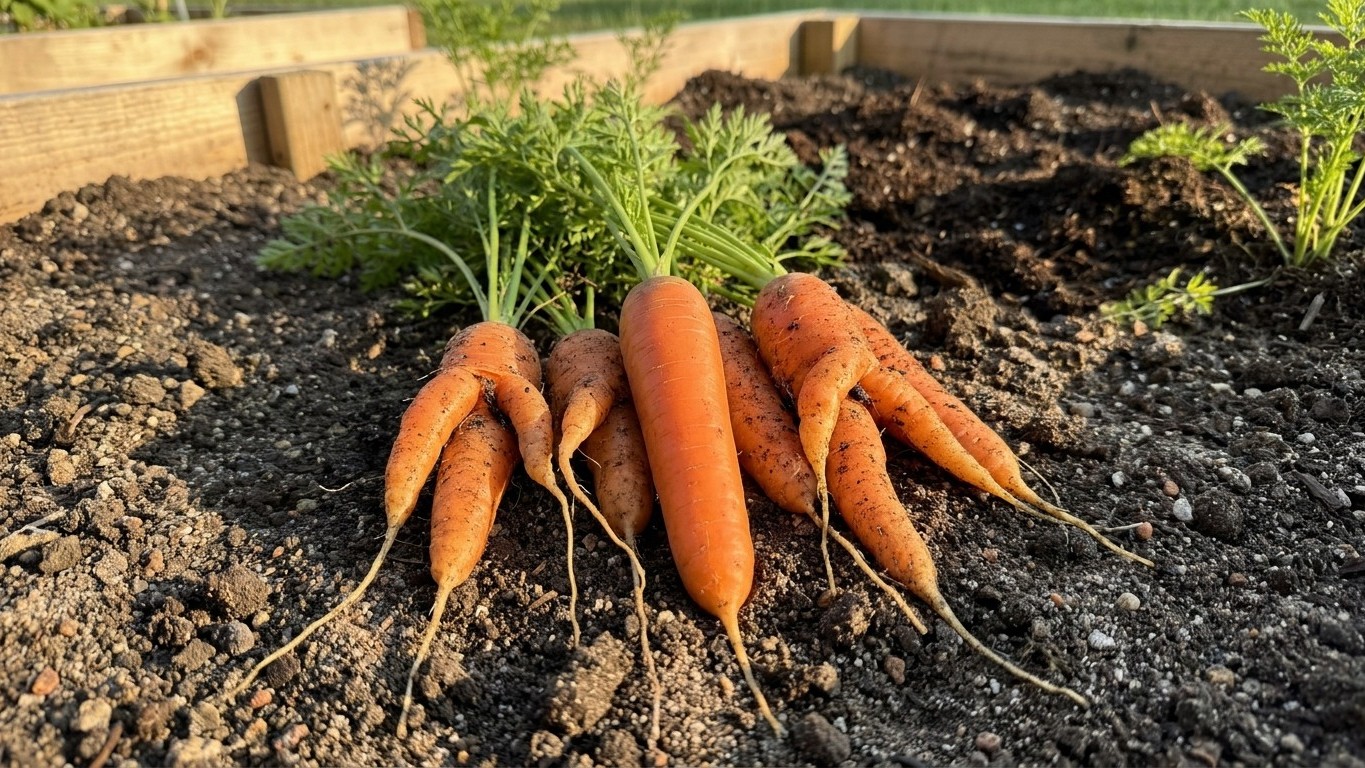

Count 70 to 100 days from the day the seed went into the ground. Carrots are sown in place and never transplanted, so seeding is the only starting date that matters. Clemson Cooperative Extension puts harvest at about 65 to 75 days after planting, so pull one early to check. After that, cut the tops off right away and hold the roots at 33 °F with high humidity. Connecticut’s state soil makes forking unlikely, but your own bed may differ.
The short answer
What Windsor ground is made of
USDA lists the Windsor series as the soil that represents Connecticut. The representative surface values come from USDA NRCS Soil Data Access (the Soil Survey Geographic Database), averaged across 188 mapped components. They read 82 percent sand, 2 percent clay and 16 percent silt. That is close to a pure sand, and the drainage class is excessively drained, the label for ground that sheds water faster than any other category.
Windsor is also an Entisol, a very young soil with almost no profile development. There is no tight clay layer and no hardpan-style subsoil built up over centuries. The surface pH is about 5.1, which is strongly acid. The organic matter figure is about 95.0 percent, and that number looks like peat for a reason. The mapped surface of this series includes a natural organic layer, forest litter and the like, which a cultivated vegetable bed will not have. Treat it as a feature of the map, not a promise about your garden.
Will a carrot fork in it?
Not because of the texture. Utah State University Extension says carrots want deep, sandy, well-drained soil rich in organic matter, and that heavy or rocky soil makes the root fork. Windsor ground is sandy and well drained, with only 2 percent clay to grab a growing taproot and split it. If your ground resembles it, the weak points are the reverse of forking: water running through too fast and not enough organic matter to hold any. Compost worked into the bed addresses both.
Where the ground is heavy, the same Extension guidance calls for plenty of compost and double digging, which means loosening the subsoil under the bed and not just the top few inches. If water pools and drains slowly, build a raised bed. A different variety will not fix a drainage problem (and the source behind this page names no variety anyway).
One caution before you rely on any of this. Connecticut spans hundreds of soil series, and Windsor is a starting point, not a diagnosis. River bottoms, hill country, and any lot a builder has scraped or filled can behave nothing like it. The pH of 5.1 belongs to the mapped soil, not to your yard, and the source here gives no pH target for carrots, so a lab soil test is the way to get your number. For the longer treatment of this question, see Will Carrots Fork in Connecticut Soil?, and for the whole season, Growing Carrots in Connecticut.
The test that settles it in your own garden
An afternoon and a spade will tell you more than any state map. None of these steps needs a gadget, and none depends on a number I can’t source. Do them where the carrots will actually grow, not at the edge of the lawn where the ground looks easy.
- Dig a hole a full spade deep. Carrots send a taproot straight down, so you want to know what that root will meet. Set the soil on a tarp in the order it came out.
- Read the walls of the hole. Look for a change in color or a hard layer where the spade slowed down. Note how many stones turn up and how big they are. Heavy or rocky ground is exactly what makes a carrot fork, so a layer that stops the spade will likely stop a root.
- Feel the texture. Take a handful from root depth, moisten it, and rub it between your fingers. Gritty and falling apart means sand. Slick and sticky that holds a shape means clay. A smooth, flour-like feel points toward silt. Squeeze it, then poke it. A clay-heavy clump keeps its form, while a sandy one crumbles.
- Fill the hole with water and watch. Let it drain, fill it again, and see how the second filling behaves. Water that vanishes quickly matches Windsor-type sand. Water still standing after a long wait means poor drainage and a case for a raised bed.
- Send a sample to a lab. Your hands tell you texture and drainage. They do not tell you pH or nutrients. Collect soil from several spots in the bed, mix it, and test that mix.
Compare what you found with the state profile. If your bed is sandy and fast-draining, plan on compost and regular watering. If it is heavy or stony, plan on compost and double digging, or build up instead of digging down. The first two steps may take twenty minutes of effort, but they can save you from pulling a crop of tangled, split roots months later.
What goes wrong here
Connecticut’s soil and its summers produce a handful of predictable carrot failures. Each one has a fix that costs little.
- Forked or stubby roots in heavy or stony ground. This is the classic result of ground that stops the taproot. Remedy: add plenty of compost and double dig, or sow into a raised bed filled with loose, sandy, compost-rich mix. Spot-check the ground first with the digging test above.
- Thin or patchy germination in a hot spell. Seed sown in place cannot be moved, and a seedbed that dries out in summer heat leaves gaps in the row. Remedy: keep the surface evenly moist until sprouts show, and lay a board or burlap over the row (checking daily and removing it as soon as seedlings appear) so the top layer stays damp. Re-sow gaps early, because late fillers will be small when the rest are ready.
- Splitting from uneven water. A dry stretch followed by a soaking rain makes the root swell faster than the skin can stretch. Sandy, excessively drained ground makes the swings worse because it dries so fast. Remedy: water on a steady schedule, add compost to hold moisture, and mulch the bed.
- Roots that are scarred, tunneled or chewed. That is a pest problem and not a soil problem, and the fix depends on what is feeding. Timing matters too, which is why What Eats Carrot in Connecticut, and When is worth reading before midsummer.
- Carrots that go limp or sprout in storage. Leaves keep drawing moisture out of the root, so cut the tops off before storing. Bunched carrots, with the tops on, keep only about 10 to 14 days, according to Clemson Extension. Trimmed roots last much longer. Then store them at 33 °F with high humidity to prevent wilting. That is barely above freezing and well below a typical cellar. At 50 °F, carrots sprout and soften in a fraction of the time.
Common questions
How do I know when carrots are ready to pull?
Start counting from seeding, since there is no transplant date on this crop. Carrots generally take 70 to 100 days from seed, and Clemson Extension says to harvest about 65 to 75 days after planting. Pull one at the early end of that window and check it. No Connecticut frost date is published here, so use your own sowing date as the clock.
How long will carrots keep after I pull them?
With the tops on, bunched carrots keep about 10 to 14 days. Trimmed carrots kept at 33 °F and high humidity can last for months. A home refrigerator is the closest match, ideally in a sealed bag or the crisper drawer, to hold humidity.
Why cut the tops off first?
The leaves keep pulling moisture out of the root after harvest. The root then wilts and softens while the greens stay green. Cutting the tops stops that drain. It is the single biggest reason trimmed carrots outlast bunched ones.
Is the Windsor soil in my yard?
Maybe, but do not assume it. Windsor is the series USDA lists as Connecticut’s representative soil, and the state has hundreds of others. Filled ground, river bottoms and hill country can differ completely. The digging and drainage test takes an afternoon, and a lab soil test gives your actual pH, which the Windsor figure of about 5.1 cannot do.