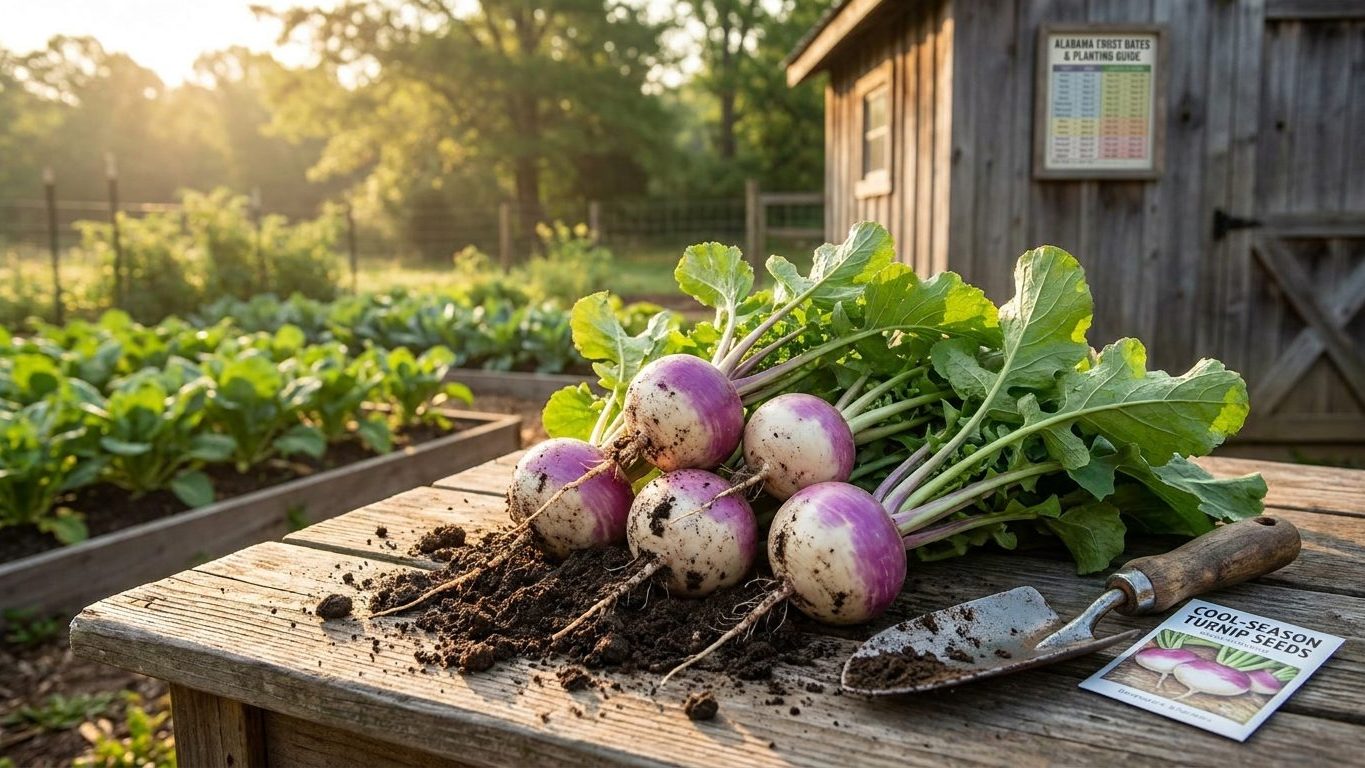

Mississippi gardeners get two turnip windows a year, and the fall one is the reliable one: sow roots from mid-August into mid-September, sow greens-only crops into early October, and treat the narrow spring slot, roughly February through early March, as a bonus round before summer heat shuts it down. The rest of this page explains why those dates hold and where they shift.
The short answer for Mississippi
Turnips are a cool-season crop that tolerates a light frost without complaint, which is exactly why fall carries the real season in Mississippi. Jackson’s climate normals put the first fall frost between November 7 and November 22, a 30 to 70 percent probability band from NOAA’s 1991-2020 data. Working backward from that window, and given that turnip roots typically need six to eight weeks to bulk up, the safest fall sowing stretch runs from mid-August through mid-September. Greens-only sowings can go later, since leaves are ready in a month, stretching the practical window into the first week of October in most years.
Spring is the trickier of the two seasons here, and shorter. The same NOAA data puts Jackson’s last spring frost between March 6 and March 22, also a 30 to 70 percent band. Turnip seedlings shrug off a light freeze, so sowing doesn’t have to wait for that date to pass entirely, but the real constraint is what comes after: Mississippi’s spring heat builds fast, and turnips left in warming soil past their maturity window turn woody, bitter, and prone to bolting. That leaves a spring sowing target of mid-February through the first week of March for anyone wanting roots before the heat arrives, with greens-only crops buying a couple extra weeks.
Neither of these dates comes from a state-wide guarantee. They’re built off a single reference station, and every county-level garden will shift them somewhat, a point the next two sections unpack.
What will not work here

Rutabaga is the crop most likely to disappoint a Mississippi gardener who plants it on a turnip schedule. Rutabaga needs closer to 90 days of steady, cool growth to size up properly, and neither of Mississippi’s two windows offers that comfortably. Sown in spring after the last frost risk clears in early-to-mid March, a rutabaga crop is racing against a summer that typically turns hostile to root crops by mid-May, a gap of roughly nine weeks against a 90-day requirement. Sown in fall, it faces the opposite problem: soil and air are often still too warm through late August for rutabaga’s slower germination and steady cool-season growth, and by the time real cool weather sets in, there isn’t enough runway left before the November frost window closes the season.
Late spring sowings of ordinary turnips fail for a related reason. Anyone who sows in April, reasoning that the frost date has long passed and there’s no rush, is sowing into soil that’s already warming past what turnip roots tolerate well. The plant reads that heat as a signal to reproduce, not to bulk up, and bolts, sending up a flower stalk instead of a root. A watering schedule built for once a week, common for gardeners treating turnips like a set-and-forget crop, compounds the problem in a Mississippi summer, since shallow, infrequent watering in high heat stresses the root and accelerates the same bolting response.
Tight spacing is the third failure point, and it’s specific to Mississippi’s humidity rather than its heat. Turnip roots crowded closer than a few inches apart in a humid Gulf South summer are more exposed to fungal leaf disease, since damp air lingers longer between plants that don’t have room to dry out after a rain. The fix isn’t a different variety, it’s simply more room between rows in a state where humidity, not just heat, is doing part of the damage.
What changes across Mississippi
Mississippi sits across the 7b to 9a hardiness zone range, a spread built by USDA on one variable, average annual extreme minimum temperature. That’s nearly two full zones inside one state’s borders, and it means the fall and spring windows described above are a Jackson-area estimate, not a statewide rule. A garden in the northern hill country, closer to zone 7b, should expect its first fall frost earlier than Jackson’s November 7-22 band and its last spring frost later than the March 6-22 band, both compressing the growing season from both ends.
A garden along the Gulf Coast, sitting closer to zone 9a, runs the opposite way. Winters there rarely dip as cold, and the mean daily minimum of the coldest month statewide sits at a mild 36.6°F, well above freezing on average even in the coldest stretch. That gives coastal gardeners room to push fall sowings later into November and sometimes restart a second small round in January, something a north Mississippi garden usually can’t manage.
There’s no single sowing date that covers a state with that much internal range, and this page won’t pretend otherwise. The right move is to check the USDA Plant Hardiness Zone Map for the specific zone at your address, then treat the Jackson-based dates above as a starting estimate to adjust earlier or later depending on which end of the 7b-9a spread you land on.
Where to check this for your own county
A state-level page like this one is built for a statewide audience, which means it’s built to be adjusted. The Mississippi State University Extension Service, at extension.msstate.edu, publishes county-level guidance that goes further than any hardiness zone map can, because it’s built from local trial data rather than a single airport weather station.
Two things are worth searching for once there. First, a local planting calendar for vegetables, which will translate the fall and spring windows described here into dates specific to your county rather than to Jackson’s airport station. Second, a list of turnip and rutabaga varieties trialled by extension agents in your part of the state, since heat tolerance and disease resistance vary enough between varieties that a county-tested list beats a generic seed rack recommendation.
A county recommendation will always beat a state one, for the simple reason that it’s measured closer to your own soil and microclimate. This page draws its dates from a single reference station’s climate normals, useful as a starting point but not a substitute for local data. Anyone gardening near an elevation change, a large body of water, or an urban heat pocket should weight the county-level source more heavily than the numbers above, since those local features can shift frost timing by one to two weeks in either direction from what a regional average predicts.
The Moon calendar is a separate, older custom: see when to plant turnips by the moon, written as tradition rather than fact.
Checking this against your own garden
Calendar dates are an average of past years, not a promise about this one, and three things in the garden itself will tell a gardener more than any chart. The first is soil warmth, checked by hand at planting depth. Soil that crumbles loosely and feels cool but not cold to the touch is ready for turnip seed; soil that’s still damp and clumping in a cold ball usually isn’t, regardless of what the calendar says.
The second is how fast true leaves appear after germination. Turnip seedlings that push their first true leaves within about a week of sprouting are growing in soil warm enough to support steady development. A slow, uneven emergence, stretching past ten days, is often a sign the soil was sown a little too early for that particular spot, even if the calendar date looked right.
The third is the appearance of a flower stalk earlier than expected. A turnip crop that starts bolting well before its roots have sized up is responding to heat or day length stress that arrived faster than the season’s average, and it’s the clearest signal a gardener will get that next year’s sowing needs to move a week or two earlier in that particular plot. None of these three checks require a tool beyond a hand and a bit of attention, and together they tell a gardener more about their own patch of ground than any regional frost date ever will.