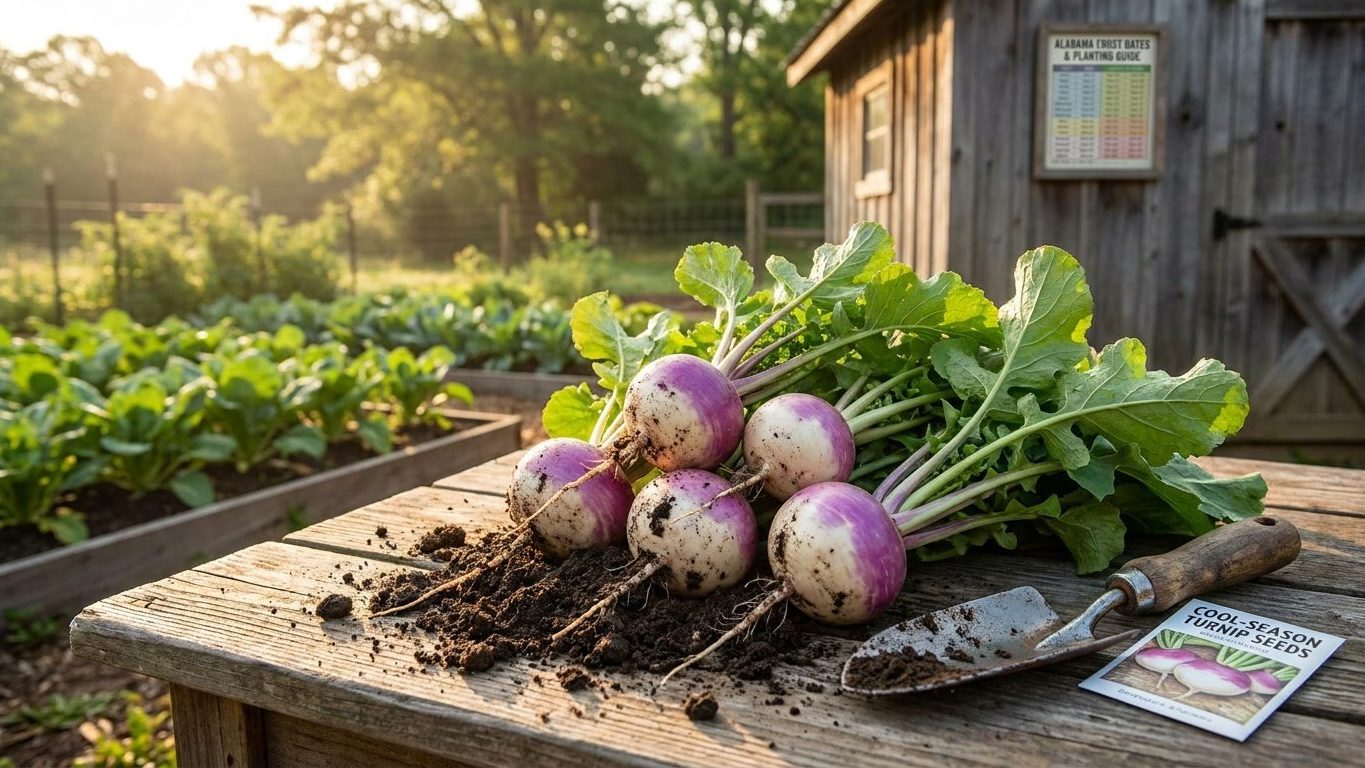

Montana’s answer depends on which frost you’re planting around. For a spring crop, get seed in the ground from mid-April through the first week of May, timed to the region’s last-frost window. For a fall crop, the safer bet is a mid-summer sowing that finishes before the first hard freeze in October.
The short answer for Montana
Turnips are a cool-season root that shrugs off light frost but still needs a runway to bulk up, usually 30 to 60 days depending on variety. Billings-area records put the last spring freeze between April 29 and May 10, and the first fall freeze between October 1 and October 14 (NOAA NCEI 1991-2020 Climate Normals). Those dates are a 30 to 70 percent probability band, not a guarantee, which is why gardeners work a couple of weeks on either side rather than one fixed calendar day.
For the spring planting, that means sowing turnip seed roughly two to three weeks before the last frost date, since the seed germinates in soil as cool as the low 40s and the seedlings tolerate a light freeze once up. Working backward from the April 29 to May 10 window, sow between April 15 and May 1 for a spring harvest, and expect roots ready in late May through June depending on the variety’s days-to-maturity.
The fall crop is the one Montana gardeners tend to get wrong by sowing too late. Count backward from the earliest fall frost date, October 1, and subtract the days-to-maturity plus a short buffer for slowing fall growth. A 45-day turnip needs to go in the ground by mid-August at the latest to size up before that first freeze risk arrives; a slower 60-day type needs to be sown by the start of August. Rutabaga, which typically runs 90 to 100 days, does not fit inside this fall window at all here, and belongs to the spring sowing instead if it’s going to mature before autumn cold shuts things down.
Neither of these dates is a hard rule and neither should be treated as one. They mark the middle of a probability range recorded at one reference station, and a garden three miles away in a low frost pocket can differ by a week or more in either direction.
What will not work here

The single most common mistake in Montana is choosing a slow variety for the fall slot. A rutabaga sown after the Fourth of July, expecting the same 45 days a quick turnip needs, will still be a marble-sized root when the first freeze arrives in the October 1 to October 14 window. The math doesn’t work: 100 days from July 4 lands in mid-October, right into or past the frost date, and roots that haven’t sized up don’t catch up once growth slows in the cool, shortening days of September.
Summer sowing for a fall crop also runs into Montana’s dry heat. The Billings area’s growing season includes stretches where soil dries out fast, and turnip seed sown into a hot, cracked seedbed in July either fails to germinate evenly or comes up stressed and bolts early, sending up a flower stalk instead of a root. Watering once a week is not enough during that establishment window; seedbeds need to stay consistently damp, which in practice means checking the soil every day or two until germination, not treating it like an established bed.
Winter survival is the other trap. The coldest month here averages a daily minimum of just 17.9°F, and that’s the mean, not the record low. Overwintering turnips or rutabaga in open ground without heavy mulch or a cold frame simply doesn’t survive that kind of cold snap repeated night after night through the coldest month. Gardeners who’ve had luck overwintering brassica roots in milder states shouldn’t assume the same trick works unprotected here.
Close spacing is less of a problem in Montana’s dry air than it would be in a humid climate; there’s less disease pressure from crowding. The bigger spacing issue is competition for scarce soil moisture, so crowded rows in a dry summer still stunt roots even without the fungal problems a humid state would see.
What changes across Montana
Montana is not one climate, and the state’s USDA Plant Hardiness range makes that plain: it spans zone 3a to zone 6a, a spread of roughly three full zones inside one state’s borders (USDA Plant Hardiness Zone Map, 2023, built on 1991-2020 normals). That range is based on extreme annual minimum temperatures, and it’s wide enough that a single statewide sowing date is close to meaningless without knowing where in that range a given garden sits.
Billings, the reference city behind the frost dates above, sits toward the milder end of that spread, closer to zone 6a river-valley conditions. Higher elevations and the state’s mountain valleys, more typical of zone 3a to 4a, run colder in every season: later last frosts in spring, earlier first frosts in fall, and a shorter overall window to work with. A gardener at higher elevation should expect to push the spring sowing back and pull the fall sowing forward relative to the Billings dates, potentially by several weeks rather than days.
There is no single sowing date that covers a zone 3a mountain valley and a zone 6a river bottom in the same state. The safest approach is to treat the Billings-based dates in this article as a mid-range reference, then shift earlier or later depending on which end of Montana’s zone spread a garden falls into, confirmed against the USDA map rather than guessed from elevation alone.
Where to check this for your own county
This page gives a state-level picture built from one reference station. A county-level recommendation, built from local weather records and local variety trials, will always beat it. Montana State University Extension maintains that county-level information, and it’s the next stop for anyone trying to nail down a sowing date closer to their own soil.
Start at the Montana State University Extension site and look for two things specifically: a local planting calendar for the county office nearest the garden, and any variety trial results for turnips or rutabaga run through that same office. County extension agents often track which varieties actually performed well in local trial plots, information that a statewide climate normal simply can’t capture.
It’s also worth asking the county office directly whether they publish a printed or downloadable garden calendar; many land-grant extension offices do, and it will reflect local frost records rather than the single reference station cited here. Call or visit the county extension office before finalizing a sowing date if the garden sits at meaningfully different elevation or in a known frost pocket relative to the nearest weather station.
Treat this article as the starting estimate, not the final word. State-level climate normals are useful for understanding the general shape of a Montana growing season, but they average over a lot of local variation that a county office is specifically set up to correct for.
Some gardeners also time this by the Moon: when to plant turnips by the moon, as almanac tradition rather than fact.
Checking this against your own garden
Calendar dates are a starting point; the garden itself has the final say. Three signs are worth checking before trusting any date on this page, and none require equipment beyond a hand and a pair of eyes.
First, feel the soil itself. Turnip seed wants soil that’s cool but crumbles easily in the hand rather than clumping wet or resisting like a brick. If it still clumps cold and wet in mid-April, the ground isn’t ready regardless of what the calendar says, and waiting a week costs less than a poor germination rate.
Second, watch how fast the seed comes up. Turnip seed germinates in about 5 to 7 days in properly warmed soil; if it’s taking 10 days or more, the soil is running colder than ideal for that spot, a useful signal for adjusting next season’s date earlier or later.
Third, watch for an early flower stalk. If plants send up a stalk and start to bolt before the roots have sized up, that’s the plant reading heat or stress in the soil that a calendar can’t show. An early flower stalk is the garden’s clearest warning that the sowing date or the summer’s watering needs to shift the following year, and it outranks any date printed on a page like this one.