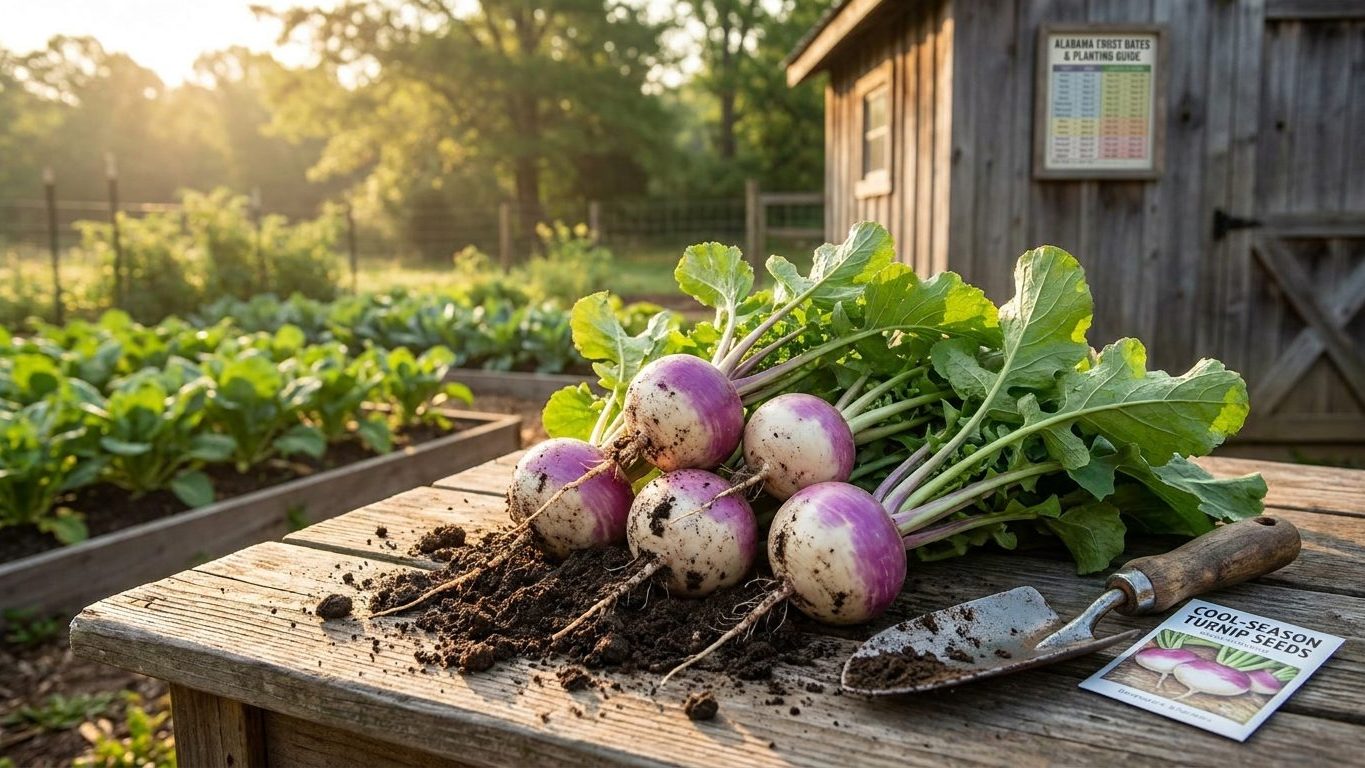

New Brunswick gardeners get two windows for turnips: a spring sowing roughly three weeks before the mean last frost, and a fall sowing timed backward from the mean first frost. Those two dates, May 23 and October 2, come from the Moncton climate station, and neither one is a promise the ground will actually behave that way this particular year.
The short answer for New Brunswick
Sow turnips for a spring crop from late April into mid-May, and sow the fall crop between mid-July and early August. That’s the whole calendar, built directly off two numbers Environment and Climate Change Canada publishes for the Moncton station: a mean last spring frost of May 23 and a mean first fall frost of October 2, both drawn from the 1981-2010 Canadian Climate Normals.
Turnip seedlings shrug off a light frost, which is why spring sowing doesn’t wait for the frost-free date the way a tomato transplant would. Gardeners typically get seed into the ground two to four weeks ahead of that mean last frost, which lands the earliest spring sowing in late April, with a second round through mid-May for a staggered harvest. The fall side works backward: most turnip varieties bulb up in 40 to 60 days, and you want that bulb finished, or close to it, before the mean first frost on October 2. Count back 60 days from October 2 and you land in early August; count back 40 and you’re already in mid-July. Sow the fall crop between mid-July and early August and you’ve bracketed both cases.
The caution that matters here is what these two dates actually are. May 23 and October 2 are means, not safe dates and not a guarantee. A mean frost date is the midpoint of a distribution: in roughly half of all years on record, the last spring frost arrived after May 23, and the first fall frost after October 2. Some years it’s earlier, some years later, and the average just happens to sit in the middle. Treat these dates as the center of a window you should build slack around, not as a line you can sow right up against.
Run the two mean dates together and you get a mean frost-free season of about 132 days, from May 23 to October 2. That’s the number that decides which turnip varieties are even worth planting here, and it’s the subject of the next section, because it rules a few things out entirely.
What will not work here

A 132-day mean frost-free window sounds generous until you put a rutabaga in it. Rutabagas typically need 90 to 120 days to size up properly, and that’s assuming the season runs its full average length. If a gardener sows rutabaga in late June, banking on the full window, they’re gambling that this particular year matches the mean exactly, when in fact half of all years run shorter on one end or the other. A rutabaga sown after early June is racing a clock that has a real chance of running out before the bulb finishes. Sow rutabaga no later than early June here, not later, and treat anything after that as a crop you’re hoping gets lucky rather than one you’re planning around.
Fast turnip varieties don’t have that problem in summer, but they have a different one in winter. The mean daily minimum of the coldest month at the Moncton reference station is -13.9°C. That’s not a record cold snap, it’s the average low night after night through the depth of winter, and it means nothing in the turnip or rutabaga family survives in the ground here once the season turns. Any plan to leave roots in situ for a Southern-style extended harvest simply doesn’t apply in this climate; everything has to come out of the ground and into storage before that cold sets in, and that storage window closes fast once October’s mean frost date passes.
Spacing is the third thing that fails here specifically, though for a different reason than the season length. New Brunswick’s Maritime climate runs humid through the growing months, and turnip foliage packed in tight rows holds moisture against the leaves longer than it would in a drier inland climate. Gardeners who use spacing guidelines written for arid Western states, with rows crowded close to save space, tend to see more foliar disease pressure here than the same spacing would cause somewhere drier. Wider row spacing than the tightest recommendations on a seed packet is the safer call in a climate this damp, particularly for the fall sowing, when cooler, wetter weather is already moving in as the crop matures.
What changes across New Brunswick
The zone figure attached to this page, Canadian hardiness zone 5a, belongs to Moncton, the reference station these frost dates come from. It is not New Brunswick’s zone, because New Brunswick doesn’t have one zone. The Canadian system builds its rating from seven separate climate variables, not just a winter minimum, and a province this size runs through more than one of those ratings between its milder river valleys and its colder northern uplands. There is no single hardiness number for New Brunswick, and any page that hands you one without naming the specific place it applies to is smoothing over real variation.
What that means for the calendar in this article is straightforward: Moncton’s frost dates describe Moncton, and they describe it reasonably well for the southeastern part of the province, but they run early for anywhere colder. Northern districts and higher inland elevations typically hold onto spring cold longer and lose their fall warmth sooner than a station down near the Fundy shore. A gardener working land in one of those colder pockets should expect both ends of the season to arrive later than these dates suggest, and shifting the whole calendar back by one to two weeks in each direction is a reasonable adjustment until they’ve watched a season or two on their own ground.
The honest way to use zone data is to go find your own municipality’s rating rather than borrow Moncton’s. Natural Resources Canada’s Plant Hardiness site maps this down to the municipal level, using the 1991-2020 normals, and it’s a five-minute check that tells you far more than assuming your garden matches a station that might sit an hour or two away by road.
Where to check this for your own county
Everything above describes New Brunswick using one station’s data. A county-level extension recommendation, built from local trial plots and local frost records, will always beat a provincial or national generalization, and this page is the general one, not the local one. The federal agriculture department, at agriculture.canada.ca/en, is the working starting point here; the provincial department’s own site did not return a reliable response when checked, so the federal address is the one worth bookmarking.
Once there, the two things worth hunting down are a local or regional planting calendar, if the department publishes one, and any list of turnip or rutabaga varieties that have actually been trialled in New Brunswick conditions rather than simply sold in a national seed catalog. Varieties that perform well in a longer, drier growing season elsewhere in Canada don’t always carry that performance into a shorter, damper Maritime one, and a trial list, where it exists, tells you which ones have actually been tested against this province’s weather rather than assumed to work here.
Check agriculture.canada.ca for a New Brunswick-specific calendar before locking in the dates from this page, especially if your garden sits well outside the Moncton area. Provincial and county-level agricultural offices, where they publish anything at all, tend to fold in soil type and local rainfall patterns that a national page can’t account for. Absent a county page, though, the frost-date math in this article is the best general framework available, applied with the adjustments the previous section already laid out for colder districts.
Checking this against your own garden
No calendar, provincial or federal, replaces what your own soil is doing this particular spring. Three things are worth paying attention to, and none of them require anything beyond your own hands and eyes.
Soil warmth by feel comes first. Turnip seed germinates poorly in cold, wet soil regardless of what the calendar says, and a handful of soil that feels merely cool rather than genuinely cold, and crumbles instead of clumping into mud, is telling you the ground is ready before any date on paper confirms it. The second sign is how fast the seedlings move once they’re up. First true leaves within about 10 days of sowing suggests soil temperature is running close to or ahead of the Moncton average for that date; a much slower emergence suggests your particular patch of ground is running colder than the station data assumes, which matters most for anyone planning a fall crop against that October frost date.
The third sign is a flower stalk showing up early, before the bulb has sized up. Turnips that bolt prematurely have usually been through a cold snap during germination or early growth, and a bolted spring crop is a fairly reliable sign that the actual last frost, or a hard cold spell after it, ran later than the mean date this page is built around. That’s not a failure of the calendar so much as confirmation of the caution built into it from the start: a mean date describes an average year, and gardens don’t get to choose which year they’re planted in.
The Moon calendar is a separate, older custom: see when to plant turnips by the moon, written as tradition rather than fact.