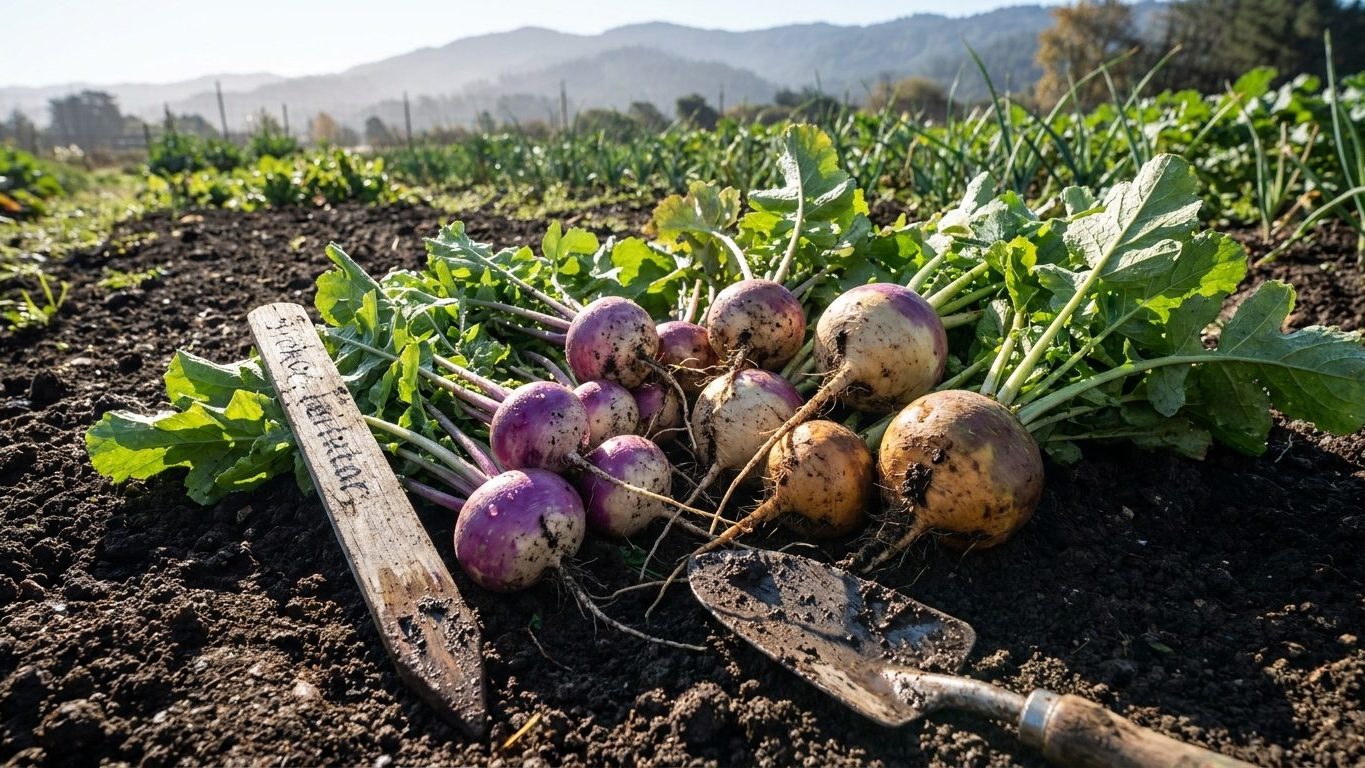

Fast-maturing turnip varieties succeed almost anywhere in North Carolina, from the coastal plain to the mountains, because the state’s frost-free window is generous enough for a 40-day root crop twice a year. Rutabaga is pickier: it needs a long, cool finish, which only the Piedmont and coastal plain reliably deliver before the ground freezes.
The short answer for North Carolina
Turnips and Rutabaga are both brassicas, but they don’t ask the same thing of a season. A turnip grown for salad-size roots or greens is done in 30 to 45 days. A rutabaga needs 90 to 120 days of cool, steady growth to bulk up its root without turning woody. That difference is the whole decision.
Short-season turnip types (the kind bred for quick greens or small, tender globes) work in every corner of North Carolina because even the coldest reference point in this state’s data, the mountain zones, still carries a frost-free stretch long enough to squeeze one crop in before the last spring frost and another after the first fall frost eases off. Plant them in early spring as soon as the soil can be worked, then again in late summer for a fall harvest that actually tastes better, since cool nights sweeten the roots.
Rutabaga is the variety that separates North Carolina’s regions. Because it needs three to four months of mild weather to finish, the safest approach statewide is to work backward from the first fall frost rather than forward from spring, since a fall-finished rutabaga handles a light frost just fine and tastes sweeter for it. Using the Piedmont reference station in Charlotte, where the first fall frost lands between October 30 and November 8, that means sowing rutabaga by August 1 gives it the full 90-to-120-day runway it needs to size up before the ground turns cold. Coastal counties, with a frost date that typically lags a bit behind Charlotte’s, get a little more slack. Mountain counties, where frost often arrives weeks earlier, get a lot less, and that’s where rutabaga becomes the riskier bet.
So the practical split is this: grow fast turnip types everywhere, twice a year, without much worry. Save rutabaga for the Piedmont and coastal plain, timed to finish in the cool of fall, and treat it as a gamble at higher elevations unless the local frost date runs later than the state average.
What will not work here

Spring-sown rutabaga is the classic mistake in North Carolina gardens. Sow it in March alongside your turnips, and its 90-to-120-day clock runs straight into June and July, months where Piedmont and coastal soil temperatures climb well past what a rutabaga root wants. The result isn’t failure exactly, it’s disappointment: pithy, bitter, cracked roots that bolted to seed before they filled out. The fix isn’t a different variety, it’s a different calendar. Rutabaga belongs in the ground in summer, aimed at a fall finish, not in spring aimed at a summer one.
At the other end of the season, leaving rutabaga in the ground too long in the mountain counties is its own failure mode. North Carolina’s coldest-month reference figure, a mean daily minimum of 31.8°F at the Charlotte station, describes a Piedmont winter mild enough that roots left in the ground under mulch often survive just fine. But that number comes from the Piedmont, not the mountains, where real winter lows run considerably colder and for longer stretches. A rutabaga left unmulched in a mountain garden past the first hard freeze can lose its roots to actual freeze damage, not just a light nip of frost.
Close spacing is a third trap, and it’s a humidity problem more than a cold one. North Carolina’s summers and falls carry enough moisture that turnip and rutabaga foliage packed tightly together stays damp longer after rain or dew, which invites the fungal leaf spots and root rots that brassicas are prone to. Thinning seedlings aggressively, so air can move between plants, matters more here than it would in a drier climate, because the humidity does the rest of the damage on its own.
Finally, treating the whole state as one growing zone will not work. A planting date that suits the coastal plain can be weeks too early for a mountain garden, and a date that suits the mountains can waste half the coastal plain’s usable fall season. That mismatch is the subject of the next section.
What changes across North Carolina
North Carolina’s official hardiness range runs from 5b to 8b, which is an unusually wide spread for one state, covering everything from the high peaks of the Blue Ridge to the warm, humid coastal plain. That’s not a rounding error in the data, it’s a real description of how different the growing conditions are within the same set of state borders.
The practical effect on Turnips and Rutabaga shows up mostly in timing, not in whether the crops can be grown at all. The last spring frost and first fall frost used as this page’s reference come from the Piedmont, specifically the Charlotte area. The Blue Ridge mountains to the west run their spring frost dates several weeks later than that reference, and their fall frost arrives correspondingly earlier, which shrinks the usable rutabaga window described above. The coastal plain runs the opposite direction: earlier springs, later falls, which gives coastal gardeners a longer stretch on both ends of the season and more room for a slow rutabaga to finish without racing the calendar.
Elevation complicates this further inside the mountain region itself. Two gardens twenty miles apart in the same county can sit at meaningfully different elevations, and elevation shifts frost dates almost as much as latitude does across the whole state. That’s part of why this page can’t hand a single reader a single planting date and call it done, the range genuinely is that wide.
The one thing that doesn’t change much is which crop tolerates which strategy. Fast turnip types stay the reliable, low-risk choice from the coast to the mountains. What shifts is how much cushion a mountain gardener has for rutabaga, and the honest answer is less cushion, sometimes not enough, depending on exactly where in that elevation range a particular garden sits.
Where to check this for your own county
This page describes North Carolina in broad strokes, using a Piedmont reference station because that’s what the statewide frost data is built on. A county recommendation will always beat a state one, because it accounts for the exact elevation, the exact microclimate, and years of local trial results that a state-level page simply can’t fold in.
North Carolina State University runs the state’s official Cooperative Extension service, and it’s the right next stop for anyone who wants numbers specific to their own county rather than the Charlotte-area figures used here. The address is https://www.ces.ncsu.edu/, and from there, look for two things specifically: the county’s own vegetable planting calendar, which will list actual local sowing windows for both fall and spring crops, and any variety trial results for turnips or rutabaga that the local office has run or published. Extension offices frequently test which cultivars hold up best against their specific soil, humidity, and pest pressure, and that kind of ground-truthed data outranks any general guidance a statewide article can offer.
It’s also worth asking the county office directly, by phone or email, whether rutabaga is commonly grown as a fall crop in that particular area, especially for anyone gardening in the higher mountain counties where the frost window is tightest. Extension agents deal with exactly this question from local gardeners every season, and they’ll know whether the local fall window realistically supports a 90-to-120-day root crop or whether it’s better left to gardeners a bit further east or at lower elevation.
Checking this against your own garden
Every date on this page is a regional average, and a reader’s own garden will always tell a more accurate story than any calendar. Three simple observations, none requiring instruments beyond a hand and an eye, do most of the work.
Soil warmth by feel is the first check for spring sowing. Turnip seed germinates poorly in soil that still feels cold and heavy to the touch, even if the calendar says it’s past the last frost date. Waiting until the soil crumbles loosely and feels closer to room temperature than to refrigerator temperature is a better trigger than any specific date.
The first true leaves are the second signal, and they matter for thinning timing rather than planting timing. Once seedlings push out their first true leaf pair, beyond the initial rounded seed leaves, that’s the moment to thin aggressively, especially in humid stretches of the state where crowding invites disease. Thinning too early wastes effort, thinning too late lets crowding damage already start.
The third and most useful check for rutabaga specifically is watching the root shoulders push up above the soil line in the weeks before the expected first frost. A rutabaga that’s shouldering up on schedule is on track to finish; one that’s still flat and buried with only a few weeks of season left is a sign the planting date ran too late for that particular garden’s frost timing, and it’s worth noting the date for next year’s planting rather than gambling on the current crop.