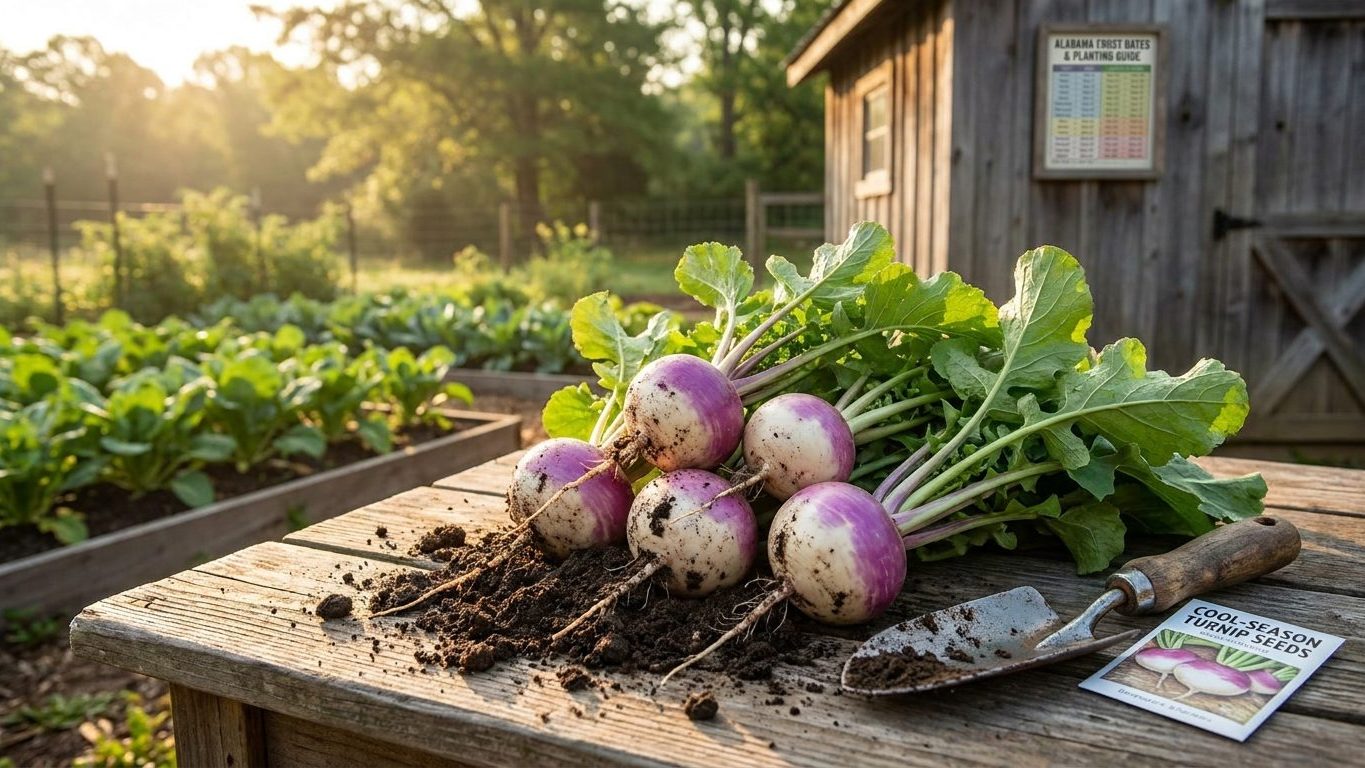

North Carolina gardeners get two turnip windows a year: a short spring one and a longer, more reliable fall one. Using Charlotte’s average frost dates as the Piedmont reference, spring seed goes in from mid-February into early March, and the main fall crop goes in from mid-July through mid-August, counted back from first frost in October 30 to November 8.
The short answer for North Carolina
Turnips are a cool-weather root crop, and in the Piedmont that means working around two frost dates rather than one planting date. The last spring freeze at the reference station (Charlotte, USW00013881) falls between March 23 and April 5. Turnip seed germinates in soil as cool as 40°F and the seedlings shrug off a light frost, so gardeners typically sow four to six weeks ahead of that last-frost window, which lands spring seeding in mid-February through early March for most of the Piedmont.
The fall crop is the one experienced growers lean on, because turnip roots sweeten with the cooling nights of autumn instead of turning woody in spring heat. First fall frost at the same reference station runs October 30 to November 8. Turnips need roughly 30 to 60 days from seed to a usable root depending on variety, so counting backward from early November puts the safe sowing window from mid-July through August 15 for most varieties, with faster 30-day types plantable as late as the first week of September in a mild year.
Those frost dates aren’t a guarantee, they’re a probability band. NOAA’s 30 to 70 percent freeze-probability range means that in three years out of ten, frost will show up before March 23 or after April 5 in spring, and before October 30 or after November 8 in fall. A gardener who sows right at the edge of the window is playing those odds, not beating them.
This page gives the state-level picture built from the Piedmont reference station. If a reader gardens somewhere with a noticeably different frost pattern, the numbers below still apply as a starting point, but the timing shifts, sometimes by weeks, once elevation or distance from the coast enters the picture. That’s covered in the section on what changes across the state.
What will not work here

Rutabaga is the crop that gets people into trouble here. It needs roughly 90 days to bulk up a root, nearly double what a fast turnip needs, and counting 90 days back from the November frost window lands the sowing date in late July to early August, which is exactly when Piedmont soil surface temperatures routinely sit in the 85 to 95°F range. Rutabaga seed germinates poorly and unevenly in soil that hot, and seedlings that do emerge often stall rather than grow, so a rutabaga sown on the same August calendar that works for turnips frequently runs out of season before the first hard freeze forces harvest.
A slow-maturing turnip variety sown late for a fall crop runs the same risk without the built-in cushion rutabaga growers already expect. Anyone treating the August 15 date as a hard deadline for a 60-day variety, rather than a soft outer limit for a 30-to-40-day one, is gambling on a frost date that only holds two years out of three.
Summer watering habits fail here too. A Piedmont July and August routinely deliver stretches of heat with no rain, and turnip seed sown into dry topsoil for a fall crop simply won’t germinate reliably on a once-a-week watering schedule. The seedbed needs to stay damp through the first week or so after sowing, which in practice means light watering every day or two during a dry spell, not a single deep soak on the weekend.
Humid Piedmont summers punish tight spacing in the opposite direction. Turnips crowded at planting hold moisture between the leaves in August’s humidity, and that combination of warmth and wet foliage is when foliar diseases like Alternaria leaf spot and downy mildew take hold. Thinning promptly, rather than letting a dense stand ride until harvest, matters more here than it would in a drier climate.
What changes across North Carolina
North Carolina isn’t one garden, it’s a stretch of hardiness zones running from 5b to 8b under the USDA system, and that’s about as wide a spread as a single state gets. Zone alone is built from one number, the average annual extreme minimum temperature, but it’s a useful shorthand for how differently a frost calendar behaves once you leave the Piedmont reference point.
The Blue Ridge mountains to the west sit at the cold end of that range. Spring there runs several weeks later than the Charlotte dates used above, and fall frost arrives correspondingly earlier, which compresses the whole growing season and pushes the fall turnip sowing window back into late June or early July rather than mid-July.
The coastal plain sits at the other end. Spring frost retreats earlier there than in the Piedmont, and fall frost holds off longer, stretching both the spring window forward and the fall sowing deadline later into September in some years.
| Region | Spring frost timing vs. Piedmont | Fall sowing window shift |
|---|---|---|
| Blue Ridge Mountains | Several weeks later | Move fall sowing to late June/early July |
| Piedmont (reference) | March 23 to April 5 | Mid-July to August 15 |
| Coastal Plain | Earlier than Piedmont | Sowing can extend into September |
None of this replaces a local check. A reader can’t tell from a state map which side of a mountain ridge or how far inland from the coast their own plot sits, and that’s exactly the kind of detail a zone map answers better than a paragraph can.
Where to check this for your own county
The state-level windows above are a starting point, not a substitute for what your own county extension office publishes. North Carolina State Extension runs the state’s Cooperative Extension program, and its site is where a county-specific planting calendar and locally trialed variety lists live.
Look for two things once there. First, a county-level vegetable planting calendar, which will translate the frost-date logic on this page into actual sowing weeks for the specific county rather than the Piedmont reference station used here. Second, a list of turnip and rutabaga varieties the local agents have actually trialed, since disease pressure and heat tolerance needs shift enough across the state that a variety that thrives in the mountains isn’t always the best pick near the coast.
A county extension agent’s recommendation will beat this page every time, because it’s built from local trial data and local frost records, not a single reference station averaged over the whole state. This page exists to explain the mechanism, the frost dates, the season length, the zone spread, so that a county recommendation makes sense once you find it, not to replace the search for one.
Extension offices also field direct questions by phone or email, and a quick call describing your soil and past frost experience often gets a faster, more specific answer than digging through a published calendar alone. That’s worth doing before committing an entire fall turnip planting to a date pulled from a state-wide average.
If you follow the almanac, here is when to plant turnips by the moon. It is a tradition, not a proven method.
Checking this against your own garden
Every date on this page is an average built from three decades of weather records. A reader’s own plot, with its own drainage, its own slope, its own tree shade, will run its own schedule, and three simple checks tell you more than any calendar.
Soil warmth by feel is the first. Turnip seed wants soil that no longer feels cold to the bare hand at a couple inches down, roughly the point where spring soil stops feeling like refrigerator temperature. Sowing into soil that still feels chilly is the single most common reason spring turnip seed sits without germinating for two or three weeks.
The first flush of tiny yellow male flowers on nearby wild mustards or early brassicas is a second signal worth watching, since turnips are in the same family and respond to the same seasonal cues. Seeing that bloom start locally is a rough sign that soil and air temperatures have crossed the threshold turnip seed responds to.
The appearance of the first true leaves, the second set that emerges after the rounder seed leaves, tells you the seedling has moved past the fragile germination stage and into active growth, which is the point to start thinning crowded rows. A stand that’s slow to reach true leaves in the heat of an August sowing is a sign the bed is drying out faster than the watering schedule accounts for, and that’s worth fixing before the whole planting stalls.