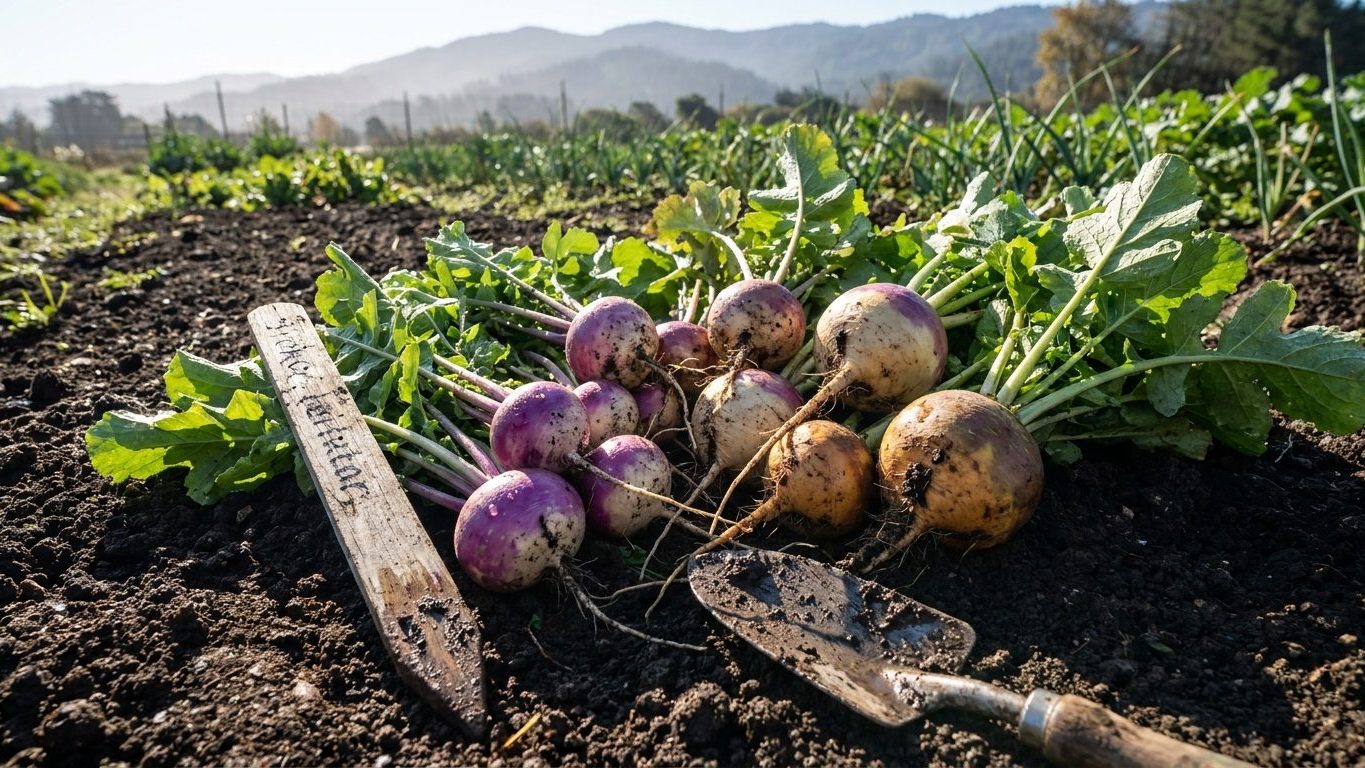

For Nova Scotia’s short, cool maritime season, fast-maturing turnips beat slow ones almost every time, and rutabaga only pays off if it goes in the ground early. The frost-free window here runs roughly from early May to mid-October, tight enough that a 100-day rutabaga started late has real trouble finishing before the cold sets back in. Below is what actually holds up, what doesn’t, and how much that changes depending on where in the province you garden.
The short answer for Nova Scotia
Start with the numbers that set the rules here. Environment and Climate Change Canada’s 1981-2010 normals for Halifax Stanfield put the average last spring frost at May 7 and the average first fall frost at October 18. That’s an average 164-day window between the two, but it’s a mean, not a guarantee. Half the years on record, frost arrived later than May 7 in spring, and the same logic applies in reverse come fall. Treat these dates as the midpoint of a risk band, not a green light.
That window shapes which crop makes sense. Turnips grown for the table, not storage, mature in 35 to 60 days depending on variety, which leaves plenty of room even with a late spring or an early fall. Rutabaga is a different animal: most varieties need 90 to 100 days or more to bulk up properly, which eats most of the safe part of that 164-day span the moment you factor in the real chance of a late frost.
| Crop type | Typical days to maturity | Fit for Nova Scotia’s season |
|---|---|---|
| Salad turnip (e.g. Tokyo-type white) | 35-45 | Very good, room for two sowings |
| Standard purple-top turnip | 50-60 | Good, single main sowing |
| Rutabaga (swede) | 90-100+ | Workable only if sown early, no room for delay |
The practical decision, then, is by type rather than by named variety alone. Fast turnips give a forgiving margin against a late spring or early fall. Rutabaga demands you commit early and accept that a slow start can cost the harvest.
What will not work here

The slowest rutabaga varieties are the clearest failure point in this climate. Anything pushing past 100 days, sown any time after the calendar tips into June, is racing a fall frost that averages October 18 and sometimes comes sooner. A rutabaga that needs until late October or November to size up properly simply runs out of runway in most years, and the roots that do form are often undersized and woody rather than the dense, sweet storage roots gardeners expect.
Winter storage-in-the-ground is the other trap. Leaving turnips or rutabaga in the soil past the first hard frost works in milder climates, but Nova Scotia’s coldest month averages a daily minimum of -10.4°C, cold enough to freeze unmulched roots solid and split them once thawing cycles start. That figure is a mean minimum, not the record low, which means most winters dip colder than that on their worst nights. Roots left in unprotected ground here are gambling against a climate that regularly punishes the bet.
Long-season storage turnip types, the big yellow rutabaga-adjacent varieties bred for extended fall harvests, run into the same math as slow rutabaga. If a variety’s seed packet lists maturity north of 80 days, it needs to go in the ground as early as the soil allows, not as a follow-on crop after peas or lettuce come out in July. That habit works fine in longer, milder growing regions further south, but it stacks the odds against success on a Nova Scotia timeline.
Weekly watering schedules built for drier inland climates also don’t map well onto the province’s maritime moisture pattern, though that’s less about failure and more about wasted effort: consistent rain and humid air here mean Turnips and Rutabaga rarely need supplemental watering the way they would in a drier interior climate, and overwatering on top of natural rainfall can encourage rot in heavy clay soils more than it helps growth.
What changes across Nova Scotia
Nova Scotia is not one garden, and the province’s Canadian hardiness zone rating makes that clear on its own. The reference figure for Halifax sits at zone 6b under the Canadian system, a rating built from seven climate variables rather than the single minimum-temperature measure the U.S. system uses. That distinction matters: a Canadian 6b does not translate directly to a USDA zone, and Natural Resources Canada itself warns against treating the two scales as equivalent.
That 6b figure describes the Halifax area specifically, not the whole province. Nova Scotia’s coastline, its inland valleys, and its higher ground toward Cape Breton do not share one climate. Coastal areas tend to run milder through fall thanks to the moderating effect of the ocean, which can push the safe planting and harvest window later than the Halifax averages suggest. Inland and upland districts, by contrast, typically see frost arrive earlier and linger longer in spring, tightening that 164-day window further.
There is no single zone number that applies province-wide, and this page won’t guess at one for any particular county. The right move is to check Natural Resources Canada’s Plant Hardiness site for the specific municipality closest to a given garden, rather than assuming Halifax’s rating applies everywhere. The map accounts for elevation, coastal proximity, and other local factors that a provincial average simply can’t capture.
Where to check this for your own county
This page gives Nova Scotia’s provincial picture, built from Halifax-area climate normals. A county-level recommendation will always beat that, because it accounts for the microclimate differences described above, differences a provincial average necessarily smooths over.
The place to look is Nova Scotia’s own agriculture service. Visit novascotia.ca/agri and look specifically for two things: a local planting calendar that reflects the actual frost pattern for your county rather than the Halifax station average, and any list of turnip or rutabaga varieties that have been trialled or recommended for your specific growing region within the province. Provincial agriculture services often maintain variety trial results precisely because a single provincial recommendation can’t account for the gap between a sheltered valley and an exposed coastal plot.
If a local calendar or variety list isn’t posted online, a phone call to the extension office is worth the ten minutes. Extension staff typically have access to more granular data than what makes it onto a public webpage, including informal notes from local demonstration gardens and grower feedback from the same county. That kind of on-the-ground detail is exactly what a provincial page, including this one, can’t replace.
Checking this against your own garden
Every date on this page is an average pulled from decades of weather station data. A reader’s actual garden, with its own slope, soil, and exposure, will often disagree with that average, and it’s worth trusting the garden over the calendar when the two conflict.
Three signs are worth watching. First, soil warmth by feel: turnip and rutabaga seed germinates poorly in cold, wet soil, so if the top few inches still feel cold and heavy to the touch in early May, waiting a week costs nothing and saves a re-sowing. Second, watch for the first true leaves to appear after the seedling’s initial rounded seed leaves; that’s the point where the plant has actually started building the root system that matters, and a slow appearance signals the soil is still too cool for vigorous growth. Third, for rutabaga specifically, watch how quickly plants move toward flowering if a cold snap hits young plants; an early flush of flower stalks is a sign the plant bolted under stress rather than sizing up a root, and it means next year’s timing needs to shift later rather than earlier.
None of these signs need special equipment. A finger pressed into the soil and a close look at the seedlings every few days tell a gardener more about their own particular patch of ground than any provincial frost date ever will.