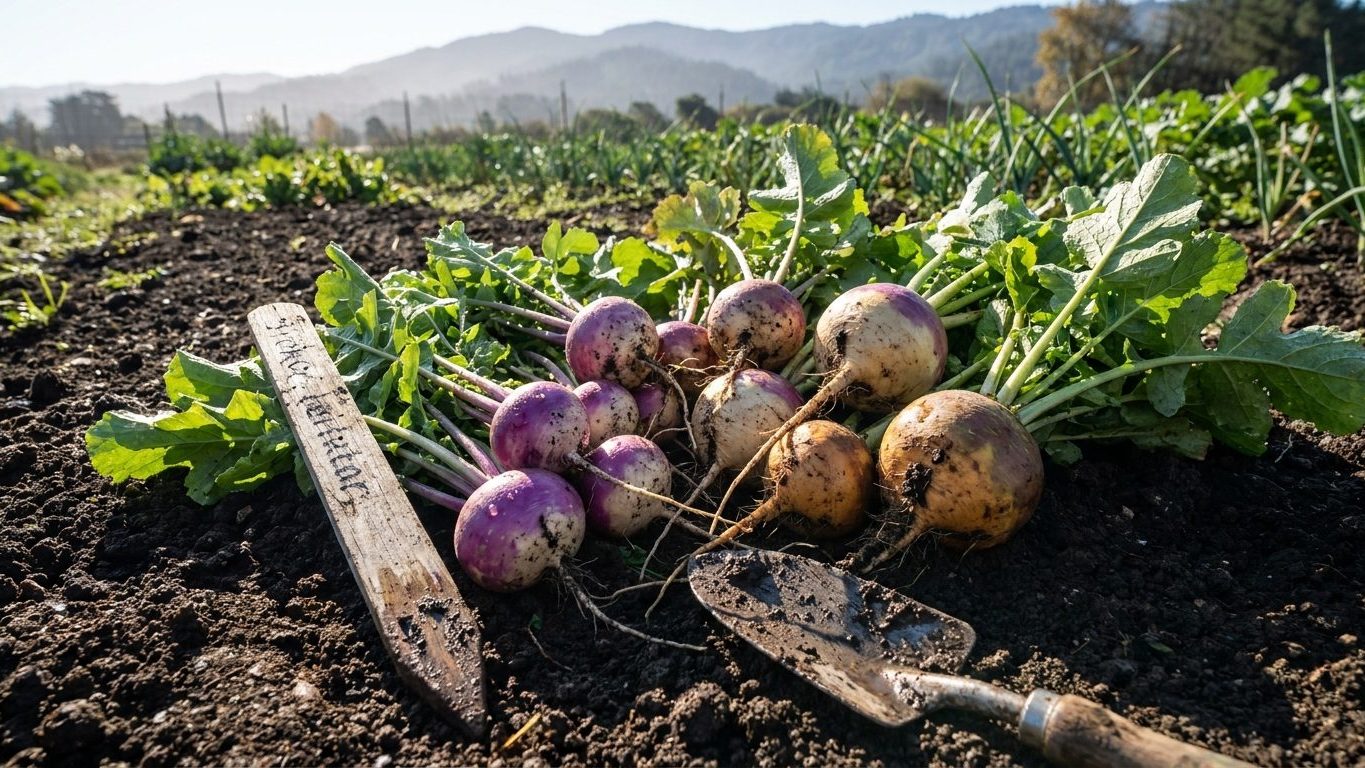

Nunavut’s growing season is too short and too unpredictable for rutabaga to mature reliably outdoors, and only the fastest turnip varieties stand a real chance in open ground. Quick-maturing turnips (30 to 45 days) sown right after the last frost risk, plus container or greenhouse growing under cover, are the realistic path here. Everything else on the seed rack is a gamble against the calendar.
The short answer for Nunavut
Start with the arithmetic, because it settles most of the argument. Environment and Climate Change Canada’s normals for Rankin Inlet put the average last spring frost at June 19 and the average first fall frost at September 13. That’s a frost-free window of roughly 86 days in an average year, and remember: this is a mean, not a guarantee. Half the years on record run shorter than that.
Rutabaga needs 90 to 100 frost-free days to bulb up properly. Even in the best-case average year, Nunavut doesn’t have that many days to offer. In a below-average year, the crop doesn’t get close. That single fact rules rutabaga out of open-ground planting for almost anyone gardening in the territory, no matter how good the seed or how careful the care.
Turnips are a different story only if you pick fast types. Varieties bred to mature in 30 to 45 days can be sown right after the frost risk eases in mid-to-late June and still bulb before the September frost arrives, with a buffer of a few weeks to spare. That buffer matters, because it absorbs the years when frost comes early or the season runs cold and slow, which in a place like this happens more often than the “average” figure suggests.
Anything marketed as a slower turnip, the 55-to-65-day types sold widely in southern Canadian catalogs, cuts that buffer down to almost nothing. In a normal year they might just squeak by. In a short year, they don’t.
| Crop type | Typical days to maturity | Fits Nunavut’s ~86-day window? |
|---|---|---|
| Fast turnip | 30-45 days | Yes, with margin |
| Standard turnip | 55-65 days | Tight, no margin |
| Rutabaga | 90-100 days | No |
None of this addresses soil, snow cover, or wind, all of which matter here too. But days-to-maturity against the frost dates is the first filter, and it eliminates rutabaga before those other factors even come into play.
What will not work here

Rutabaga sown outdoors is the clearest failure case, and it’s worth being blunt about why. The math above already shows the gap between what the crop needs and what the season offers. Add to that the fact that rutabaga develops slowly at first, building leaves before it starts bulbing, and a cool, late spring (which is common, not exceptional, this far north) eats into the growing days before the plant has even gotten started.
Standard 55-to-65-day turnip varieties fail for a subtler reason: they don’t leave room for error. A gardener who sows on June 19, the average frost date, and gets a normal season might harvest just before the average fall frost on September 13. But average years are not the only years. When the spring frost lingers past its mean date, or the fall frost arrives early, a 60-day turnip simply runs out of clock.
The cold itself is the other obstacle, and it’s a different kind of failure than a slow-maturing crop. Nunavut’s coldest month averages a daily minimum of -34.3°C (-29.8°F), a temperature that has nothing to do with summer cropping but everything to do with what infrastructure has to survive the rest of the year. Cold frames, hoop houses, and greenhouse structures left up over winter need to be built or braced for that kind of cold, not the milder winter lows a southern Canadian gardener plans around.
Dense spacing is a mistake too, though for a different reason than in humid southern gardens. Nunavut’s growing season is short and cool rather than warm and wet, so the risk isn’t fungal disease from crowding, it’s competition for the limited light and warmth available during that narrow window. Turnips packed tight take longer to bulb because they’re sharing a scarce resource, and in a season with no days to spare, that delay is the difference between a harvest and a frozen row.
Direct-seeding without any season-extension cover is the last common misstep. Bare soil in Nunavut warms slowly and stays cool even in July. Skipping row cover or a cold frame at the start of the season isn’t a minor convenience lost, it’s often the few extra degrees of soil warmth that let seed germinate on schedule instead of sitting dormant for a week or two the crop can’t afford to lose.
What changes across Nunavut
Nunavut is not one climate, and treating it that way is the single biggest mistake a gardener here can make. The hardiness zone figure available for the territory, zone 0a in the Canadian system, is tied specifically to the reference station at Rankin Inlet. That number does not describe Iqaluit, Cambridge Bay, Grise Fiord, or any other community across a territory that stretches from the Arctic Circle to well past the 82nd parallel.
The Canadian zone system itself is built from seven climate variables, not the single winter-low figure the USDA system uses, so it already captures more than just “how cold does it get.” But even with that added detail, one reference point can’t stand in for a territory this size. A community at a more southerly latitude with some tree cover nearby is working with a meaningfully different growing reality than one on the high Arctic coast with near-continuous permafrost and a shorter, colder summer.
The honest answer is that there is no single number for Nunavut, only a spread, and the spread here is wide even by Canadian standards. Communities can differ by multiple zone classifications depending on latitude, coastal exposure, and elevation, which is a bigger swing than what separates, say, coastal and inland regions in a smaller southern province.
What that means practically: a fast turnip variety that clears the season with room to spare at one settlement might be pushing its limits at another a few hundred kilometers north. Nobody reading this article can know their own zone from a territory-wide article, and this page isn’t the place to guess it for you. Natural Resources Canada’s Plant Hardiness Site maps zones by location, and checking a specific community there is a five-minute step that replaces a guess with an actual figure.
Where to check this for your own county
Nunavut doesn’t use the county system that structures agricultural extension in the United States, but the equivalent principle holds: a territory-wide article, this one included, is a starting point, not a final answer. The community-level picture almost always beats the territorial one, because it accounts for local latitude, coastal exposure, and whatever greenhouse or cold-frame growing has actually been tried nearby.
Agriculture and Agri-Food Canada, at https://agriculture.canada.ca/en, is the federal starting point for gardeners across the north. It’s the one worth bookmarking, because provincial and territorial agriculture sites in this region don’t always maintain public-facing pages that stay reliably accessible.
What to look for once there, or through any regional gardening program or community greenhouse network in Nunavut: first, whether anyone nearby has actually trialed turnip varieties outdoors or under cover, since real local results beat any generic days-to-maturity figure on a seed packet. Second, whatever local planting-date guidance exists for the specific community, since the June 19 and September 13 dates cited on this page come from one station and won’t match every settlement exactly. Third, any notes on cold-frame or hoop-house construction suited to winter loads and the deep cold documented earlier in this article, since a structure built to a southern Canadian standard won’t necessarily hold up through a Nunavut winter between growing seasons.
Community greenhouse programs, several of which now operate across Nunavut communities, are often the most useful source of all, because they carry season after season of direct, local results that no climate normal or territory-wide guide can replicate. A conversation with whoever runs the nearest one is worth more than another article.
Checking this against your own garden
Every date and figure in this article is an average pulled from decades of station data. The plants in front of you, in the soil you actually have, will tell you something more current and more precise, if you know what to watch for.
Soil warmth by feel is the first and most useful check. Press a bare hand into the soil a couple of inches down in the days after the average frost-risk date passes. If it still feels cold and damp rather than merely cool, germination will be slow no matter what the calendar says, and it may be worth waiting a few more days, or adding row cover to help the soil catch up.
The speed of the first true leaves is the second signal. Turnip seedlings that push past their initial seed leaves and into true leaves within the expected week or so are growing on schedule. A longer lag than that, even by several days, is the plant telling you the season is running cooler than the average this year, which matters more to your harvest than any date printed on a seed packet.
The third thing to watch is early bolting, when a turnip sends up a flower stalk before it’s had time to bulb. In a place with long summer daylight and a compressed season, stress from cold snaps or a late, rushed sowing can trigger this response early. A row that bolts ahead of schedule is a sign to sow earlier, choose a faster variety, or add cover next season rather than a signal that something was done wrong this time.
None of these three checks require anything beyond a hand and an eye, and together they tell you more about your own patch of ground than the territory-wide averages this article opened with.