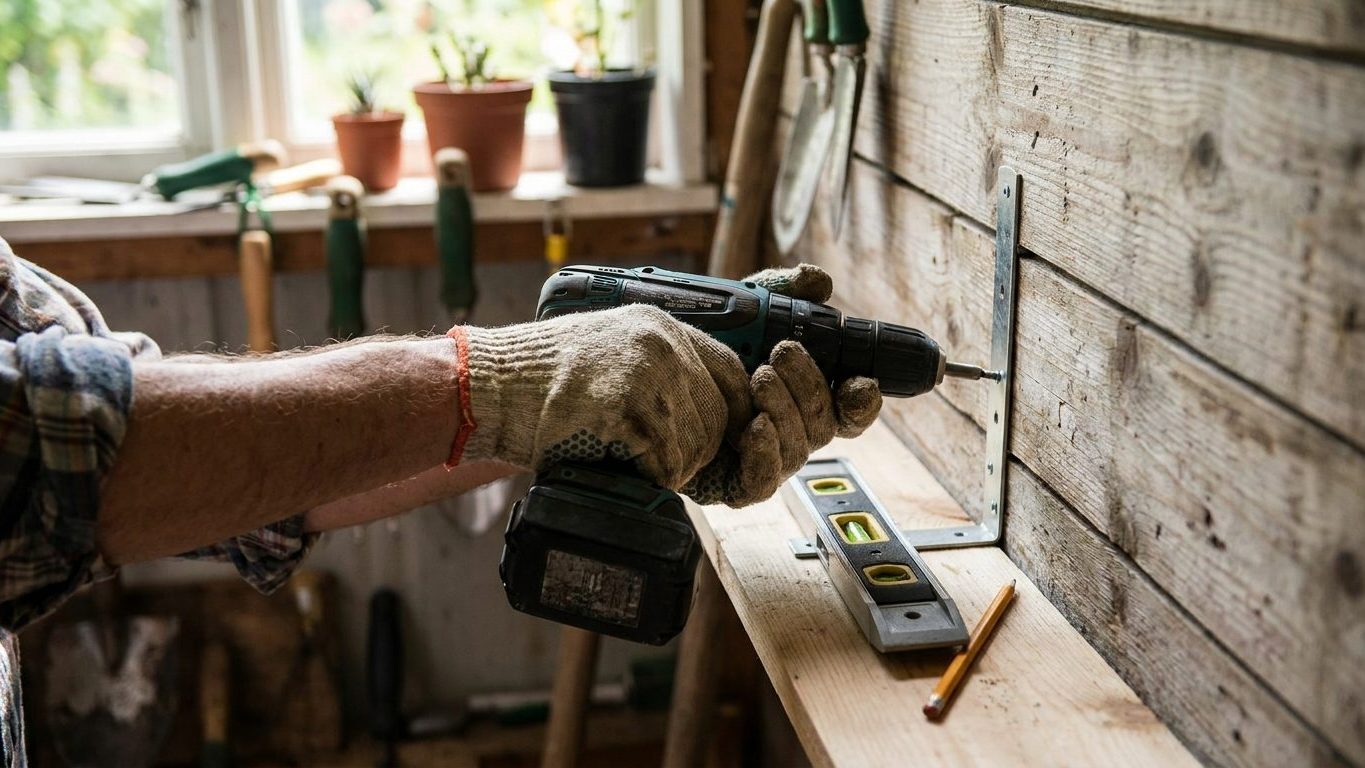

Floating shelves hide their brackets inside the board and ask one blind fixing to carry the whole load. A bracket shelf puts the hardware in the open, and that’s what makes it the sturdier choice: the weight runs down each bracket into the wall instead of out along a hidden rail. Check what’s behind the wall before you drill, then choose brackets and fixings rated for that wall type.
What is actually going on

A bracket shelf works on a simple mechanical idea. The bracket carries the shelf’s weight down into the wall, rather than asking the wall to resist a force pulling straight out from its face. That downward load path is a far easier thing to ask of a fixing than the sideways pull a floating shelf puts on a single embedded rail. Working out what your wall actually is (stud frame, solid masonry, or drywall over something else) is the step this page assumes you’ve already taken care of. If you haven’t, Hanging, Shelving and Fixing: The Wall Decides walks through it first.
The bracket itself does two things at once. The horizontal arm supports the board from underneath, so the fixings into the wall are mostly resisting a downward and slightly inward force, not the awkward twisting load a hidden rail has to withstand. The strength of the whole shelf depends on what the bracket is screwed into, not on the bracket’s own rating. A bracket built to hold a heavy load is worthless if its screws land in plaster with nothing solid behind it.
What’s inside the wall
This is where the wall becomes the real subject of the job. Use a stud finder, or check what you can find about the house’s construction, before committing to a drilling point, because what’s inside the wall is not something you can see from the front. Cables run inside stud walls and solid walls alike, and older houses in particular don’t reliably follow the conventions builders now use for where wiring and pipework sit. Check before you drill, and if you can’t check with any confidence, don’t drill there. A cable clipped by a masonry bit is a hazard, not an inconvenience, and not a job to guess your way through.
None of this is a job for wiring work of any kind. If a shelf needs a light fitted underneath it, or a cable run to it, that part goes to a qualified electrician. The bracket and shelf are a carpentry and fixing job. The wiring, if there is any, is a separate trade entirely.
The other half of the equation is the fixing itself, and it’s not a place to work from a number in your head. What a fixing holds depends on the wall material, the fixing type, how well it was installed, and which direction the load pulls. The only figure that means anything is the one printed on the fixing’s own packaging, tested for the wall type you actually have. A loaded shelf that comes down is a genuinely heavy object landing on whatever is underneath it, and a fixing you’re unsure about is a fixing to replace before you load the shelf, not one to test by hoping.
Doing it
The order you work in decides whether the shelf sits level or slopes visibly across its length, and it isn’t the order most people reach for by instinct. Mark before you fix, and fix one bracket only far enough to check it before committing to the wall.
| Step | Why it matters | What goes wrong if skipped |
|---|---|---|
| Draw a level line at shelf height | Every bracket is measured off the same line, not off the last bracket | Small errors add up across the span and the shelf slopes |
| Locate solid fixing points along that line | The bracket’s holding power comes from what it’s screwed into, not the bracket itself | A bracket on a weak fixing loosens slowly and the shelf drops at one end |
| Fix the first bracket, then re-check its own level before the second | Catching an out-of-level bracket now costs one hole, not four | A tilted first bracket forces every later reference point to be wrong too |
| Fix the second bracket level with the first, not level to the floor | Floors and ceilings in most houses are not reliably level themselves | A shelf levelled to the floor can still visibly slope against a door frame or worktop |
| Rest the board on both brackets and check for rock before fixing it down | A board rocks if the brackets aren’t at the same height and the same forward projection | A shelf fixed down while rocking stresses one bracket every time it’s loaded |
Spacing and level
Bracket spacing is a matter of the board’s stiffness and the load you expect, not a fixed rule. A short, thick shelf can often run on two brackets set in from each end. A long span, or a shelf meant to carry real weight along its whole length, usually needs a third bracket near the middle to stop the board bowing between the two end supports. That’s a convention drawn from how boards behave under load, not a code requirement, and a heavier board or a longer span pushes it toward more support, not less.
Getting both brackets level with each other matters more than getting either one level with the room, because a shelf reads as sloped against the room’s other lines (a door frame, a window sill, a run of cabinets) long before a spirit level would call it out. If the wall itself is out of true, which is common enough in older houses, working bracket to bracket rather than bracket to floor is the only way to get a result that actually looks right. That exact problem, a wall that isn’t as flat or as square as it appears, is covered in more depth in Getting Things Level on a Wall That Is Not.
What it looks like when it goes wrong
Most bracket shelf problems show up before the shelf is even loaded, and it’s worth knowing which of them can be fixed on the spot and which mean starting again.
- A visible slope along the shelf: the board reads as tilted against the room’s other lines. Cosmetic, and correctable by loosening the brackets and re-checking bracket to bracket against the level line.
- A gap between the board and the wall at the back: the wall isn’t flat where the brackets sit, or the brackets weren’t drawn in tight before fixing. Cosmetic, correctable with packing or by refitting the offending bracket.
- The shelf rocks under light pressure: the brackets aren’t projecting the same distance from the wall, or one fixing has already started to loosen.
- A crack radiating out from a fixing point: the wall material has failed locally, most often plaster or a weak block.
- The bracket sits level but the whole shelf leans away from the wall over time: a slow failure of the fixing itself, often a sign the fixing type was wrong for the wall.
Safety versus cosmetic
The first two on that list are appearance problems and nothing more. The last three are different. A rocking shelf, a cracking wall, or a slow lean away from the wall are all safety issues, not decorating faults, because each one means a fixing is already failing rather than merely looking untidy. None of the three should be packed around, disguised, or left to see how far it goes. The fixing needs to be redone, into solid material if the original spot has failed, before the shelf carries any weight again.
What to settle first
Before any bracket goes on the wall, settle what the wall actually is. A stud wall, a solid masonry wall, and a dot-and-dab drywall wall over masonry each take fixings differently, and a fixing chosen for the wrong one is the single most common reason a shelf comes down months later rather than on day one.
Checking the wall
Find out what’s behind the surface before you drill anything. A stud finder gives a reasonable read on timber studs and can flag some cabling and pipework, but it isn’t infallible, especially in older houses where wiring and plumbing were never routed to any consistent pattern. Where you genuinely can’t tell what’s behind a patch of wall, that isn’t the spot to drill. Move the shelf, or get someone qualified to check first.
Decide what the shelf is actually for before you fix a single bracket, because a shelf meant to hold a run of paperbacks and a shelf meant to hold hardbacks or a loaded plant pot are different jobs, even if they look identical from across the room. The same question applies to anything else you might hang nearby. A mirror is deceptively heavy for its size, and a wall that won’t safely hold one won’t safely hold a heavily loaded shelf either; the considerations for hanging one are covered in Using a Mirror to Move Light Around a Room.
Last, settle whether the load belongs on that wall at all. A hollow stud wall with drywall alone will take a shelf for books or ornaments when fixed into the studs themselves, but it isn’t the wall to choose for something genuinely heavy if a solid wall is available nearby. Where the packaging on your chosen fixing gives a rated load for your wall type, that figure, not a guess and not a number carried over from a different job, is the one to work from. If it still looks marginal for what you want to put on the shelf, that’s the sign to change the wall, the fixing, or the plan, not to load it anyway and see.
Common questions
Can I put a shelf on brackets into drywall alone?
Yes for light loads, using fixings rated for drywall and spread across enough points. A genuinely heavy shelf needs at least one bracket landing on a stud or on solid wall behind the board, because drywall-only fixings hold their rated load in the board itself and that rating is lower than a fixing into timber or masonry.
How many brackets does a long shelf need?
More than two once the span gets long enough for the board to flex between the end brackets, and a middle bracket is the usual fix. There’s no fixed rule for exactly where that point falls. Judge it by whether the board visibly bows when you rest weight on the middle of the unsupported span before fixing anything permanently.
Do the brackets have to be exactly the same size?
They should be the same size and the same type. Mismatched brackets rarely project the same distance from the wall or sit at the same height even when both look level on their own, and that mismatch is what makes a shelf rock once it’s loaded.
Can I reuse the holes from an old shelf?
Only if you can confirm the fixing behind them is still sound, and in most cases it’s safer to fill the old holes and drill fresh ones slightly clear of them. A hole that has already carried a load once has already compressed or worn the material around it, and a fixing pushed into that same spot doesn’t grip as well as it did the first time.