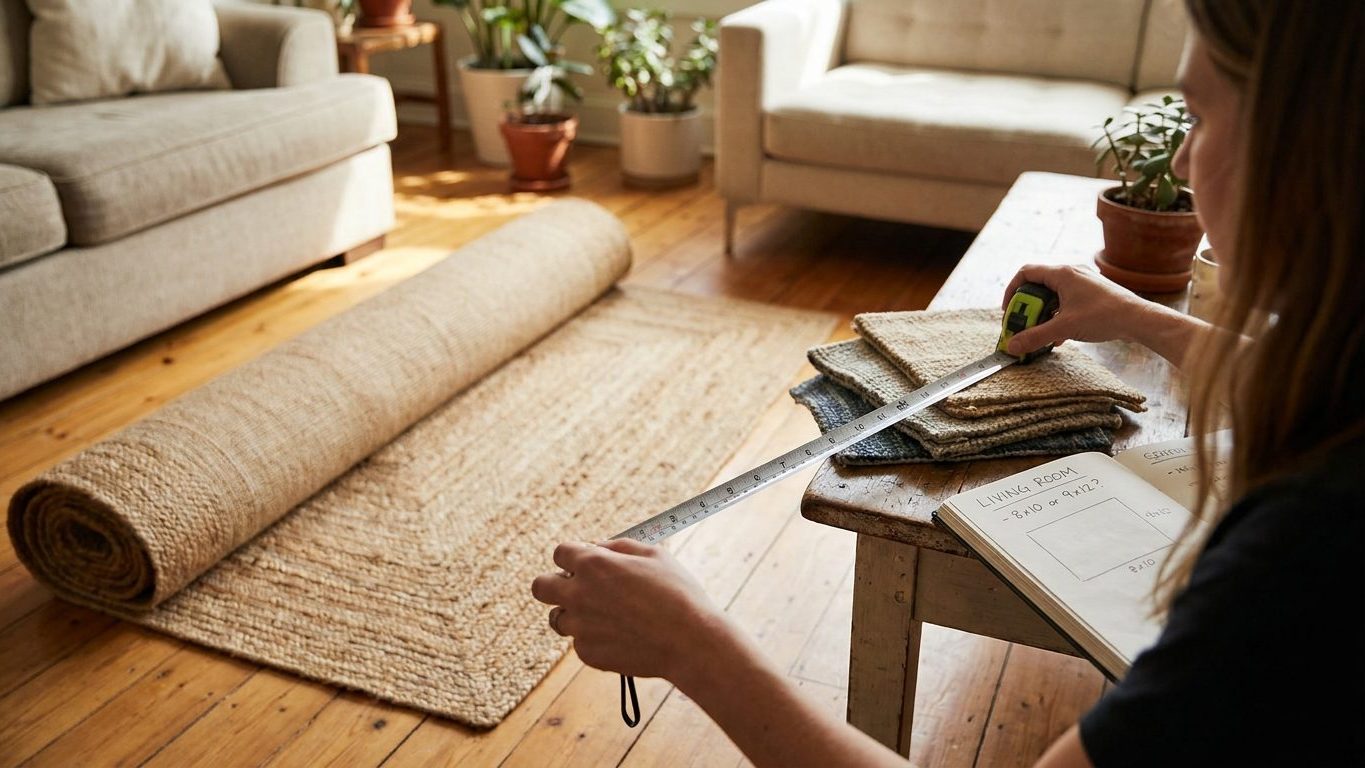

Furniture legs decide this, not floor space. A rug reads correctly when at least the front legs of the surrounding furniture rest on it. When they don’t, the rug looks like a doormat dropped in the middle of an empty floor, no matter how big or expensive it is. Measure the furniture group you want to anchor before you measure the room.
What is actually going on

The furniture is the reference point, not the room
A rug’s job is to visually tie a group of furniture together and mark out a zone inside a larger room. It is not there to cover a set percentage of the floor. This is the whole reason two rooms of identical size can need completely different rug sizes: what matters is the furniture relationship, meaning how the sofa, chairs, bed or table sit against the rug’s edges, not the square footage of the walls around them.
When furniture sits entirely off the rug, both the rug and the furniture group read as separate objects floating in the room rather than one arrangement. The eye keeps trying to connect them and fails, which is the actual mechanism behind a rug that “looks wrong.” It is rarely a color or texture problem. It is almost always a sizing problem measured against the wrong thing.
Why sizing to the room backfires
The common mistake is choosing a rug to leave a tidy, even border of bare floor around the walls, as if the rug were sized to the room rather than to what sits on it. Pulling furniture close to a rug that was bought this way often leaves the back legs of a sofa or the far side of a bed hanging off the edge, because the rug was never measured against that furniture’s actual footprint. A rug can be genuinely too small for its job even in a small room, if it doesn’t reach the furniture it’s meant to unify.
There is a usual convention for how much bare floor to leave around a rug in an open room, generally a modest border rather than the rug running wall to wall, but this is a matter of taste and proportion, not a fixed rule. What is closer to a rule is the furniture contact itself: a seating or sleeping group needs a consistent relationship to the rug’s edge, whichever version of that relationship you choose.
Doing it
There are three conventional ways to set a rug against a seating group, and each has a different failure point if it’s done halfway. The table below lays out how furniture should meet the rug in each version, and what tends to go wrong when the rug is undersized for the arrangement chosen.
| Arrangement | How furniture meets the rug | Common failure if rug is too small |
|---|---|---|
| All legs on | Every piece in the group, sofa and chairs, sits fully on the rug with room to spare at the edges | Back legs hang off the rug’s far side, so the group looks perched rather than anchored |
| Front legs on | Only the front legs of sofas and chairs touch the rug, back legs stay on bare floor | If the rug is too small even for this, the front legs land right at the very edge or miss it, and the rug reads as a mat, not a floor treatment for the group |
| Floating, furniture off | The rug sits in front of or between furniture without any legs on it, common under a coffee table or at a bedside | The rug drifts visually from the furniture it’s supposed to complement, since there’s no physical contact tying the two together |
Whichever arrangement suits the room, the furniture group has to relate to the rug consistently. A sofa with its front legs on and a chair floating entirely off the same rug looks unresolved, because the eye reads two different rules applied to one arrangement. For how far a rug should extend past a seating group in each of these setups, “/decor/rug-placement/”>Where a Rug Should Sit in a Room goes into the specific overhang each version calls for.
Testing the size before you buy
The cheapest way to check any of these arrangements is painter’s tape on the floor, marking the rug’s actual footprint before any money changes hands.
- Measure the rug size you’re considering and mark its outline on the floor with tape. Skipping this step is how most oversized or undersized rugs get bought, since a folded rug sample in a store looks nothing like it will on an open floor.
- Pull the furniture into the arrangement you actually use, not a showroom layout. Skipping this means testing a rug against furniture positions that don’t reflect how the room is really used.
- Walk the main paths through the room, doorway to sofa, sofa to hallway, and check the tape outline against them. Skipping this hides a rug edge that will sit exactly where feet land hardest, which shows up later as wear or curling.
- Leave the tape down for a few days if you can, since a size that looks fine on first glance sometimes looks cramped once you’ve walked past it a dozen times. Skipping this step means committing to a size based on a single impression rather than how the room is actually lived in.
What it looks like when it goes wrong
A handful of visible problems show up over and over, and they don’t all mean the same fix.
- The floating island: the rug sits in the middle of the room with no furniture touching it at all. This is a sizing failure and it means going back to a bigger rug or pulling the furniture group inward, not a matter of repositioning the rug an inch or two.
- The bathmat effect: a rug so small that only the front legs of one chair land on it while everything else misses. This can sometimes be corrected by rearranging the furniture closer together, but if the group is already tight, the rug itself is undersized and needs replacing.
- The curling edge: a rug that’s the right size but has started to lift or curl at a corner. This is a genuine safety issue, separate from the cosmetic ones, because a curled edge is a trip hazard on a walking path. It’s usually fixable with a rug pad or corner grippers rather than a replacement.
- The sliding rug: a rug on a hard floor without a pad underneath, which can shift underfoot when a chair is pushed back or someone walks across it quickly. This is also a safety matter, not just wear and tear, and it’s solved with a non-slip pad rather than a different rug size.
- The wall-to-wall rug in a small room: a rug so large it touches the baseboards on every side. This isn’t unsafe, but it removes the sense of the rug marking out a zone within the room, and it usually needs sizing down rather than repositioning.
What to settle first
Before buying anything, settle what the furniture group actually is and whether it’s going to stay put. A rug bought around a temporary arrangement, borrowed dining chairs, a sofa waiting to be replaced, will need re-checking against the next arrangement, so it’s worth measuring the furniture you plan to keep rather than what happens to be in the room this week.
Check the traffic pattern, not just the furniture
Walk the room the way it gets used daily, not the way it looks staged. A rug edge that lands exactly where a door swings open, or right where someone steps out of a hallway, will take the heaviest wear and is the first place curling or fraying shows up. It’s easier to shift a rug’s boundary a few inches during the tape test than to solve fraying at a doorway threshold after the fact.
If the room’s main furniture group is arranged around a fixed point rather than facing itself, a mounted television or a media console, that fixed point decides where the seating goes before the rug size is settled, so it’s worth locking in that layout first. “/decor/hanging-a-tv/”>Mounting a Television on a Wall covers how that placement gets decided, and it’s a step worth finishing before the rug is bought, since moving the seating afterward often means moving the rug’s boundary too.
Rug sizing is one piece of a larger set of decisions about what goes where on a wall and a floor in the same room, from shelving to artwork to the furniture itself, and Hanging, Shelving and Fixing: The Wall Decides covers how those pieces relate to each other once the floor plan is settled.
Common questions
Can a rug be too big for a room?
Yes, if it runs edge to edge and touches the baseboards on every side, which removes the sense of the rug marking out a distinct zone. It isn’t a safety problem, just a proportion one, and the usual fix is sizing down rather than trimming or repositioning.
Do all four legs of every piece of furniture need to be on the rug?
No. The front-legs-on arrangement is a standard convention and works fine as long as it’s applied consistently across the whole seating group, not just one piece.
What if my room is an odd shape and the furniture doesn’t form a clean rectangle?
Tape testing matters even more here, since a rug bought to a standard size rarely fits an irregular layout the way it looks on paper. Mark the actual furniture footprint on the floor first and buy to that shape, even if it means a size between two standard options.
Should the rug match the shape of the room, like round for a round table?
Matching the furniture’s shape rather than the room’s is the usual convention, a round table generally sits on a round or square rug rather than a long rectangular one, but this is a matter of proportion and taste, not a fixed rule.